🪱 Worms · Serpulidae and Sabellidae
Tube worms
Feather dusters that vanish when you blink
Meet the Tube worms
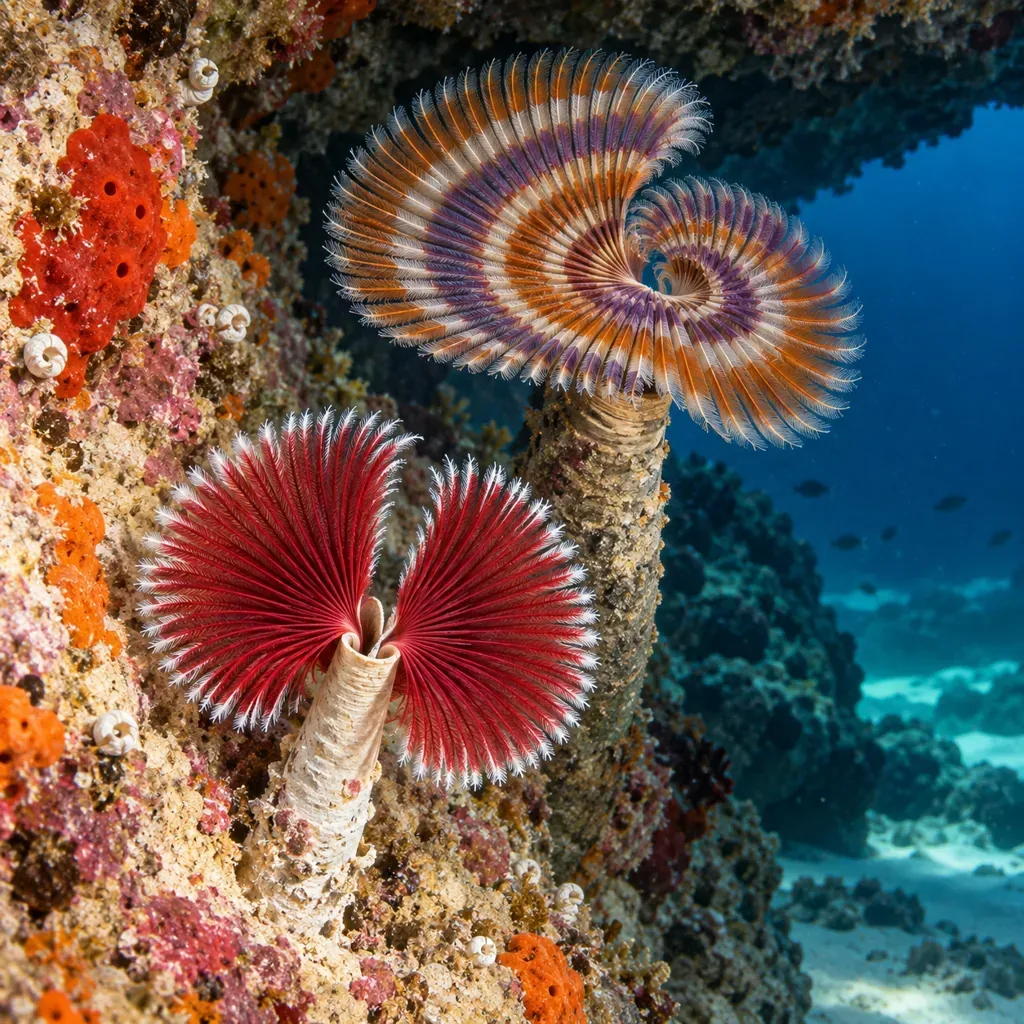
Everything visible about a tube worm is the crown. The animal itself is a soft worm permanently sealed in a tube, and what it shows the world is a fan of feathery filaments used both as gills and as a food filter. Three kinds account for most Maltese sightings. Sabella spallanzanii, the Mediterranean fan worm, is the big one: a tough, sandy, leathery tube up to thirty or forty centimetres long, topped by a crown ten to fifteen centimetres across that is usually built as two unequal spirals banded in orange, violet and cream. Protula tubularia builds a hard white chalky tube and unfurls two neat half-circles of pure white or deep crimson filaments. Serpula vermicularis and its relatives are smaller, with orange-red crowns and a distinctive funnel-shaped plug that corks the tube shut behind them.
The chalky-tubed serpulids like cave walls, shaded overhangs and the vertical plating of wrecks; the big Sabella prefers sheltered, siltier water and stands upright out of soft bottoms in harbours and inner bays. Between them they cover the whole range from a metre or two down past forty. On Maltese wrecks they are among the first colonisers, and the tiny white spirals you see stuck to Posidonia leaves are their smallest relatives.
They have a trick everyone discovers by accident. The worm has light-sensitive spots on the crown, so a shadow, a wave of a hand or a pressure pulse makes it snap back into the tube in a fraction of a second. Hold still and it eases back out over the next minute or so, filaments unrolling in slow motion. That is the whole game: patience buys you the shot.
When to look: All year; crowns are out whenever there is water movement to filter, and they close up in strong surge.
Diving with them
- Approach from below and to the side, never from directly above, and keep your shadow off the crown.
- If one snaps shut, stay put and stop moving. Most reopen within a minute, and the slow unfurling is the best thing to photograph.
- Control your exhaust bubbles; a burst of bubbles under an overhang closes every worm on the wall at once.
- Look along wreck railings and the shaded plating of the Um El Faroud and the Ċirkewwa tugs, where they colonise fastest.
- The big Sabella stands proud of soft bottoms in sheltered bays, so check the silty ground you would normally swim straight over.
- Watch your fins near a wall of them. A careless kick snaps chalky tubes that took years to build.
Can it hurt you?Harmless
Entirely harmless. There is no sting, no venom and no bite; the only hazard is to the worm if you blunder into its tube.
Easily confused with
- The two families themselves: a hard, white, chalky tube means a serpulid, a soft leathery sandy tube means a sabellid like Sabella.
- Spirographis spallanzanii in older books is simply the old name for Sabella spallanzanii, not a separate animal.
- Worm-shells (Vermetus, Dendropoma) build similar white calcareous tubes on rock but are snails, and they never show a feathery crown.
- Small anemones and colonial sea squirts can read as a 'fan' from a distance, but they do not vanish instantly when you move.
Where to meet them: 56 sites
Fungus Rock
Gozo
Further reading: Wikipedia: Sabella spallanzanii · Atlantis Gozo Diving: Mediterranean fan worm around Malta and Gozo · WoRMS: Sabella spallanzanii · IUCN Global Invasive Species Database: Sabella spallanzanii · Subdiversion species factsheet: Sabella spallanzanii