🦈 Sharks & rays · Dasyatis pastinaca
Common stingray
Bollin Maltese, also Ħamiema, Ħamiema tas-sikkina, Rajja
A grey kite asleep under the sand
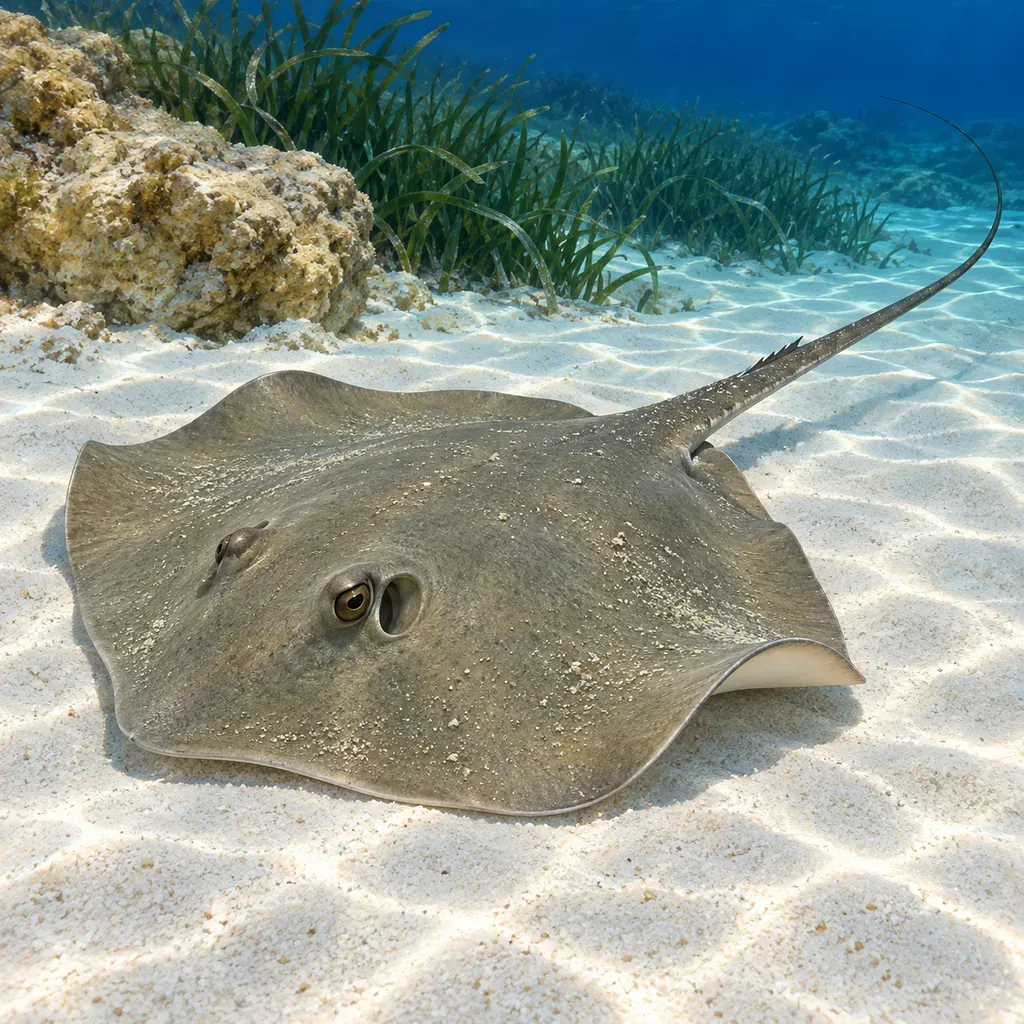
Meet the Common stingray
A flat, diamond-shaped ray with a bluntly pointed snout, smooth skin and no dorsal fin worth mentioning. The upper side is a plain olive-grey to muddy brown, sometimes with a faint scattering of darker freckles, and the underside is creamy white with a dark margin. The tail is a long whip, usually about as long again as the body, carrying one or two backward-pointing serrated spines on its upper surface roughly a third of the way along. Most rays divers meet around Malta are 30 to 50 cm across the disc; a big female can reach about 60 cm across and well over a metre in total length with the tail included.
It is a sand specialist. It settles on a clear patch, shuffles until only the eyes and the twin spiracles behind them are showing, and waits, breathing through the spiracles rather than through the mouth buried underneath. Disturb one and it lifts off in a slow ripple of the disc edges, glides a few metres and settles again. At night it works the sand actively, blowing pits to expose worms, small crabs and buried bivalves.
Around the Maltese islands this is the ray a diver is most likely to meet, and it has been described as common here for over a century. Look for it on the open sand between Posidonia patches and at the sandy foot of a reef, from about 3 m in sheltered bays down to 40 m and beyond. It is easy to swim straight over one without noticing, because the outline under a dusting of sand is only a soft diamond-shaped shadow with two raised eyes.
When to look: All year on sandy ground, with more sightings in the warm months from June to October when rays move into shallow bays.
Diving with them
- Scan sand patches for a faint diamond outline with two bumps: the eyes and the spiracles behind them give it away before the body does
- Approach low and slow from the side, never from directly above, and stop as soon as the disc edges start to lift
- Never stand or kneel on open sand in the shallows; shuffle your fins if you have to touch down
- Keep well clear of the tail and never try to hold or ride one - the barb is a defensive weapon aimed upwards and backwards
- Night dives are the best time to see one hunting, blowing craters in the sand with its disc
- For photographs, get the camera on the sand and shoot along the bottom so the eyes and tail base are in the frame
Can it hurt you?Can hurt you
The tail carries one or two serrated venomous spines that the ray whips upward and forward if it is stepped on, cornered or grabbed. The wound is a deep, dirty puncture with severe pain, and fragments of the sheath often break off inside.
First aid: Get out of the water, control bleeding and immerse the wound in hot water, as hot as can be tolerated without scalding, around 45 C, for 30 to 90 minutes until pain eases. Irrigate thoroughly, do not pull out a barb embedded in the chest, abdomen or neck, and go to hospital for wound exploration, antibiotics and tetanus cover - retained fragments and infection are the real problems.
Easily confused with
- Common eagle ray, which has a raised, duck-like head that sticks out in front of the wings and flaps its wings like a bird rather than rippling the disc edges
- Tortonese's stingray, a very similar Mediterranean species usually told apart only by skin denticle detail rather than in the water
- Flatfish such as turbot and wide-eyed flounder, which are also buried in sand but are bony fish with a fin fringe rather than a smooth disc with a whip tail
Where to meet them: 56 sites
Further reading: Shark-References: Dasyatis pastinaca · FishBase: Dasyatis pastinaca · FishBase common names (includes Maltese) · Revision of shark and ray records from the Maltese Islands (Central Mediterranean Naturalist) · Guide Me Malta: Malta's stingray