🐟 Fish · Bothus podas
Wide-eyed flounder
Barbun tal-għajnin Maltese, also Barbun għajnejh imbiegħda, Barbun
A left-eyed flatfish that melts into the sand
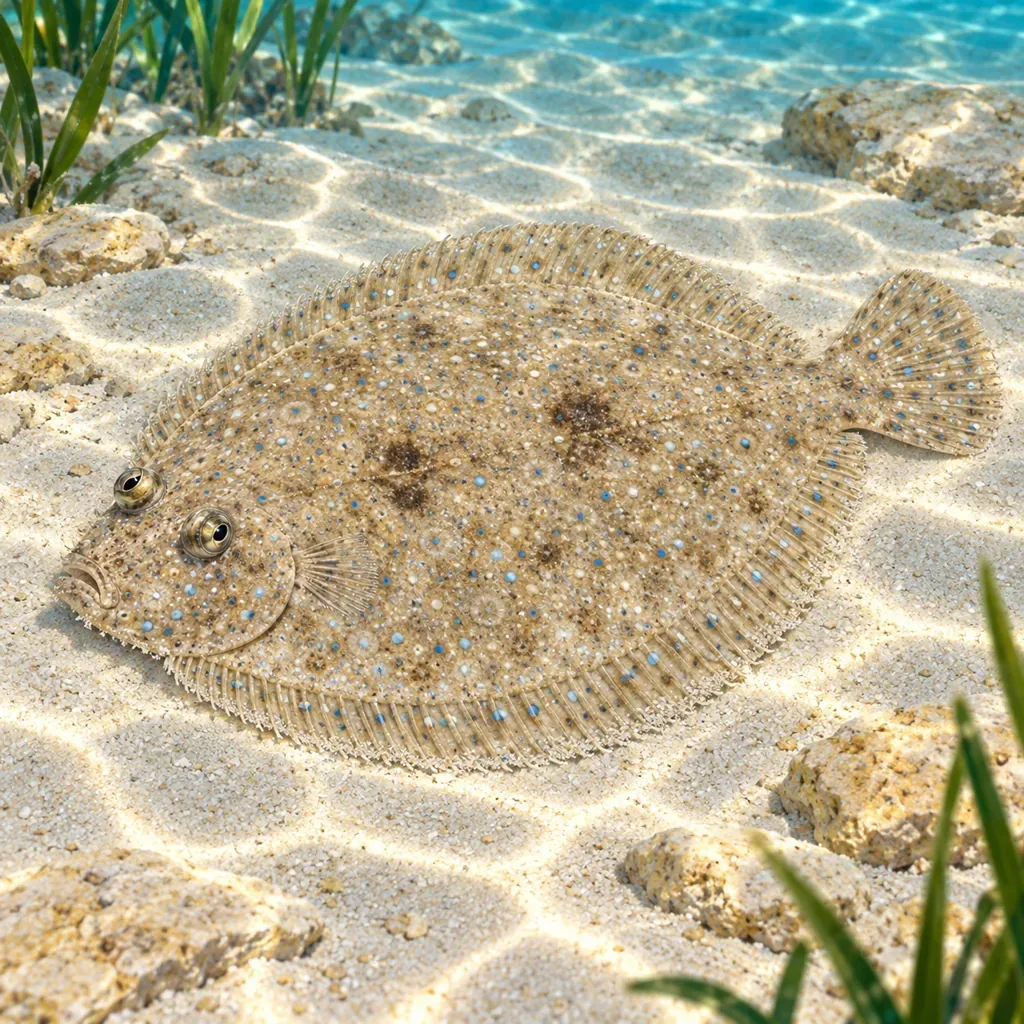
Meet the Wide-eyed flounder
This is the little flatfish you almost step on. It lies on its right side with both eyes on the left, so the patterned upper surface is really the fish's left flank. The colour is sandy beige to grey-brown, broken by darker blotches and scattered rings and clusters of pale blue or white spots, plus two or three larger dark smudges along the midline. Fins run as a continuous fringe all the way round the body. Most Maltese individuals are 12 to 20 cm; 45 cm is the recorded maximum and you will not see anything near it here.
Males are easy to separate once you know the trick: their eyes are set startlingly far apart, sometimes a full eye-width or more, while a female's eyes almost touch. Males also have a longer front pectoral ray they flick up as a flag when displaying or squaring up to a rival.
Around Malta and Gozo they live on clean sand and on the sandy patches between Posidonia, from a few metres down to well beyond diving depth. Look for them on the sand runs at Għar Lapsi, Xlendi, Ramla, the shallows off Comino and the sandy approach to almost any bay dive. They shuffle sand over the fin fringe until only the eyes break the surface, then dart off in a short, fast, low glide and vanish again a few metres away.
When to look: All year on any sandy bottom, and easiest in calm summer conditions when the sand is undisturbed and their outlines show.
Diving with them
- Hover a metre off the sand and scan for two raised eyes and a faint oval outline rather than for a fish shape
- Once one bolts, watch where it lands, it usually settles within five metres and buries again in seconds
- Fin carefully and keep your gauges clipped, most are found by accident when a dangling console ploughs the sand
- Count the gap between the eyes to sex it: wide apart is a male, nearly touching is a female
- Shoot from a low angle with the strobe well off to the side, flat-on light kills the blue spotting
- Never lift or move one to get a photo, the mucus and camouflage layer matter to it
Can it hurt you?Harmless
Harmless. It has no spines, venom or bite worth worrying about and its only defence is to disappear.
Easily confused with
- Scaldfish (Arnoglossus species), smaller, thinner and much plainer, without the blue spot clusters
- Common sole (Solea solea), right-eyed, oval and uniformly brown with a dark blotch on the pectoral fin
- Turbot and brill, far larger, more circular, and very rare in Maltese recreational diving depths
- Buried weever fish, which is the one to be sure about, since a weever sits with only the eyes and a venomous black dorsal fin showing
Where to meet them: 5 sites
Further reading: FishBase: Bothus podas, Malta country page with Maltese names · Wikipedia: Bothus podas · Atlantis Gozo Diving: wide-eyed flounder in Maltese waters · Monaco Nature Encyclopedia: Bothus podas biology and sexual dimorphism