🦈 Sharks & rays · Myliobatis aquila
Common eagle ray
Ħamiemain Maltese, also Għasfur, Ħamiema rasha twila
Wings that beat like a bird over the sand
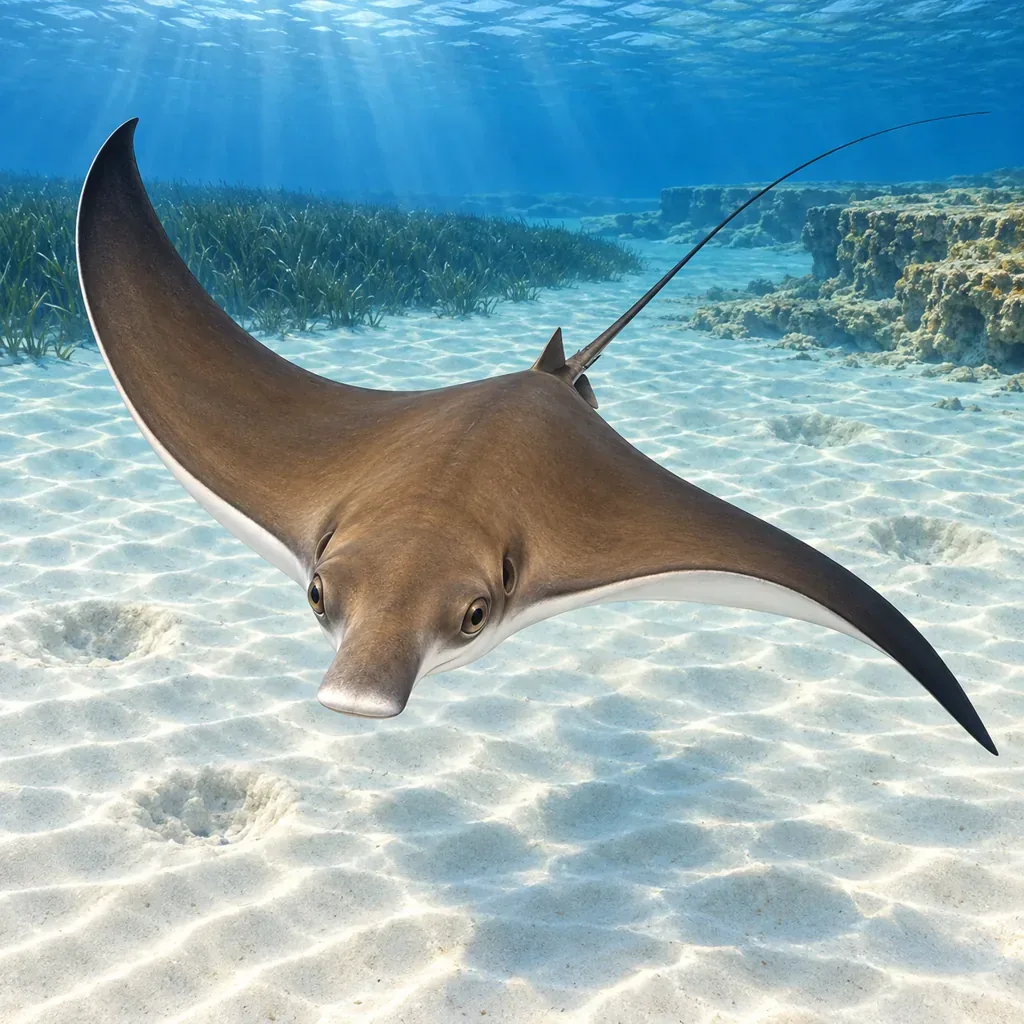
Meet the Common eagle ray
A big, unmistakable ray built like a delta wing. The disc is far wider than it is long and ends in sharply pointed wing tips, and the head is raised into a rounded, duck-billed snout that projects clearly in front of the wings - the quickest way to tell it from a stingray. The back is plain bronze, dark olive or near-black, the belly white, and a slim tail perhaps twice the body length carries a small dorsal fin and, just behind it, one or two serrated spines. Around Malta most are 50 cm to 1 m across the wings; the species reaches about 1.5 m and has been recorded to 1.8 m.
Unlike a stingray it rarely lies buried. It flies, flapping its wings in slow, deliberate beats, cruising a metre or two above open sand or drifting past a reef edge in mid-water. It feeds by settling briefly, blowing away sediment and crushing clams, whelks and crabs with flat grinding tooth plates, so a feeding animal leaves a line of shallow craters in the sand.
Around the Maltese islands it has been recorded as a frequent species for a hundred years, and divers meet it over sand flats and along the drop-offs of the north and north-east coasts, typically between 5 and 40 m. Something remarkable was documented off north-east Malta in October 2024, when a remotely operated vehicle filmed an estimated 100 to 150 eagle rays gathered on the seabed at about 50 m under a tuna ranch, apparently feeding on baitfish scraps sinking from the pens - the largest aggregation of the species known anywhere.
When to look: All year, with most sightings in late spring and summer when they move over shallow sand flats and reef edges.
Diving with them
- Look out into the blue and along the sand-reef boundary rather than down at the bottom; the silhouette appears as a slow-flapping dark diamond
- Do not chase it - hold your depth, stay still and let it complete its pass, and it will often circle back
- Keep your breathing quiet on approach; a burst of bubbles is usually what turns one away
- Watch for fresh feeding craters and broken shell fragments on the sand, a sign one has been working the area
- Wide angle only for photographs, and expose for the pale sand so the dark back does not go to a silhouette
- Give the tail base a wide berth; the spines sit close behind the small dorsal fin
Can it hurt you?Can hurt you
Harmless while it is swimming and it will not approach a diver, but the tail carries one or two venomous serrated spines used defensively if the animal is grabbed, netted or trapped against the bottom.
First aid: Immerse the wound in hot water at around 45 C for 30 to 90 minutes, irrigate well, leave any deeply embedded barb in place and get to hospital for wound exploration, antibiotics and tetanus cover.
Easily confused with
- Bull ray, the other eagle ray in Maltese waters, which has a longer, flatter, more shovel-shaped snout and pale bars across the back in juveniles - juvenile bull rays are common in Maltese bays
- Common stingray, which is flatter-headed with no protruding snout, lies buried in sand and ripples its disc edges instead of flapping
- Devil ray, a much larger open-water animal with cephalic fins like horns at the front of the head
Where to meet them: 4 sites
Further reading: FishBase: Myliobatis aquila · Report on the Maltese tuna-ranch eagle ray aggregation, Marine Biodiversity 2026 · CIESM Guide of Mediterranean Skates and Rays · Sharklab-Malta bull ray booklet (Maltese names, local threats) · Revision of shark and ray records from the Maltese Islands