Malta
Sikka l-Bajda
A big, wild offshore reef north of Malta with a drop-off that keeps falling past 70 metres. Open sea, open water, proper boat diving, and the closest thing Malta offers to a blue-water hunting ground.
Sea conditions
Excellent right now
Flat, sheltered and calm
Forecast for the site, updated 01:47 AM
- Waves
- 0.3 m
- from SE
- Wind
- n/a
- Swell
- 0.3 m
- 5 s period
- Sea temp
- 29 °C
Next 7 days
Exposed to wind and swell from: N (0°), NE (45°), E (90°), NW (315°), W (270°). Wide open to anything from the northern half of the compass. Only worth attempting on a flat, settled day with the wind off the land, and even then expect swell over the shallow bank. Best season: June to early October, when the northerlies ease and visibility on the plateau is at its best. Pelagic action peaks in late summer..
The dive
Sikka l-Bajda is the reef that most visiting divers never see, because it takes a boat, an echo sounder and a skipper who knows the transits. Local clubs still line up landmarks ashore, the Mosta dome against the eastern tip of St Paul's Island, the Red Tower against a cliff chapel at Ahrax, to find the good bits. Get it right and you are on a broad rocky plateau at 15 to 20 metres, all crevices and undercuts, running out to a shoulder that drops away into the blue.
The reef top is a patchwork: seaweed here, bare rock there, sand channels between, and large stretches that nobody has really swum. The drop-off is the reason to make the trip. It starts around 35 to 42 metres and keeps going well past 70, which means most recreational teams park on the lip, look down, and let the shallow plateau handle their off-gassing on the way back.
Because it sits in open water off the north coast, this is where you get the encounters Malta is usually shy about: shoals of barracuda hanging over the edge, amberjack and tuna cutting through, dentex that appear and vanish, eagle rays and stingrays working the sand. There is a sad footnote too, as the reef has taken a hammering from netting and trawling and you will see lost trammel net draped over the rock.
Bring everything you would bring to a real offshore dive: a DSMB you can actually deploy, a cutting tool, a plan for the boat losing sight of you, and honest gas reserves. The site is graded for experienced divers for good reasons.
- A genuine offshore drop-off falling past 70 metres
- The best odds in north Malta of barracuda, amberjack and dentex
- Huge, half-explored plateau of crevices and small caves
- Shallow reef top makes a convenient deco platform
- Remote enough that you will usually have it to yourselves
Typical plan
Follow the shot to the reef top around 15 metres, swim out across the plateau on a compass bearing to the shoulder, then run along the lip at 30 to 40 metres for ten to fifteen minutes with one eye on the blue. Turn back up the slope, spend the rest of the dive at 15 to 18 metres on the reef top clearing your ceiling, and surface under a DSMB well clear of the boat's swing. Nitrox 28 to 32 suits the profile; anything below 40 metres belongs on twins or a sidemount set with a proper deco plan.
What the bottom looks like
- 1Reef top plateau, crevices and undercuts15 m deep · 20 m out
- 2Broken rock and small caves20 m deep · 80 m out
- 3Sand channels between rock fingers25 m deep · 120 m out
- 4Shoulder of the main drop-off40 m deep · 180 m out
- 5Wall falling past 70 metres65 m deep · 200 m out
Flat coralline rock with weed patches and sand channels on top, ending at a rubble shoulder that tips into deep water.
Who you might meet
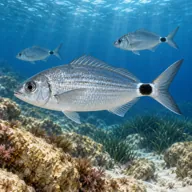
Saddled seabream
Almost always · Kahlija
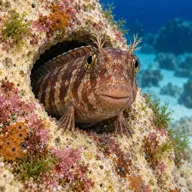
Gobies and blennies in the crevices
Almost always · Budakkra

Barracuda
Sometimes · Lizz · late summer

Greater amberjack
Sometimes · Accola · summer
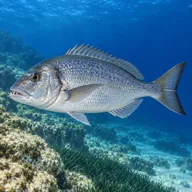
Dentex
Sometimes · Dentici
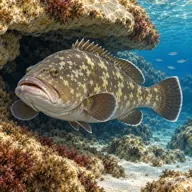
Dusky grouper
Sometimes · Cerna
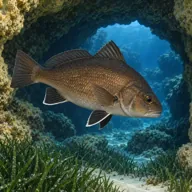
Brown meagre
Sometimes · Gurbell
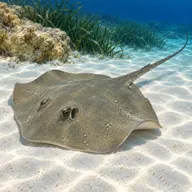
Common stingray
Sometimes · Boll
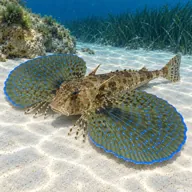
Flying gurnard
Sometimes · Bies
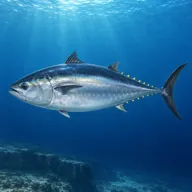
Atlantic bluefin tuna
Lucky day · Tonn · summer
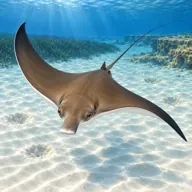
Eagle ray
Lucky day · Ħamiema
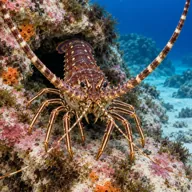
Spiny lobster
Lucky day · Awwista
Getting in and staying safe
Boat only, with no facilities anywhere near. Charters usually run out of Cirkewwa, Mellieha or Bugibba. A sounder is more or less mandatory to put people on the drop-off rather than a random patch of plateau, and most operators anchor or hang a shot into the reef top and have divers follow the line down. Surface cover must stay with the divers because the site sits close to a busy boating route.
- Deep drop-off that invites depth creep well past recreational limits
- Current and surface chop are normal here, sometimes enough to make the line a workout
- Heavy boat traffic on a transit route; DSMB is not optional
- Lost trammel netting and monofilament snagged across the reef, so carry a cutting tool
- Easy to get separated from the boat in open water
- No shelter, no shore, no exit other than the boat
- Decompression obligation on any serious visit to the wall
A bit of history
No wrecks or legends here, just geology and fishing. The reef is an outcrop of the same hard coralline limestone that forms the north Malta headlands, left standing offshore as a shallow bank while the surrounding seabed dropped away, which is why the plateau ends in such an abrupt shoulder. Local clubs have dived it since the 1970s and 1980s, and the Maltese name simply describes the pale reef. Commercial netting and trawling on the bank have been blamed by divers for the visible decline in fish numbers over recent decades.
Divers say
Sign in to rate this site and leave a note for the next diver.
- No reviews yet. First one gets bragging rights.
Further reading: Calypso Sub-Aqua Club: Sikka l-Bajda · Calypso Sub-Aqua Club: Is-Sikka tal-Kolonna · Divers Guide: Sikka l-Bajda · Visit Malta: Sikka l-Bajda (White Reef)