L'Ahrax Point · Malta
Tunnel
The doorway into the Aħrax inland sea. A short rock passage, dark from outside and glowing blue once you are in it, shallow enough that snorkellers can do it on one breath.
Sea conditions
Excellent right now
Flat, sheltered and calm
Forecast for the site, updated 02:29 AM
- Waves
- n/a
- Wind
- 4 km/h
- S, gusts 8
- Swell
- n/a
- Sea temp
- n/a
- air 25 °C
Next 7 days
Sunrise 06:47, sunset 19:05
Exposed to wind and swell from: NW (315°), N (0°), NE (45°), E (90°). The entrance faces the open north, so swell from that half of the compass funnels straight into the passage and makes it genuinely unpleasant. Go on a southerly or south easterly when the sea at the point is flat, and the transit is effortless. Best season: June to October. Midday sun is best for the light show, and late summer gives the warmest water inside the lagoon..
The dive
From the open sea the entrance looks like a bad idea: a black slot in the rock somewhere around ten or eleven metres, with the reef wall rising above it. Swim into it and the whole thing flips. Within a few metres the passage lifts towards the surface, the walls start throwing back light from the lagoon beyond, and by the time you are halfway through you are looking at a blue and green window ahead of you.
Because the roof breaks the surface in places, this is one of the few overhead-ish features in Malta that a snorkeller can honestly enjoy. On scuba it is a thirty second transit, but nobody swims it in thirty seconds. Everybody stops, rolls onto their back and watches the bubbles spread out under the rock. The walls are dense with tube worms, sponges and cup corals, and the sheltered water inside sits a degree or two warmer than the open sea, which encourages the whole community.
The dive normally runs as a loop: reef outside, tunnel in, a circuit of the lagoon with a surface stop under the collapsed roof, then back out and along the reef to eighteen metres or so. It is a beginner site by depth and a photographer's site by content, which is an unusual combination.
- Short, bright passage that works on scuba and on a single breath
- Walls plastered with tube worms, sponges and cup corals
- Water inside noticeably warmer than the open sea
- Natural loop dive: reef, tunnel, lagoon, reef again
Typical plan
Drop on the reef outside, run out to eighteen metres for the first ten minutes while your gas is plentiful, then work back in to the tunnel mouth at eleven metres, transit slowly with a torch, and spend the back half of the dive between two and six metres in the lagoon. Fifty to sixty minutes on a single twelve litre with no deco concerns. Air is fine, and a wide angle lens earns its keep.
What the bottom looks like
- 1Reef shelf leading to the entrance7 m deep · 55 m out
- 2Seaward mouth of the tunnel11 m deep · 100 m out
- 3Mid passage, roof rising towards the surface8 m deep · 118 m out
- 4Exit into the lagoon3 m deep · 152 m out
- 5Collapse debris on the lagoon floor5 m deep · 175 m out
- 6Reef stepping down outside14 m deep · 250 m out
- 7Sand and seagrass at the reef foot18 m deep · 290 m out
Smooth scoured limestone through the passage, with rockfall and coarse sand on the lagoon floor and seagrass patches outside the reef.
Who you might meet
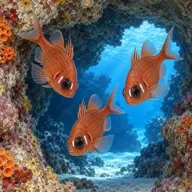
Cardinalfish
Almost always · Sultan iċ-ċawl
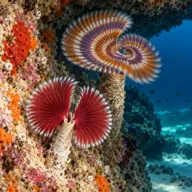
Spiral tube worm
Almost always
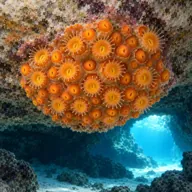
Golden cup coral
Almost always · Qroll tad-dell
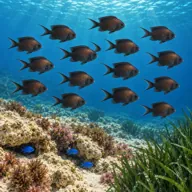
Damselfish
Almost always · Ċawl
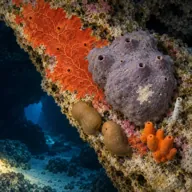
Encrusting sponges
Almost always · Sponża
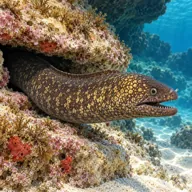
Mediterranean moray
Often · Morina
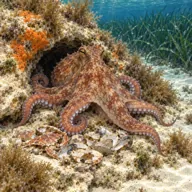
Common octopus
Often · Qarnit
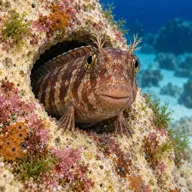
Black-faced blenny
Often · Budakkra · autumn

Red starfish
Often · Stilla tal-baħar
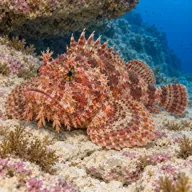
Scorpionfish
Sometimes · Ċippullazza
Getting in and staying safe
Shore divers park on the open ground near the White Tower at the end of the Armier track, then walk about a hundred and fifty metres over rough limestone to the shelf. From the water it is roughly ten minutes of finning to reach the tunnel entrance, which is why most centres prefer a boat drop straight onto the reef above it. No ladders, no steps, no facilities beyond the seasonal kiosks at Armier.
- Surge through the passage in any northerly swell, which can push you into the walls
- Low roof in places, so trim and buoyancy matter more than usual
- Snorkellers and swimmers dropping through the lagoon above you
- Sharp limestone and urchins on the tunnel walls
- Long swim from shore before the dive even starts
- Small boats entering the lagoon in summer
- Slippery rock shelf on exit
A bit of history
The tunnel and the lagoon behind it are the same story: a sea cave cut into Upper Coralline limestone by wave action, whose inner roof eventually collapsed and left an open shaft to the sky. The tunnel is the surviving seaward stretch of the original cave. It is often described locally as a miniature version of Gozo's Inland Sea at Dwejra, formed by the same process on a much smaller scale.
Divers say
Sign in to rate this site and leave a note for the next diver.
- No reviews yet. First one gets bragging rights.
Further reading: Calypso Sub-Aqua Club, Ahrax Point and Dragonara Cave · Divebooker, Ahrax Point reef and tunnel · Divers Guide, Ahrax Point site information · Dive Systems Malta, Ahrax Point