L'Ahrax Point · Malta
Inland Sea
A roofless cavern at the top of Malta where the rock has fallen in and left a near-circular pool ringed by walls ten metres high. You can surface inside, take your regulator out and look straight up at the sky.
Sea conditions
Excellent right now
Flat, sheltered and calm
Forecast for the site, updated 02:29 AM
- Waves
- n/a
- Wind
- 4 km/h
- S, gusts 8
- Swell
- n/a
- Sea temp
- n/a
- air 25 °C
Next 7 days
Sunrise 06:47, sunset 19:05
Exposed to wind and swell from: N (0°), NE (45°), E (90°). The bowl itself is well protected once you are in it, but the only way in and out is through a passage that faces open water, so northerly swell decides whether you go or not. On a southerly the lagoon is a mirror. Best season: Late spring through October. Midday for the light, early morning for having the place to yourself..
The dive
Malta has one famous inland sea, at Dwejra in Gozo, and this is its small, quiet cousin. A sea cave worked its way into the headland, the roof eventually gave up, and what remains is an almost perfectly round pool of clear water enclosed by sheer limestone with a bright circle of sky overhead. The water inside is between two and eight metres deep, the bottom is a mix of rockfall and pale sand, and the light does extraordinary things to it depending on the hour.
As a dive it is short on depth and long on atmosphere. The move is to come in through the tunnel from the open sea, circle the pool, surface in the middle and let everyone grin at each other for a minute, then drop again and pick your way around the walls where the sponges, cup corals and tube worms are thickest. Sheltered, warmer water means more growth per square metre than anywhere else on the headland, and the cracks are full of cardinalfish and small blennies.
It is also a hugely popular snorkelling and swimming spot, sold on land as the Coral Lagoon, so in July and August you will share it. Go early, go in shoulder season, or go on a weekday. Photographers should be aware that the best fifteen minutes of the day here are the ones when the sun is high enough to drop straight down the shaft.
- Surfacing inside a roofless cavern with cliffs all around you
- Warmer, sheltered water and unusually dense growth on the walls
- A genuine miniature of Gozo's Inland Sea without the crowds of Dwejra
- Works equally well as a dive, a snorkel or a photo set
Typical plan
Treat it as the centrepiece of a longer dive rather than a dive on its own. Reef and tunnel on the way in, fifteen to twenty minutes circling the pool between two and eight metres including a surface stop in the middle, then back out through the passage and along the reef to finish. Expect sixty minutes plus on a single tank and no decompression anywhere near you. Torch for the wall cracks, camera for everything else.
What the bottom looks like
- 1Reef outside the entrance5 m deep · 40 m out
- 2Connecting passage from the open sea8 m deep · 78 m out
- 3Collapsed chamber, open to the sky4 m deep · 112 m out
- 4Rockfall cone under the opening3 m deep · 130 m out
- 5Sandy shallows in the middle of the pool2 m deep · 150 m out
- 6Encrusted inner walls6 m deep · 190 m out
Collapsed limestone blocks fading into fine pale sand, with a thin silt layer in the deeper corners of the pool.
Who you might meet
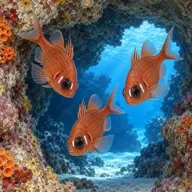
Cardinalfish
Almost always · Sultan iċ-ċawl
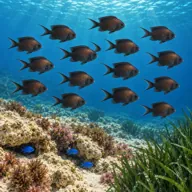
Damselfish
Almost always · Ċawl
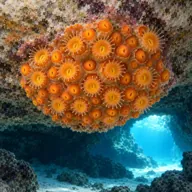
Golden cup coral
Almost always · Qroll tad-dell
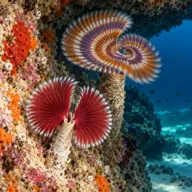
Spiral tube worm
Almost always
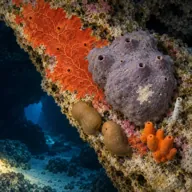
Encrusting sponges
Almost always · Sponża
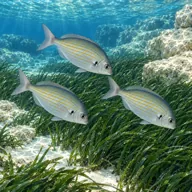
Salema
Almost always · Xilpa
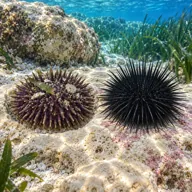
Sea urchins
Almost always · Rizzi
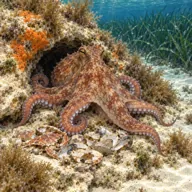
Common octopus
Often · Qarnit

Red starfish
Often · Stilla tal-baħar
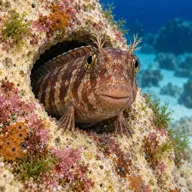
Black-faced blenny
Often · Budakkra · autumn
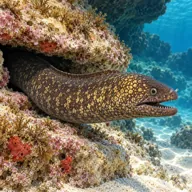
Mediterranean moray
Sometimes · Morina
Getting in and staying safe
By land, follow the track from Armier towards the White Tower, park on the open ground and walk out over the rock. From above you can look down into the lagoon, but the sensible dive entry is the shelf on the north side of the point followed by a swim to the tunnel. Most centres bring divers in by boat and drop them on the reef outside. Nothing here in the way of facilities: seasonal kiosks and toilets at Armier, and that is it.
- Cliff jumpers and snorkellers dropping in from the rim above
- Surge pushing through the connecting tunnel on northerly days
- Shallow rockfall and sharp limestone, easy to scrape a knee
- Sea urchins on the walls at swimmer depth
- Crowded with swimmers and small boats in high summer
- Long swim from the shore entry
- Silt on the lagoon floor that clouds quickly
A bit of history
Same geology as the tunnel that feeds it: a wave-cut cave in Upper Coralline limestone whose ceiling collapsed, leaving a circular opening rising roughly ten metres above the waterline and a debris cone on the floor below. It is the same collapse mechanism that produced Gozo's Inland Sea and, in far more dramatic fashion, the Azure Window before it fell in 2017. Locally the feature has picked up several names over the years, including Dragonara Cave and, in tourist marketing, the Coral Lagoon.
Divers say
Sign in to rate this site and leave a note for the next diver.
- No reviews yet. First one gets bragging rights.
Further reading: Divewise Malta, Coral Lagoon at L'Ahrax Point · Seashell Dive Centre, Dragonara Cave · Calypso Sub-Aqua Club, Ahrax Point and Dragonara Cave · We Seek Travel, getting to the Coral Lagoon