🐟 Fish · Parablennius spp.
Blennies
Budakkrain Maltese, also Budakkra tal-qawwi, Budakkra ħamra, Budakkra tal-għalla
Big-eyed rock dwellers with feathery eyebrows
Meet the Blennies
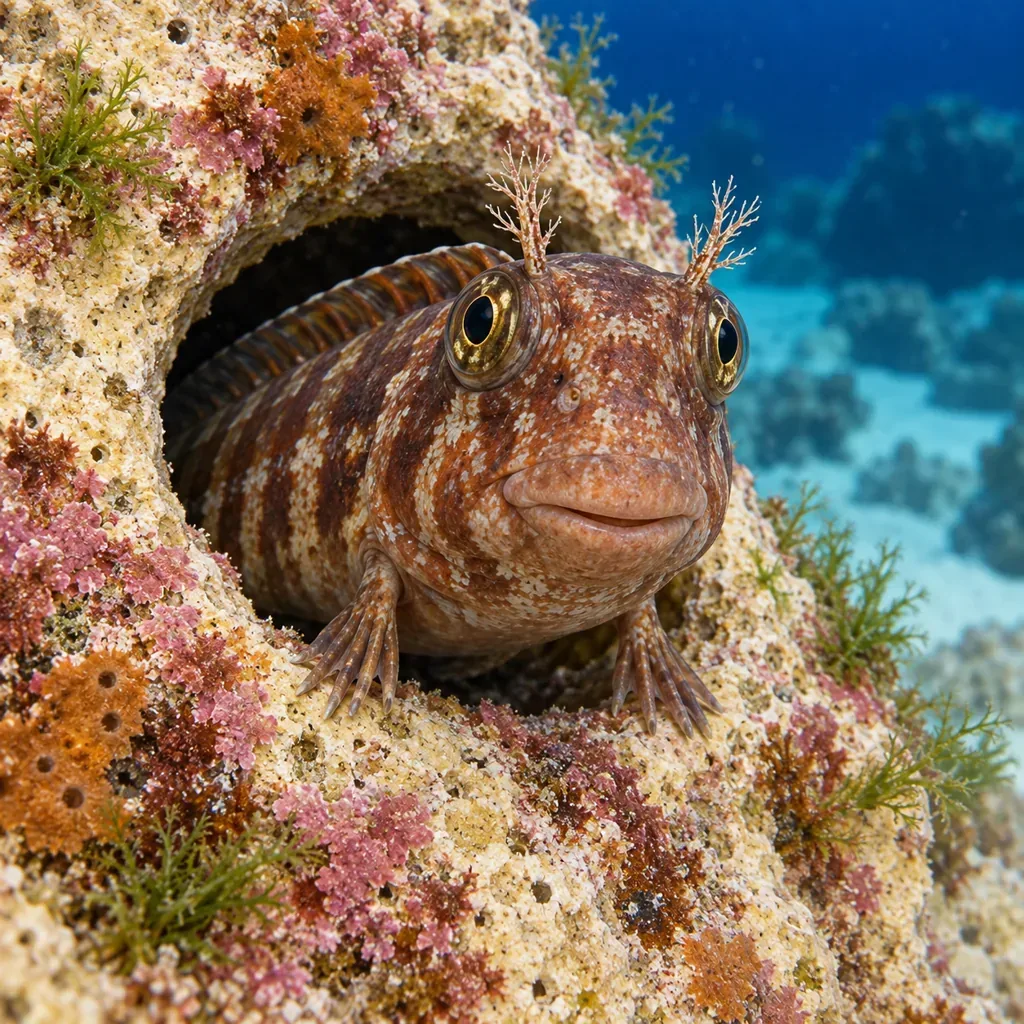
Blennies are the small, blunt-headed fish that sit propped on their pelvic fins in a hole in the rock and stare at you. They have a scaleless, slightly rubbery body, one long dorsal fin running almost the whole length of the back, high-set bulging eyes and, in most Maltese species, branched tentacles above the eyes that look like small feathery eyebrows. Colours are browns, olives and creams in bars and mottling, though breeding males often flush much darker and brighter.
Three are worth knowing around Malta and Gozo. The tompot blenny, Parablennius gattorugine, is the big one at up to about 20 cm here, reddish-brown with broad dark bars and thick branched head tentacles, and it lives in holes on rocky reef from a few metres to thirty. The striped blenny, Parablennius rouxi, is tiny and unmistakable: pale cream with one crisp black stripe from snout to tail, usually looking out of an abandoned worm tube. The rusty blenny, Parablennius sanguinolentus, is a chunky green-brown fish of the surge zone in the top few metres, often in rock pools. Divers also lump in the black-faced blenny, Tripterygion delaisi, which is really a triplefin, and in summer the males are impossible to miss, bright yellow with a jet-black head, perched on shaded vertical rock and cave roofs.
All of them are territorial homebodies. A blenny you find today will be in the same crack next month, which makes them the best subjects in Malta for practising slow approach and macro work.
When to look: All year; late spring and early summer are best, when males are in breeding colour and guarding eggs in their holes.
Diving with them
- Search holes, empty tube-worm tubes, old bolt holes and the gaps between boulders, not open rock
- They retreat and then reappear, so hold position for thirty seconds instead of chasing, and they come back out to look at you
- Blenny or goby: a blenny has one continuous dorsal fin, a blunt face and usually tentacles over the eyes, a goby has two separate dorsal fins and no tentacles
- For macro, get the camera down to the fish's eye level and focus on the eye, a top-down shot loses the character completely
- Look on shaded vertical walls and cave ceilings in summer for the yellow and black male black-faced blennies
- Never poke or flood a hole to make one emerge, males in spring are guarding a clutch of eggs
Can it hurt you?Harmless
Harmless. Blennies have no venom, and even the largest tompot has a mouth built for scraping algae and small invertebrates rather than for biting divers.
Easily confused with
- Gobies, separated by their two distinct dorsal fins and a fused pelvic sucker under the chest
- Small scorpionfish, which are far warty-er, sit on the rock rather than in a hole, and do carry venomous spines
- Clingfishes, which are flatter, smoother and have a broad sucker disc under the body
- Juvenile combers and gobies in the same holes, told apart by the blenny's high-set eyes and blunt forehead
Where to meet them: 7 sites
Sikka l-Bajda
Malta
Slugs Bay
Malta
Submarine Pen
Malta
Further reading: FishBase: Parablennius gattorugine, Malta country page with Maltese names · Il-Miklem: Budakkra, Maltese name for blennies · Diversity: A critical checklist of the marine fishes of Malta and surrounding waters · Atlantis Gozo Diving: tompot blenny in Maltese waters