🐟 Fish · Gobius spp.
Gobies
Mazzunin Maltese, also Mazzun tal-port, Mazzun kannella, Mazzun iswed, Mazzun żbirr
Little bottom-sitters that watch you pass
Meet the Gobies
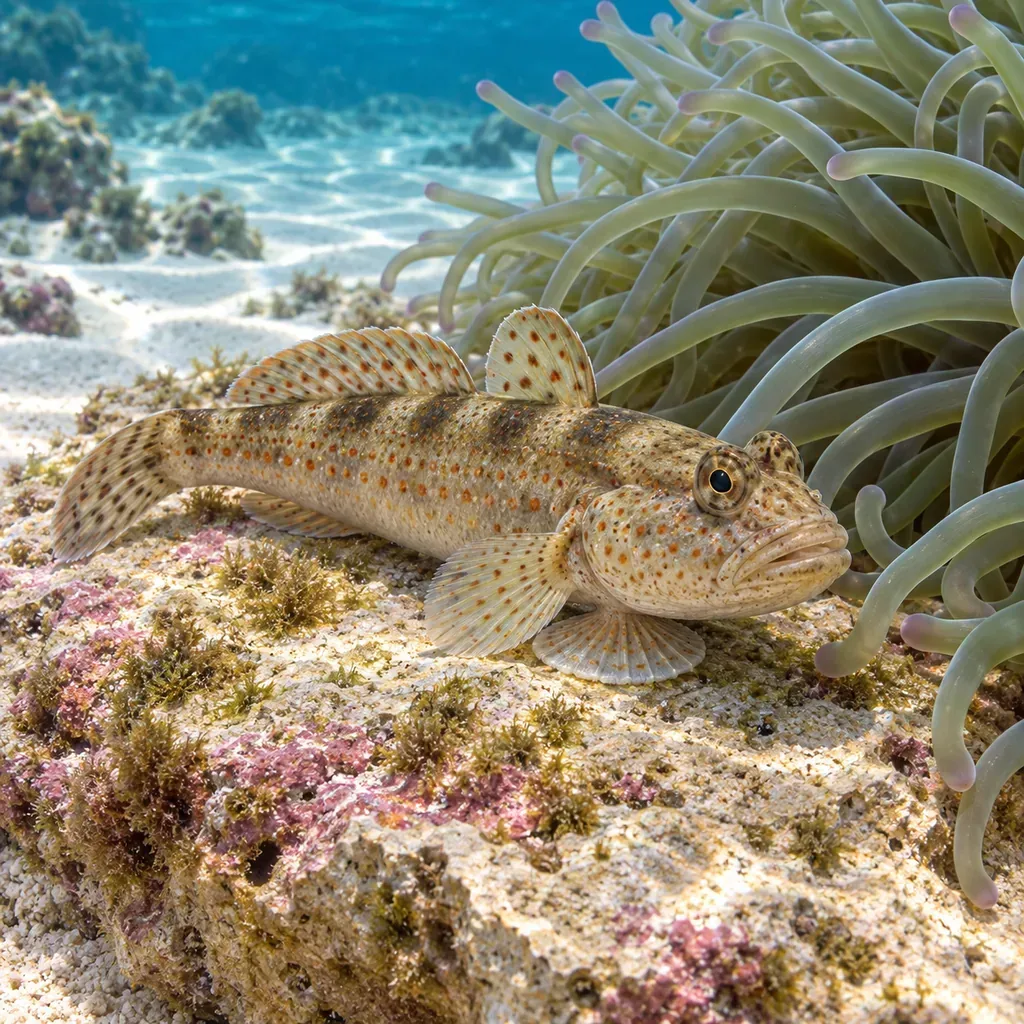
Gobies are small, cigar-shaped bottom fish that rest directly on the seabed rather than swimming above it. The giveaway is underneath: their two pelvic fins are fused into a shallow suction cup that lets them grip rock in surge. They also have two separate dorsal fins, where a blenny has one long one, and a smooth rounded head with no tentacles over the eyes. Most Maltese species are 5 to 12 cm.
Four turn up regularly around the islands. The rock goby, Gobius paganellus, is a dark mottled fish of the top few metres, under stones and in surgy gullies, with a pale or orange margin along the first dorsal fin. Bucchich's goby, long called Gobius bucchichi and now often identified as the very similar Gobius incognitus, is sandy-brown with rows of reddish dots and is the one you see sitting fearlessly among the stinging tentacles of a snakelocks anemone. The slender goby, Gobius geniporus, is pale, longer-bodied and lies out on open sand beside seagrass. The red-mouthed goby, Gobius cruentatus, is the handsome one, grey-brown with blood-red streaks on the lips and cheeks, usually deeper and in shade.
They are ideal subjects for a diver who moves slowly: they hold station, tilt their head to track you, and only hop a short distance when you push too close.
When to look: All year; the shallow rock species are easiest on calm days, and the sand species show best in the flat light of early morning.
Diving with them
- Look down, not ahead, gobies sit on the bottom and almost never rise into midwater
- Check every snakelocks anemone on the reef, there is often a goby living unharmed inside the tentacles
- Two dorsal fins and no eyebrow tentacles means goby, one long dorsal fin and feathery tentacles means blenny
- Settle your breathing before the shot, they react to the pressure wave of a moving diver more than to light
- Turn over nothing to find them, lifting stones destroys exactly the shelter they depend on
- On night dives look for them sitting out in the open on sand, far bolder than during the day
Can it hurt you?Harmless
Completely harmless. No venom, no spines of consequence, and nothing large enough to hurt a diver.
Easily confused with
- Blennies, which have one continuous dorsal fin, a blunter face and branched tentacles above the eyes
- Juvenile combers and cardinalfish, which hover above the bottom rather than resting on it
- Dragonets, which are flatter, broader-headed and shuffle along on sand with a wide fan-shaped first dorsal in males
- Transparent goby (Aphia minuta), the tiny see-through whitebait species, which swims in open-water shoals instead of sitting on rock
Where to meet them: 3 sites
Sikka l-Bajda
Malta
Slugs Bay
Malta
Further reading: FishBase: Gobius paganellus, Malta country page with Maltese names · FishBase: Gobius bucchichi, Malta country page · Diversity: A critical checklist of the marine fishes of Malta and surrounding waters · WoRMS: Gobius, current taxonomy of Mediterranean gobies