🐟 Fish · Serranus cabrilla
Comber
Kannain Maltese, also Serran, Sirran, Sirrana, Sirrana tar-rigi
Slim, orange-lined and endlessly curious
Meet the Comber
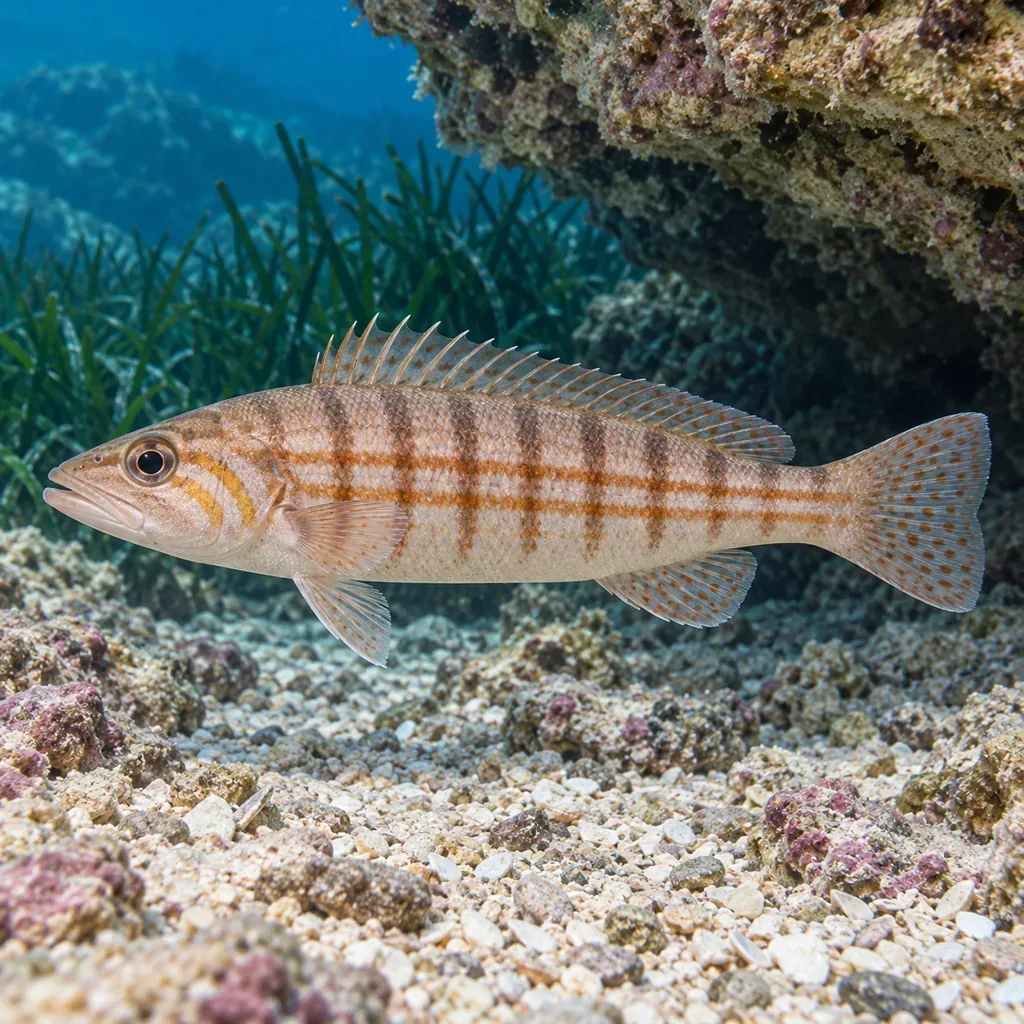
The comber is the painted comber's slimmer, paler cousin and a small member of the grouper family. The body is elongated and gently tapered, with a pointed head and a sizeable mouth, and the background colour is pale sandy pink to reddish brown. Across it run seven to nine faint dark vertical bars, and along it run two or three horizontal orange to yellow-brown stripes, so the flank ends up with a criss-cross pattern that no other small Maltese fish shows. There are usually two or three curved white or yellowish bands on the cheek. Maltese fish are commonly 15 to 25 cm and can reach about 40 cm.
Combers cover a huge depth range, from about 5 metres down past 300, which means divers meet them almost everywhere but see the most at 15 to 60 metres on the lower parts of reefs, on rubble and coarse sand at the foot of walls, over Posidonia edges and around wrecks such as the Um El Faroud, P29 and Rozi. They perch on the bottom, often in the open, and are famously unbothered by divers. Like the painted comber they are simultaneous hermaphrodites, and they feed on small fish, crustaceans and cephalopods, hunting most actively around dusk.
Because they are curious, combers often become the fish that follows you around a sandy patch, hovering just off your fin tips and darting in whenever something moves in the sediment.
When to look: All year at any time of day, with most feeding activity at dusk and a noticeable tendency to sit out in the open on sand in the middle of the day.
Diving with them
- Look on rubble and coarse sand at the base of a wall rather than on the reef top, where it sits still and is easy to swim past.
- It is the small fish most likely to shadow you over sand, so let it come rather than approaching it.
- The horizontal orange stripes are the giveaway against the painted comber; check the flank before calling either one.
- Deeper Maltese sightings are common on the sandy shoulders of the wrecks, so it is worth a look on your way back up the shot line.
- Good colour needs light: at 40 metres it looks grey-brown, and only a torch shows the orange lines.
Can it hurt you?Harmless
Harmless. It has stiff dorsal spines and small teeth but is far too small and too shy of handling to present any risk.
Easily confused with
- Painted comber (Serranus scriba), which is stockier, more orange, with red scribbles on the face and a bright blue belly patch but no horizontal stripes
- Brown comber (Serranus hepatus), which is far smaller and has a black blotch on the spiny dorsal fin
- Blackbelly rosefish, which is deeper-bodied with a big spiny head and hangs on deep rock rather than sand
Where to meet them: 1 sites
Further reading: FishBase: Serranus cabrilla (size, depth range, habitat, diet) · GBIF vernacular names for Serranus cabrilla, Maltese entries (Kanna, Serran, Sirrana) · Atlantis Gozo Diving: comber around Malta and Gozo