🐟 Fish · Helicolenus dactylopterus
Blackbelly rosefish
Ċippullazza tal-għajnin Maltese, also Ċippullazza tal-fond, Skorfna mperjali, Skorfna tal-għajn
The scorpionfish of the deep shelf edge
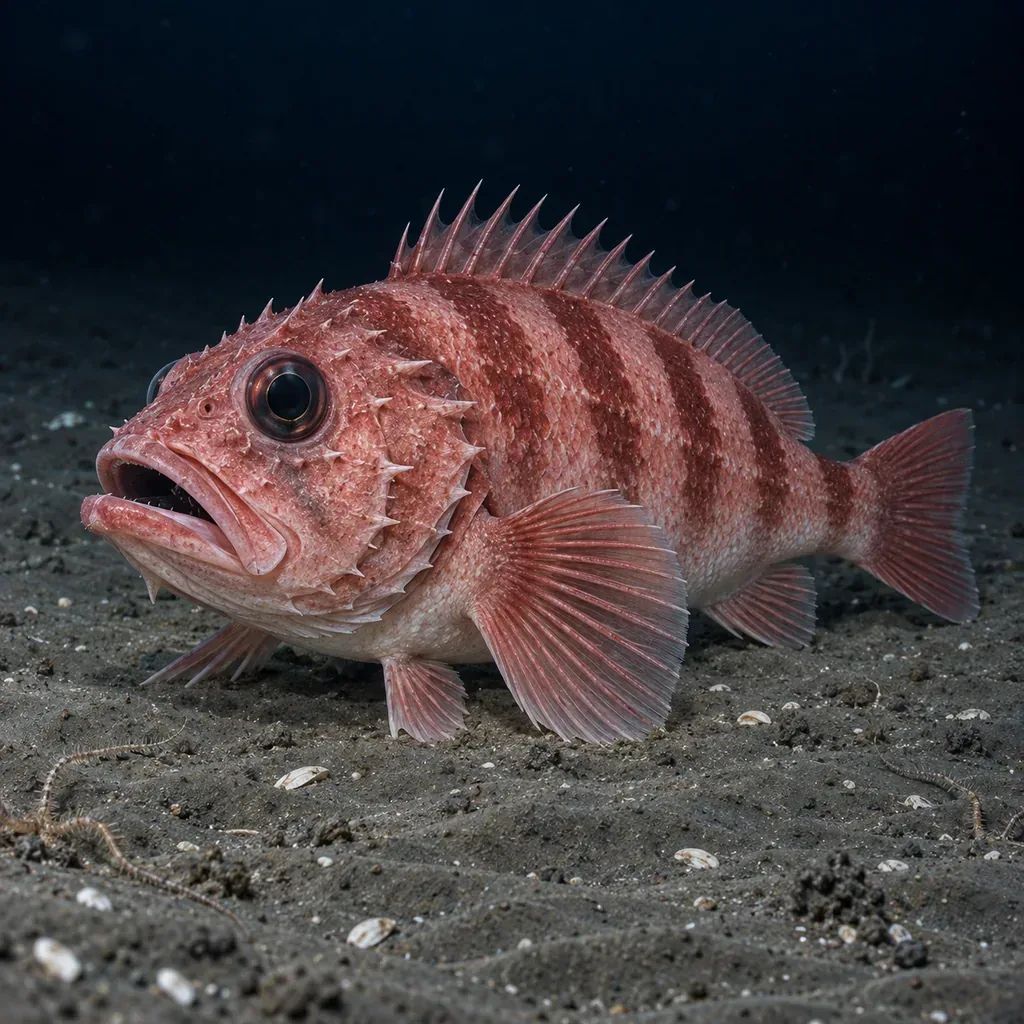
Meet the Blackbelly rosefish
A deep-water relative of the scorpionfish: rose-pink to brick-red, with four or five darker red bands across the back, a large head, a very big dark eye adapted to low light, and spiny ridges over the cheeks and gill covers. The inside of the mouth and the lining of the body cavity are blackish, which is where the English name comes from. The long spiny dorsal fin carries venom glands in grooves along the spines. Most are 20 to 30 cm; 50 cm is the maximum on record.
This is not a fish of the recreational reef. It lives on soft and mixed bottoms of the outer shelf and upper slope, usually between about 150 and 600 m and recorded from 50 m down past 1,000 m. Around Malta that means the shelf edge and the deep banks, where it is taken on bottom longlines and trawls and turns up on the market with the deep-water species. Only technical divers working beyond normal limits, or people watching ROV footage from the Maltese slope, are likely to meet one alive.
It sits still on the bottom and relies on camouflage and spines rather than speed, so its whole strategy assumes you will not touch it. Anyone who does handle one, almost always while unhooking a catch, finds out that the spines work.
When to look: All year at depth; realistically this is a fish you meet on a longline, in a fish market or on deep video, not on a recreational dive.
Diving with them
- Do not expect this one on a normal Maltese dive, it lives far below recreational and most technical limits
- If you do see one deep, it will be sitting motionless on soft bottom, not swimming, so approach as you would a scorpionfish
- Never steady yourself by putting a hand on a deep soft bottom without looking, it is the classic way people get spined
- Keep everything off the seabed, the sediment communities it lives in are fragile and slow to recover
- In photos, look for the black mouth lining and the banded red back, which separate it from shallow scorpionfish
- If you handle a landed one, hold it by the lower jaw and keep well clear of the first dorsal fin
Can it hurt you?Can hurt you
The dorsal, anal and pelvic spines carry venom glands, and a puncture causes immediate intense pain, swelling and sometimes numbness that can last hours. Nearly all injuries happen while handling a caught fish rather than while diving.
First aid: Get out of the water. Remove any visible spine fragments with tweezers and let a small puncture bleed briefly, then wash the wound with clean fresh water. Immerse the limb in hot water, as hot as can be tolerated without scalding and no more than about 45 C, for 30 to 90 minutes, topping it up as it cools, and have someone else test the temperature because numbness makes burns easy. Seek medical care for pain that does not settle, for spreading swelling, for any wound over a joint, and to check tetanus cover and the need for antibiotics.
Easily confused with
- Large-scaled scorpionfish (Scorpaena scrofa), the shallow Maltese ċippullazza, which is mottled red-brown with skin flaps on the head and lives within diving depth
- Black scorpionfish (Scorpaena porcus), smaller, darker and with long tentacles above the eyes
- Bluemouth relatives and small redfish sold alongside it on the market, separated by the black mouth lining and the banded back
- Juvenile red gurnards, which have huge wing-like pectoral fins and walk on finger-like rays
Where to meet them: 3 sites
Further reading: FishBase: Helicolenus dactylopterus, Malta country page with Maltese names and venom note · EU commercial designations: Helicolenus dactylopterus Maltese names · Eye lens radiocarbon dating validating extreme longevity in blackbelly rosefish · Toxins: hot-water immersion versus ice packs as first aid for marine envenomation