A German fast attack boat shot up by Malta's 9.2 inch coastal guns in May 1942, abandoned, and finished off the next morning by a Luftwaffe fighter sent to sink her. She lies somewhere out on the plateau off Zonqor Point, position unpublished, and nobody has reported diving her.
 Wreck
Divers rarely, if ever, come here.
We found no record of anyone diving this site. It is charted so the picture of what lies under the water is complete, not because it is a place to go: there is no set route, no local briefing to lean on, and nothing on this page has been proven in the water.
Sea conditions
Reading the sea…
Exposed to wind and swell from: N (0°), NE (45°), E (90°), SE (135°), S (180°), NW (315°). Work the exposure from the geometry and it is grim. Sitting out on the plateau east to northeast of Zonqor, the only thing blocking anything is Malta itself, and the island only covers the west and southwest arc, roughly from west-southwest round to west-northwest. Everything from north through east and south is open sea. The northwest sector is open too, which is the one that catches people out: the majjistral tracks down the Malta Channel from Sicily and slides past the north of the island without being stopped, so a fresh northwesterly still builds a short awkward sea out here even though the land looks like it should help. In practice this is a flat calm day site only, and at these depths you want the forecast flat for the whole day, not just the morning. Best season: Late May through September, when settled high pressure gives multi-day windows and the water on the plateau is warmest. Anything outside that is search-vessel weather rather than dive weather..
The dive
Let us be straight with you at the top: this is an entry in a wreck register, not a dive you can book. S-34 was one of the 3rd Schnellboot Flotilla's S-30 class boats, a little under 33 m long, about 5 m across, a shade over 100 tons, three Daimler-Benz diesels and a top end near 44 knots. She spent the spring of 1942 running out of Sicily by night to drop mines across the approaches to Valletta, which is how she ended up on the wrong side of the island's coastal artillery.
Where she actually sits is not public. The German loss list records only the date and the general area off Valletta. Wrecksite keeps the position for paying members. Every retelling repeats the same twelve kilometres off Zonqor Point without a bearing, and no operator, survey team or diver has published a depth, a photograph or a dive report. Heritage Malta's underwater unit has mapped a great deal of the seabed here and has S-31 fully documented, but S-34 has not surfaced in any of that work that we can find.
The one encouraging detail is the water. The plateau east of Malta is shallower than people assume. Across the likely search arc the seabed runs roughly 65 m to 135 m over soft sediment, so if she were ever pinned down she would be a genuine target for a well organised trimix or rebreather team rather than a submersible job. A 33 m wooden-framed hull that was blown up, abandoned and then bombed will not be in one tidy piece, and after eighty years in the mud it may be little more than engines, frames and armament in a scatter.
Until somebody finds her and says so out loud, treat this page as history with a pin attached. The numbers below are reasoned from bathymetry and from what deep Maltese wrecks generally look like, not from anyone's dive.
- Sister boat to the S-31, lost eight days later in the same mining campaign against the Grand Harbour
- Knocked out at nine kilometres by Malta's 9.2 inch coastal guns, one of the few E-boats killed by shore artillery
- Her own scuttling charges failed, so the Luftwaffe sent a Bf 109 to finish her the next morning
- Position withheld by every source, no published depth, and no reported dive on her to date
- Sits on a plateau running roughly 65 m to 135 m, so she is findable and divable in principle if anyone locates her
Typical plan
There is no plan, because there is no site. If the wreck is ever located and released, expect a shot-line descent on a flat day to somewhere between 65 m and 135 m, trimix or closed circuit, a bottom time in the fifteen to twenty-five minute range with a deco obligation running well past an hour, twin stages or bailout, a live boat and a long lift bag. Until then, the only sensible dive on this story is the S-31 off Sliema, which is on charter, surveyed, and tells the same tale.
What the bottom looks like
- 1Assumed position of the S-34 hull, around 33 m long and not expected to be intact110 m deep · under the boat
- 2Flat plateau mud and sand over consolidated sediment, no relief111 m deep · 29 m from the boat

Soft mud and sand lying over consolidated sediment, the typical Malta Plateau floor, flat and featureless apart from whatever the wreck itself provides.
Who you might meet



Sometimes




Lucky day

Marked ones can hurt you. What they do and what to do about it is under Getting in and staying safe.
Getting in and staying safe
Only for serious professionals who know exactly what they are doing. With no record of anyone diving here there is no one to ask and no set route, so treat every line below as the start of your own planning, not a briefing. Plan it as an expedition, not a dive.
There is no access, because there is no mark. No charter runs this site, no depth has been published, and nothing on the seabed here has been identified as S-34 in public. Anyone serious about it is looking at a search project with side-scan and a magnetometer over an arc several kilometres wide, in the middle of a busy shipping approach to Malta Freeport and the Grand Harbour, not a dive booking. Maltese law protects wrecks over a century old and the Underwater Cultural Heritage Unit at Heritage Malta is the body to talk to before any of that, as it is for the sister boat S-31. A found wreck with three men still associated with it is also a matter for the German war graves authorities.
- The position is not published, so any attempt is an offshore search rather than a dive
- Likely depth of 65 m to 135 m, deep trimix or closed circuit territory at the shallow end and beyond most teams at the deep end
- Twelve kilometres offshore with no shelter, long boat cover and long surface intervals for a deco team
- Heavy commercial shipping on the Freeport and Grand Harbour approaches, so surface cover and a clear lift bag plan are essential
- Unexploded ordnance is a fair assumption: she carried mines, torpedoes and 20 mm and 37 mm ammunition, was blown up by her own charges and then bombed
- Soft sediment bottom, so any contact will silt out visibility in seconds
- Snagged trawl net and long-line monofilament are common on the plateau
- Three of her crew died in the action, so treat anything found as a grave
Marine life to respect

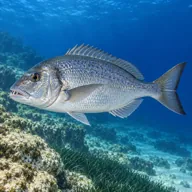
Blackbelly rosefish · Ċippullazza tal-għajn Can hurt you
Venomous spines, like a scorpionfish. Do not handle it; hot water if stung.
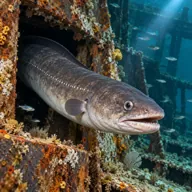
Conger eel · Gringu Can hurt you
Crushing bite if a hand goes into its hole. Look in from a distance and keep fingers out.
A bit of history
S-34 was a Lurssen-built S-30 class Schnellboot launched in 1940 and serving with the 3rd Schnellboot Flotilla, which moved into the Mediterranean and worked against Malta from Sicilian bases. On the night of 9 to 10 May 1942 she sailed from Augusta with S-31 and S-61 to sow mines in the harbour approaches. S-31 hit a drifting mine from an earlier lay and went down off Sliema with eight men lost in her engine room. A week later, on the night of 17 May, S-34 was out again on the same work northeast of Valletta with S-35, S-58 and S-59 when the searchlights picked the boats up after two in the morning. The island's 9.2 inch coastal batteries opened at a range of about nine kilometres and put a shell straight into her. Accounts differ over which battery scored the hit, some naming Garden and Fort St Rocco, others Fort St Leonardo, and over whether the round landed amidships or in the engine room. What is agreed is that she began flooding fast, S-59 came alongside under a smoke screen to lift the crew off, and three men, two ratings and a petty officer, were killed. The demolition charges were fired and failed to finish her. On the morning of 18 May a Bf 109 was sent out to the drifting hull and put a bomb into it, which is what finally sank her. The German loss register lists her as heavily damaged by coastal artillery on 17 May off Valletta, blown up, and sunk by her own side's fighter-bomber the following day. The day after that the flotilla was ordered away to Derna, its Malta mining campaign over after 24 operations and 557 mines.
Divers say
Sign in to rate this site and leave a note for the next diver.
- No reviews yet. First one gets bragging rights.
Further reading: Wrecksite: S-34, S-30 class Schnellboot, Lurssen 1940, lost 17 May 1942 · Battlefront Malta: Schnellboot operations around Malta and their losses · WLB Stuttgart, Der Seekrieg: German S-boat loss and disposal register · Wikipedia: E-boat, S-30 class dimensions, power and armament · Heritage Malta: Schnellboot S-31, the sister boat that has been surveyed · GEBCO 2020 global bathymetry, used for the depth bracket over the search arc