🦈 Sharks & rays · Scyliorhinus canicula
Small-spotted catshark
Gattarellin Maltese, also Gattarell tat-tikek, Kelb il-baħar
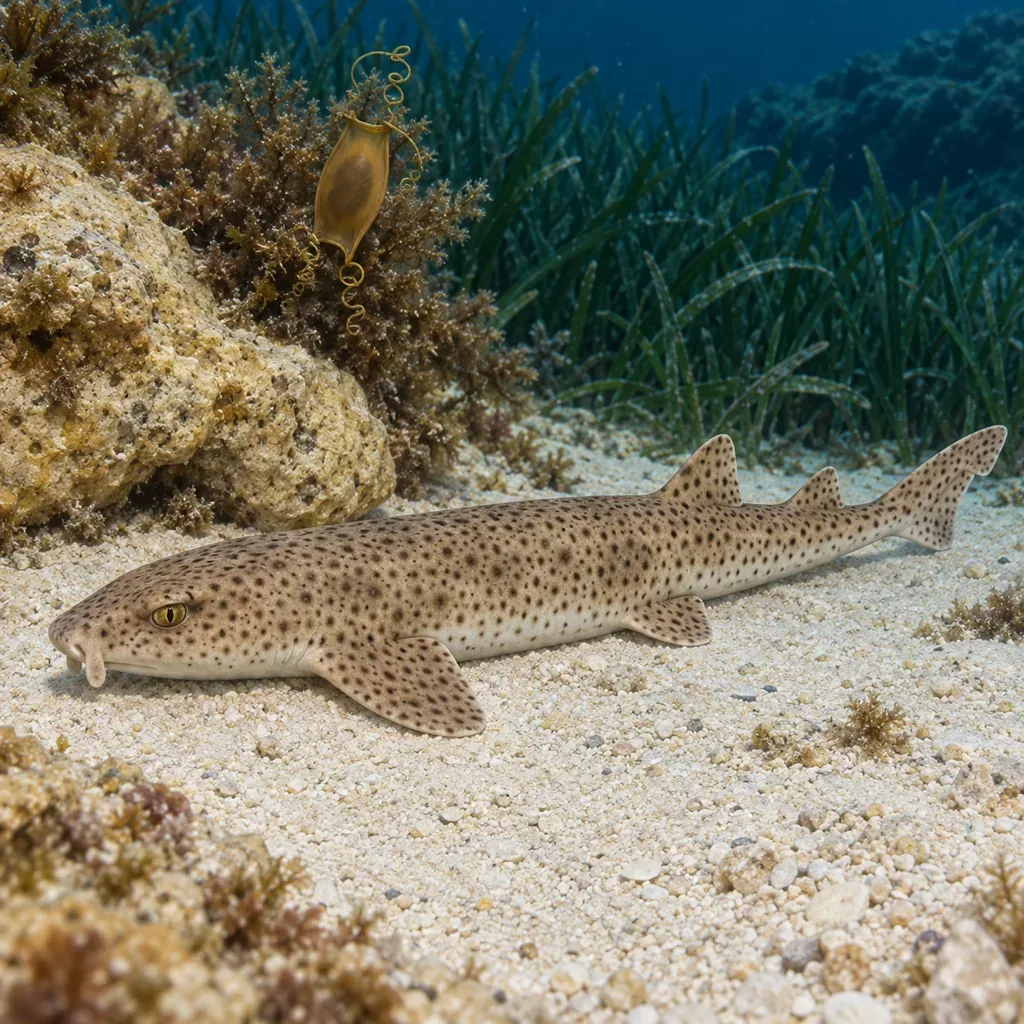
A little freckled shark asleep on the sand
Meet the Small-spotted catshark
A small, slender shark with a rounded snout, cat-like slit eyes and two dorsal fins set well back towards the tail. The back and sides are sandy fawn to pale brown, covered in dense small dark brown spots, and the belly is cream. A useful identification point is at the nose: the flaps of skin in front of the nostrils are fused into a single broad lobe that reaches all the way down to the mouth. Most are 40 to 60 cm long; the species reaches about 80 cm to a metre. The skin is like fine sandpaper and the body feels surprisingly firm.
It is a bottom-dweller that spends the day resting on sand, gravel and muddy detritic ground, often tucked against a rock or half under a ledge, and hunts at night for worms, small crabs, shrimps and molluscs. Females lay tough, translucent egg cases with long curling tendrils that anchor them to seaweed, sea fans and sponges; the pup develops inside for months before wriggling out.
Around Malta this is the shark that turns up most often in fishing nets and at the Valletta and Marsaxlokk fish markets, but divers see it less often, because it prefers deeper, softer bottoms than most recreational dives reach. Your best chance is a sandy or silty slope below about 25 m, or a night dive on open sand. Sharklab-Malta has been recovering egg cases from dead females landed at the market and releasing the hatched pups back into Maltese waters.
When to look: All year; most likely on a night dive or on deeper sand and silt, as there is no distinct breeding season here and egg cases turn up year-round.
Diving with them
- Search the transition where reef meets soft sediment, and look for a slim tail lying alongside a rock rather than the whole animal
- It usually sits still and lets you get close; move in gently and do not shine a bright torch straight into its eyes
- Never grab or lift one - handling strips the protective slime, and it will twist its body hard enough to injure itself
- Hunt the seaweed, sea fans and sponge clumps for the amber egg cases with their long curling tendrils, and leave them exactly where they are
- Night dives on sand give by far the best chance of seeing one moving and feeding
- Photograph the head in profile: the single broad nose flap running down to the mouth is the feature that separates it from the nursehound
Can it hurt you?Harmless
Completely harmless to divers. It has tiny teeth, no interest in people, and the only thing it can do is graze you with its rough sandpaper skin if you handle it, which you should not.
Easily confused with
- Nursehound, which grows much larger, has bigger and more widely spaced dark blotches often mixed with white spots, and nose flaps that stop short of the mouth
- Blackmouth catshark, a deeper-water relative with a dark mouth lining and a chain-like pattern of saddle blotches rather than fine freckles
- Juvenile smooth-hound, which is grey and unspotted with much larger eyes set differently
Where to meet them: 1 sites
Filfla
Malta
Further reading: Shark-References: Scyliorhinus canicula · Small-spotted catshark overview · Sharklab-Malta: eggcase rescue programme for Scyliorhinus in Malta · Revision of shark and ray records from the Maltese Islands