🦈 Sharks & rays · Scyliorhinus stellaris
Nursehound
Gattarell tar-rukkalin Maltese, also Gattarell
The leopard-spotted sleeper of the caves
Meet the Nursehound
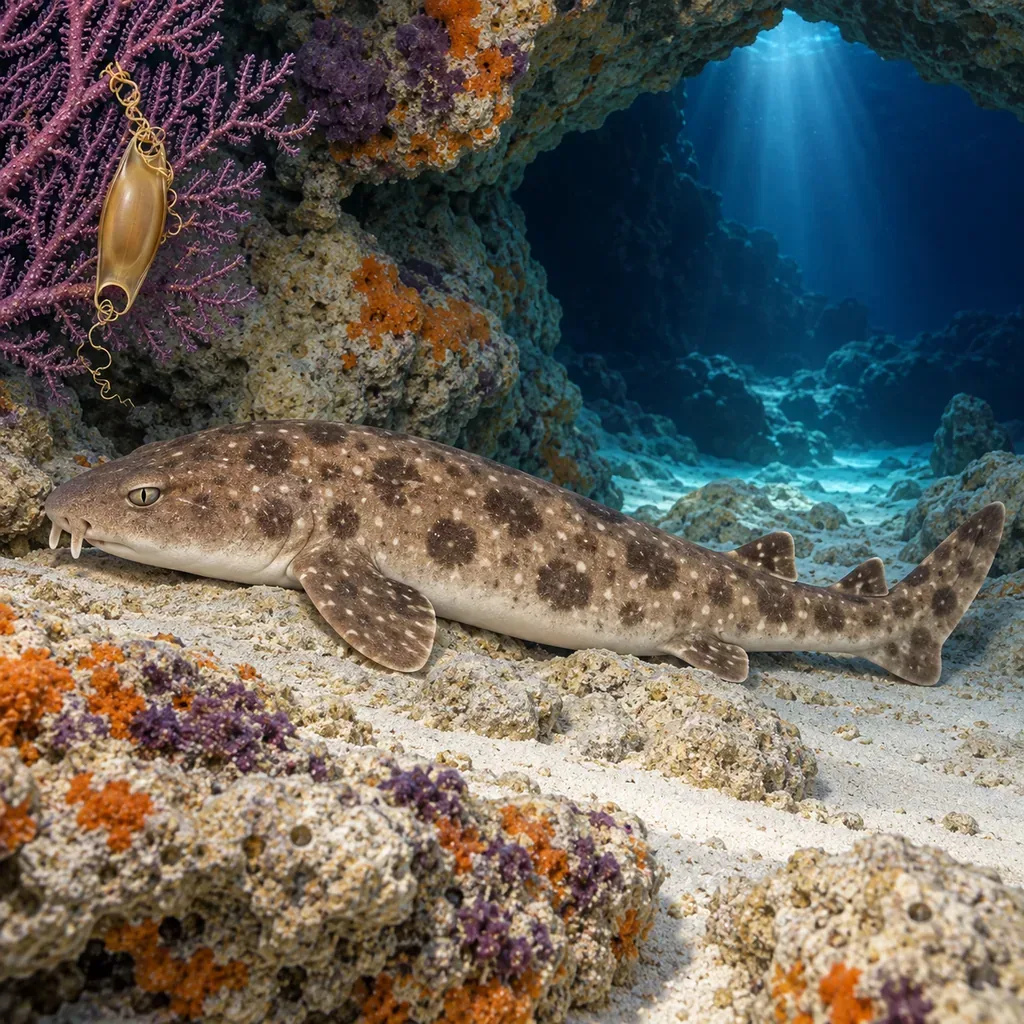
The bigger of Malta's two catsharks, and a genuinely handsome animal: a stout, muscular body in warm greyish-brown, patterned with large chocolate blotches and, in many individuals, a scatter of small white spots between them. The head is broad and blunt, the eyes are narrow cat-like slits with a pale nictitating fold below, and the two dorsal fins sit far back near the tail. The nose flaps are the clincher against the small-spotted catshark - here they are short and separate, stopping well before the mouth. Most nursehounds divers meet are 70 cm to 1.1 m; the species reaches about 1.6 m.
By day it sleeps wedged into a crack, under a boulder or at the back of a cave, often in company, and it barely reacts to a careful diver. At night it comes out to patrol reef and rubble for octopus, cuttlefish, crabs and small fish. Females lay large egg cases, 10 to 14 cm long, with tendrils twisted around gorgonians and coarse algae, and the pup takes the best part of a year to develop.
In the Maltese islands this species has been called common for over a century and is still landed regularly in small numbers. Divers meet it in the boulder fields and cave systems of the north-west coast and around Gozo and Comino, usually between 10 and 50 m. Sharklab-Malta's Mermaid's Purse project asks divers to report nursehound egg cases they find, so a photograph with a size reference is worth more than a shark portrait.
When to look: All year; resting in caves and under boulders by day, active and out in the open on night dives, with egg cases found in any season.
Diving with them
- Sweep your torch slowly across the back of caves and under big boulders - what you will usually see first is a spotted tail sticking out of a crack
- Approach from the tail end and stay low; a beam straight into the eyes is what makes them bolt
- Never pull one out of its hole or hold it by the tail; it is protected only by its own good sense and your restraint
- Look along gorgonians and coarse brown algae for large egg cases about the length of your hand, and photograph them without touching the tendrils
- Night dives on boulder slopes are the best chance to see one swimming and hunting
- For an identification photo, get the nose in profile: separate nose flaps that stop short of the mouth, plus big blotches, mean nursehound
Can it hurt you?Harmless
No threat to divers at all. It is a slow bottom shark with small teeth that has no interest in people; the only realistic injury is a graze from its rough skin if you insist on handling it.
Easily confused with
- Small-spotted catshark, which is smaller and covered in fine dense freckles, with a single broad nose flap that reaches the mouth
- Blackmouth catshark, which is slimmer, has a black mouth lining and a chain-like saddle pattern, and lives deeper
- Juvenile smooth-hound or tope, which are plain grey with no blotches and have a much more shark-like pointed snout
Where to meet them: 1 sites
Filfla
Malta
Further reading: Shark-References: Scyliorhinus stellaris (includes Maltese name) · Sharklab-Malta: Mermaid's Purse project and eggcase rescue · Revision of shark and ray records from the Maltese Islands · Micarelli et al. 2016, nursehound reproduction and juvenile husbandry