Filfla · Malta
Filfla
A protected islet five kilometres off Malta's southern cliffs, ringed by collapsed boulders that slide into water deeper than most people will ever dive. The best place in the archipelago for rays, and the worst place to pick anything up off the bottom.
Sea conditions
Good right now
Some chop (0.5 m ESE)
Forecast for the site, updated 01:47 AM
- Waves
- 0.5 m
- from ESE
- Wind
- n/a
- Swell
- 0.5 m
- 5 s period
- Sea temp
- 29 °C
Next 7 days
Exposed to wind and swell from: NE (45°), E (90°), SE (135°), S (180°), SW (225°), W (270°), NW (315°). Open sea on almost every bearing, with only a partial lee from Malta's southern cliffs in a northerly. It needs a genuinely settled forecast and a calm crossing, and the swell is usually bigger here than it looked in the harbour. Visibility is often superb, 25 to 40 m, because nothing runs off into this water. Currents are the wild card and can be strong. Best season: June to September, on settled days with a light northerly. Permits and boat availability, not water temperature, usually decide the date..
The dive
Filfla is the southernmost scrap of the Maltese archipelago, a flat-topped limestone table surrounded by crumbling cliffs, and it is an expedition rather than an outing. You need a boat with the right licence, you need written permission because the island and the water around it are a nature reserve, and you need a settled forecast because there is no shelter out here and nothing between you and the open Mediterranean.
What you get in return is scale. The island's skirts are a chaos of boulders at every conceivable depth, and between them the bottom simply keeps going: twenty-five metres is the working average, but the drop runs well past seventy for anyone equipped for it. Because almost nobody dives here, the fish behave differently. Rays are the standout, several species of them, more of them than anywhere else in the islands, lying in the sand patches or lifting off in front of you. Amberjack and dentex cruise the boulder edges, and the shy elasmobranchs that have been fished out of easier water still turn up.
The other thing on the bottom is ordnance. Filfla spent decades as a naval and air force gunnery target, and the seabed is littered with the results. Some of it is live. The rule is absolute and universal among everyone who dives here: look, photograph if you must, and do not touch.
- The best ray diving in the Maltese islands, in real numbers
- Boulder terrain tumbling past 70 m on an offshore islet
- A protected reserve that almost nobody gets to dive
- Visibility and blue water you simply do not get inshore
- Living evidence of decades of target practice, best admired from a distance
Typical plan
This is a deep, live-boated, permit-only dive and it should be planned like one. Drop in upcurrent of the boulder slope, descend promptly, and run the deep leg first along the boulder edges and sand patches at 30 to 40 m, scanning for rays. Step up in stages along the slope, spend the middle of the dive at 18 to 25 m among the blocks, and hold the last fifteen minutes shallow at 6 to 12 m under the cliffs. Twin cylinders or a sidemount setup with a deco mix are the sensible configuration if you intend to go past 30 m; 28 or 32 percent nitrox suits a capped 30 m plan. SMB, reel, backup light and a very clear pick-up procedure. And nothing, ever, gets picked up off the bottom.
What the bottom looks like
- 1Shallow collapse boulders under the cliffs14 m deep · 15 m out
- 2Edge of the main slope30 m deep · 50 m out
- 3Sand patches where the rays lie up43 m deep · 90 m out
- 4Face continuing towards 70 m and beyond55 m deep · 120 m out
- 5Scattered ordnance debris, do not touch34 m deep · 170 m out
- 6Shallow shoulder for the ascent15 m deep · 230 m out
Collapsed limestone boulders of every size over rock, with sand and rubble patches between them and military debris scattered throughout.
Who you might meet
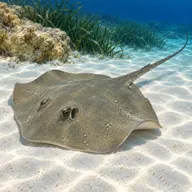
Common stingray
Often · Bokkatal-baħar
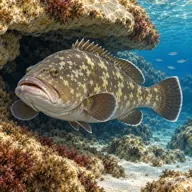
Dusky grouper
Often · Ċerna

Greater amberjack
Often · Aċċola · Late summer
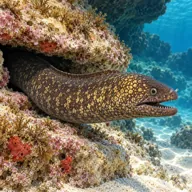
Mediterranean moray
Often · Morina
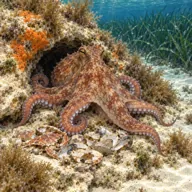
Common octopus
Often · Qarnit
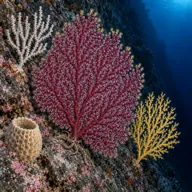
Encrusting sponges and gorgonians
Often
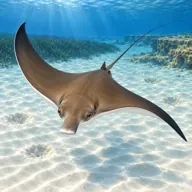
Eagle ray
Sometimes · Ħamiema · Summer
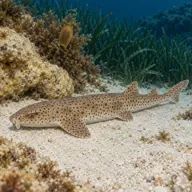
Small-spotted catshark
Sometimes · Gattarell
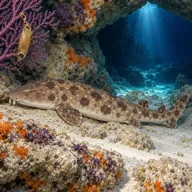
Nursehound
Sometimes · Gattarell tar-rukkal
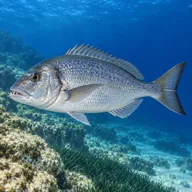
Common dentex
Sometimes · Dentiċi
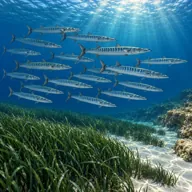
Barracuda
Sometimes · Lizz · Summer and autumn
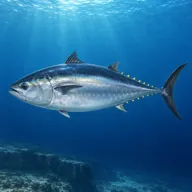
Atlantic bluefin tuna
Lucky day · Tonn · Summer
Getting in and staying safe
Boat only, roughly five kilometres out of Wied iż-Żurrieq, and the vessel must be commercially licensed to carry passengers. Written permission is required, arranged through the environment authority or via research and conservation organisations such as Sharklab Malta. Mooring and anchoring are both prohibited to protect the seabed, so every dive is a live drop and a live pick-up, which puts a premium on SMB discipline and on a skipper who knows what they are doing. Nothing on the island itself: landing is not part of the deal.
- Unexploded ordnance on the seabed, some of it live: do not touch or move anything
- Strong and variable currents around the islet
- The bottom runs past 70 m, so depth discipline and gas planning are critical
- No mooring, so live boating with no fixed reference to return to
- Completely unsheltered, with a long crossing back if the weather turns
- Permit and licensing requirements: diving without them is illegal
- Remote location with a slow evacuation to any chamber or hospital
A bit of history
Filfla covers only a few hectares and once carried a chapel built into a cave, destroyed by an earthquake in the sixteenth century. Local legend has it that the islet is the remains of a village swallowed by the sea as punishment for its sins. Its modern history is blunter: British forces used Filfla as a bombing and gunnery range for much of the twentieth century, steadily knocking the island down and carpeting the seabed with shells and bomb fragments. Target practice ended around 1971, and the island was later given full statutory protection as a nature reserve, which is why access is now restricted to scientific, educational and permitted purposes. Above water it is a seabird colony and home to an endemic subspecies of wall lizard found nowhere else.
Divers say
Sign in to rate this site and leave a note for the next diver.
- No reviews yet. First one gets bragging rights.
Further reading: Calypso Sub-Aqua Club: Filfla Island · Atlam Sub Aqua Club: Filfla dive site · Divers Guide: Filfla Island · MaltaDives: Filfla · Malta Info Guide: Filfla Island