🪸 Corals & anemones · Paramuricea clavata and Eunicella spp.
Gorgonian sea fans
Branching fans that turn deep walls into forest
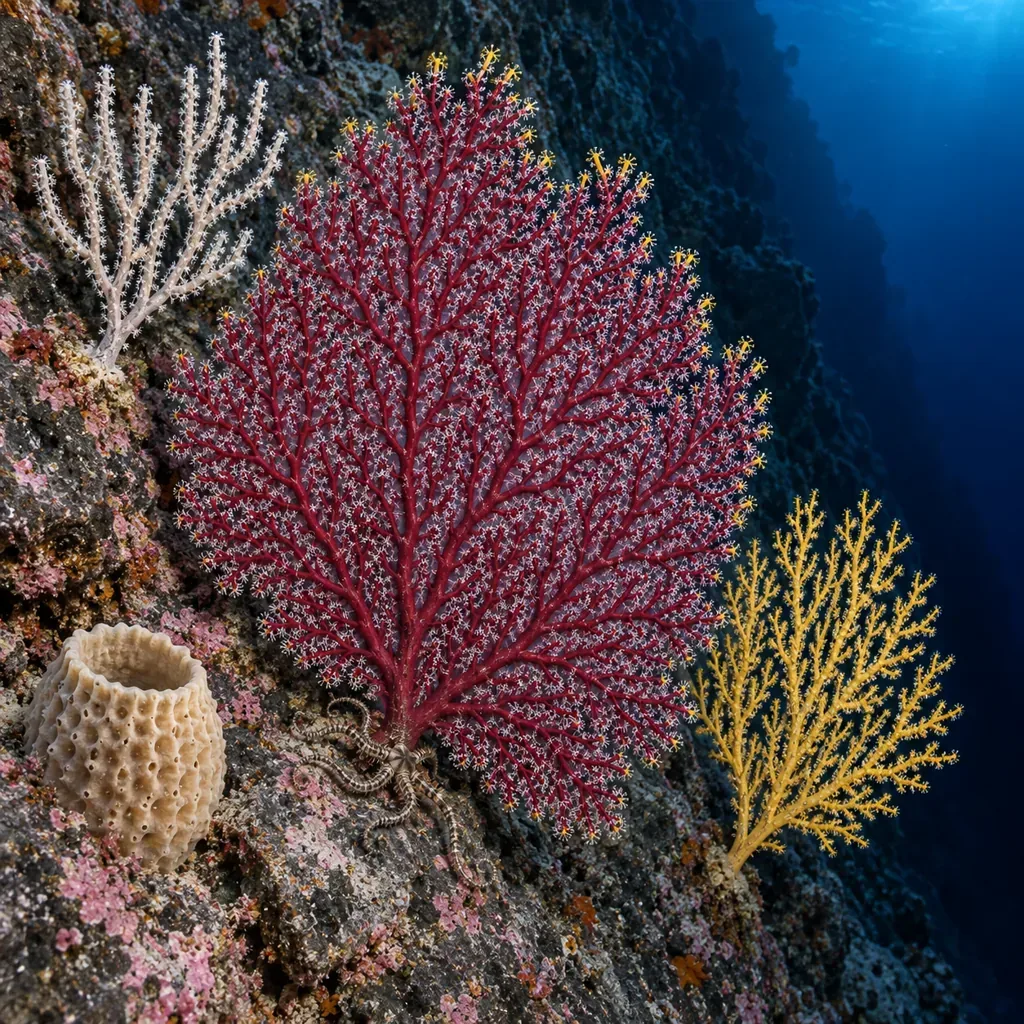
Meet the Gorgonian sea fans
Gorgonians are colonial soft corals that build a flexible horny skeleton and grow it into a flat fan set across the current, with hundreds of tiny eight-tentacled polyps studding every branch. Three species matter to divers here. Paramuricea clavata, the violescent sea fan, is the showpiece: deep red to purple, sometimes with yellow branch tips, growing to a metre tall on shaded rock from around 30 m down. Eunicella cavolini is the yellow one, smaller and more sparsely branched, comfortable from about 20 m. Eunicella singularis, the white gorgonian, is the pale candelabra of shallower, better-lit rock, and the only Mediterranean gorgonian to carry symbiotic algae in its tissue.
Malta and Gozo do not have the dense gorgonian forests of the northwest Mediterranean, but the deep walls deliver. At Reqqa Point the first significant fans appear around 20 to 30 m and the wall turns dark and austere below that; Fungus Rock, the Ras il-Ħobż pinnacle and the drop-offs off Comino and Delimara all carry fans in the 30 to 60 m band, alongside barrel sponges and, deeper still, black corals.
Fans are slow-growing, long-lived and brittle. A colony the height of your forearm may be several decades old, and warm-water summers of the kind the Mediterranean now gets regularly have caused mass die-offs of Paramuricea elsewhere in the basin.
When to look: All year; clearest in the calm, high-visibility spells of autumn and early winter.
Diving with them
- Look on shaded vertical rock facing the prevailing current, and on the outer faces of pinnacles rather than sheltered gullies
- At depth the red of Paramuricea reads black; a torch or a strobe brings the colour back instantly
- Search the branches for shy residents: long-clawed squat lobsters, brittle stars wrapped around the stems, and gorgonian-eating sea slugs
- Never hold on to a fan for stability or to steady a shot, and watch your hoses and console on the swing past
- Fans are the natural reference frame for wide-angle shots, so put a buddy in the far background rather than up close
Can it hurt you?Harmless
Harmless. The polyps cannot sting through skin and the branches are soft and flexible.
Easily confused with
- False black coral (Savalia savaglia) - yellow polyps on a thick, hard, dark branch, often started by overgrowing a gorgonian
- Black corals such as Antipathella subpinnata - finer, wiry, whitish feathery colonies on a brittle dark skeleton, usually deeper
- Sea whip (Leptogorgia sarmentosa) - loosely branched, whippy and usually on sediment-influenced bottoms rather than clean walls
Where to meet them: 10 sites
Forna Point
Gozo
Wied il-Mielah
Gozo
Further reading: Wikipedia - Paramuricea clavata · Wikipedia - Eunicella cavolini · Wikipedia - Eunicella singularis · Dive Shack Malta - Reqqa Point wall profile and marine life · IUCN - Red List of Mediterranean anthozoans factsheet