⭐ Echinoderms · Ophiuroidea, mainly Ophioderma longicauda
Brittle stars
Snake-armed stars that hide under every rock
Meet the Brittle stars
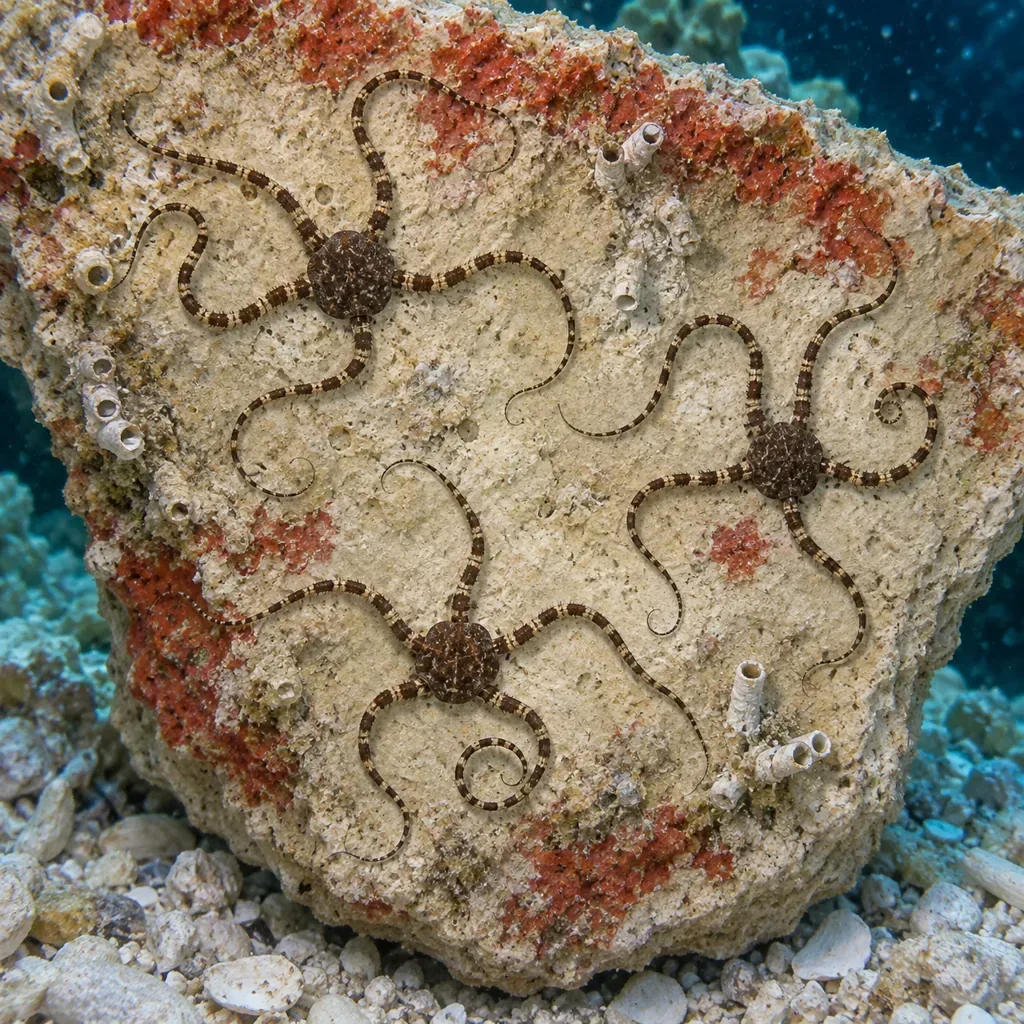
Brittle stars are starfish built the other way round: a small, neat central disc, usually one and a half to three centimetres across, with five thin, flexible, whip-like arms that are clearly separate from it rather than merging into it. The common Maltese species, Ophioderma longicauda, has a smooth-looking disc, often dark chocolate, olive or reddish-brown, sometimes finely mottled, and long banded arms that can give a span of fifteen to twenty-five centimetres. A second regular is Ophiothrix fragilis, much bristlier, with arms covered in fine glassy spines and colours running from orange to purple.
By day they are almost always hidden, packed into crevices, under loose boulders and slabs, and among the rhizomes at the edge of a Posidonia meadow, from a couple of metres down to a hundred. Lift a rock in the shallows at Ċirkewwa or Xlendi and you will often find several jammed underneath, which is exactly why you should put the rock back the way it was.
They do not walk on tube feet like a true starfish. They row, whipping two or three arms forward and dragging the disc after them in a surprisingly fast, spidery scuttle that is worth seeing at least once. At night they emerge, and the bristly kinds climb up onto sponges, gorgonian stems and wreck railings to hold their arms into the current and comb food particles out of the water. The name is earned: a grabbed arm snaps off on purpose, and grows back over the following weeks.
When to look: All year, but far more visible on night dives, when they come out of cover and climb onto anything that catches current.
Diving with them
- If you turn a stone to look, turn it back exactly as it was; a whole small community lives on the underside.
- Night dives are the easy way to see them properly, perched on sponges and wreck structure with arms held up into the flow.
- They flinch from torchlight, so approach with the beam edge rather than pointing straight at them, then let the light drift on.
- Do not pick one up. An arm will detach in your fingers, and the animal pays for your photo with weeks of regrowth.
- For macro, focus on the disc and let the arms run out of frame; trying to fit the whole animal in usually kills the composition.
Can it hurt you?Harmless
Completely harmless to divers. They have no venom and no sting, and the only thing at risk in an encounter is the brittle star's arm.
Easily confused with
- Common brittle star (Ophiothrix fragilis) — obviously spiny, hairy-looking arms and brighter orange or purple tones, usually perched up in the current rather than hidden under rock.
- Mediterranean basket star (Astrospartus mediterraneus) — far larger, with arms that branch repeatedly into a tangle; a deep-reef animal that wraps itself around gorgonians.
- True starfish — arms merge smoothly into the disc and move on tube feet; brittle star arms are clearly jointed on and move by rowing.
Where to meet them: 5 sites
Further reading: Atlantis Gozo Diving: Ophioderma longicauda around Malta · SeaLifeBase: Ophioderma longicauda · European Journal of Taxonomy: the Ophioderma longicauda cryptic species complex · Scientific Reports: mitochondrial phylogeny of Ophioderma