🐟 Fish · Sphyraena viridensis
Mediterranean barracuda
Lizzin Maltese, also Alluzz, Allozz
A silver spear that hangs in the blue
Meet the Mediterranean barracuda
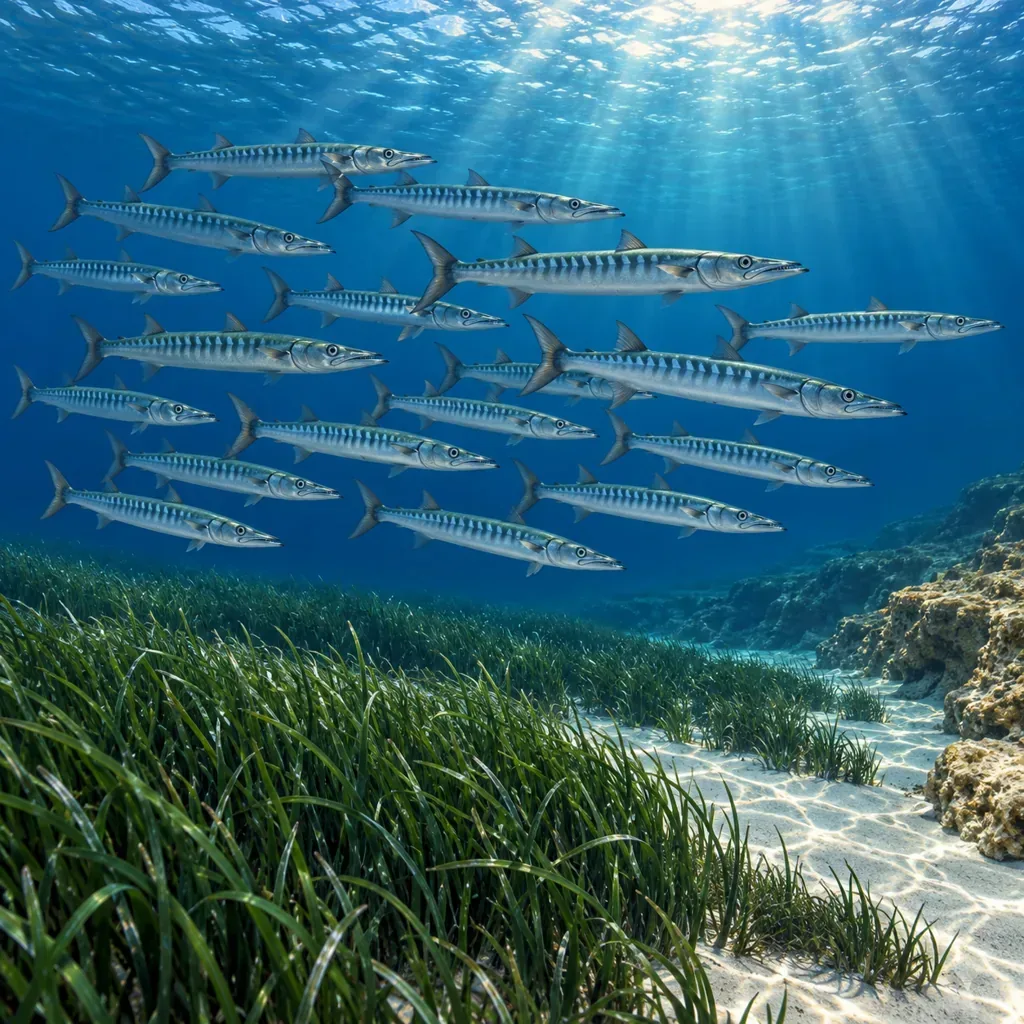
A long, cylindrical, silver fish built like a torpedo, with a pointed head, a jutting lower jaw and a mouth full of fang-like teeth. The back is grey-green, the flanks are bright silver and usually carry a set of faint dark chevrons or bars that flicker on and off, and there are two widely separated dorsal fins with a forked tail at the back. The inside of the mouth is yellowish in this species, which is where the alternative name yellowmouth barracuda comes from.
Juveniles and young adults form tight, slow-drifting shoals that hover almost motionless over seagrass and rocky shallows, turning as one and often letting divers come surprisingly close. Older fish go solitary or pair up and patrol the blue along drop-offs. Around Malta, Gozo and Comino they are now a common sight from about 3 m to 40 m, over Posidonia, along walls and hanging above wrecks, and in some years shoals of several hundred build up at particular sites.
Two barracuda species occur here and have long been confused: the European barracuda Sphyraena sphyraena and this one, the yellowmouth barracuda, which is a warm-water species that has become markedly more common in the Mediterranean as the sea has warmed. Maltese fishermen call both lizz, and older Maltese sources also use alluzz or allozz.
When to look: Most reliable from late spring through autumn in warm water, with shoals often hanging in the shallows at dawn and dusk.
Diving with them
- Approach a shoal obliquely and slowly, never straight at it, and stop finning as you get close; the shoal will usually open and re-form around you
- Breathe long and slow, as bursts of bubbles are what actually breaks a shoal up
- Look into the blue above seagrass rather than at the reef itself, since a stationary shoal is easy to swim right under
- Wide angle and available light work far better than strobes, which just bounce off the silver flanks
- Avoid dangling shiny gauges, dive knives or a hand full of jewellery in murky water, as glints are what provoke the very rare curious pass
Can it hurt you?Handle with care
Barracuda ignore divers and there is no history of unprovoked attacks on divers in Maltese waters. The real risk is from handling a hooked or speared fish, whose jaws and teeth can cause a deep slashing bite; in poor visibility a flashing metallic object can very occasionally draw a curious rush.
First aid: Control bleeding with firm direct pressure, irrigate the wound thoroughly with clean water, and get medical attention the same day for wound cleaning, antibiotics and a tetanus check.
Easily confused with
- European barracuda (Sphyraena sphyraena) is smaller, has a darker mouth lining and its dark bars sit mostly above the lateral line
- Yellowstripe barracuda (Sphyraena chrysotaenia, Lizz tal-lvant) is a small Lessepsian arrival with a clear yellow flank stripe
- Garfish (Msella) is far more slender with a long thin beak and a green skeleton, and swims right at the surface
Where to meet them: 55 sites
Further reading: Sammut, Dangerous creatures of the Maltese sea Part 2 (Lizz, bite risk) · Sea Stuff – barracuda in Malta and Gozo · Merciai et al. 2020 – activity patterns of the range-expanding Sphyraena viridensis · Wikipedia – Sphyraena viridensis · Il-Miklem – Lizz