Ras il-Hobz · Gozo
Middle Finger
Gozo's most famous pinnacle, a single column of coralline limestone whose splayed summit sits around 8 to 10 metres down while its outer face drops past 90 metres into the dark.
Sea conditions
Excellent right now
Flat, sheltered and calm
Forecast for the site, updated 01:45 AM
- Waves
- 0.3 m
- from SE
- Wind
- n/a
- Swell
- 0.2 m
- 5 s period
- Sea temp
- 29 °C
Next 7 days
Exposed to wind and swell from: E (90°), SE (135°), S (180°), SW (225°). Well sheltered from the north westerly, which makes it a dependable summer standby. Any south or east in the forecast puts chop on the swim out and turns the exit into a scramble. Current is usually mild but can pick up on the outer face. Best season: June to October, when the water is 24 to 27 degrees and visibility regularly runs 30 m or better..
The dive
Everybody gets the same reaction the first time. You leave the shallows, swim out over ground that keeps getting deeper, and just as you start to wonder whether you took the wrong bearing, a wall of rock rises up in front of you and keeps rising until it is above your head. The summit splits into five stubby prongs, and one of them is longer than the others, which is how the site got its cheerfully rude nickname.
The geometry is the whole point. Between the pinnacle and the land is a channel about 35 metres deep, which makes for a tidy recreational circuit. Swim round to the seaward face, though, and the bottom simply leaves. Technical teams work the outer wall on trimix, and at roughly 63 metres there is a large three pronged anchor wedged into the rock, a favourite turnaround landmark for people with the right gas and training.
Recreational divers get the best of it anyway. The top third of the column is plastered in tube worms and algae, and the fissures are reliably occupied by moray, octopus and the occasional slipper lobster. Clouds of damselfish and bogue hang off the summit, and they draw in the fast movers: amberjack, dentex and, in late summer, barracuda that seem entirely unbothered by divers.
The swim is honest work. Reckon on ten minutes each way from either entry point, which on a windless day is fine and on a lumpy day is a proper effort. Do it on the surface going out and save the gas for where it counts.
- The reveal, when the column appears out of open blue
- Five pronged summit at 8 to 10 m with fish stacked around it
- A 35 m channel and a 90 m wall from the same shore entry
- The three pronged anchor at 63 m for suitably qualified teams
Typical plan
Surface swim out on a compass bearing for eight to ten minutes, descend on the edge of the drop, and cross the channel at around 30 metres keeping the slope on one shoulder. Arrive at the base of the column, spiral up its flank to the summit at 9 or 10 metres, and spend the back half of the dive circling the top while the pelagics do their laps. Return over the shallow reef and off gas at 5 metres. Forty to fifty minutes on a 12 litre, nitrox 32 strongly recommended, and nitrox 28 or trimix if you intend to go past 40.
What the bottom looks like
- 1Split in the rock holding lobster and octopus11 m deep · 60 m out
- 2Archway on the approach, 6 m to 15 m12 m deep · 130 m out
- 3Channel floor between headland and pinnacle35 m deep · 205 m out
- 4Five pronged summit of the Middle Finger9 m deep · 225 m out
- 5Vertical outer face of the column40 m deep · 245 m out
- 6Three pronged anchor stuck in the wall63 m deep · 275 m out
- 7Seaward drop beyond sport limits95 m deep · 305 m out
Bare coralline limestone column skirted by coarse sand and broken rubble at the base of the channel.
Who you might meet
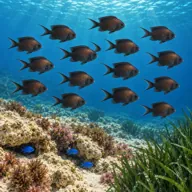
Damselfish
Almost always · Cawlija

Bogue
Almost always · Vopi
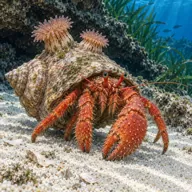
Hermit crab
Almost always
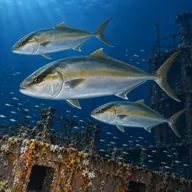
Greater amberjack
Often · Aċċola · Late summer
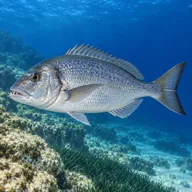
Common dentex
Often · Dentiċi
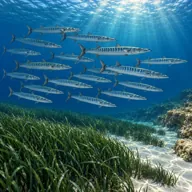
Mediterranean barracuda
Often · Lizz · Summer and autumn
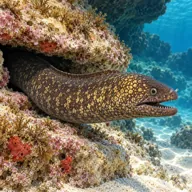
Mediterranean moray
Often · Morina
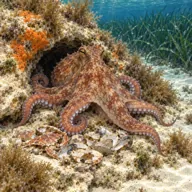
Common octopus
Often · Qarnit
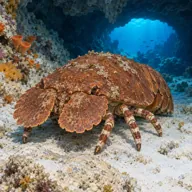
Slipper lobster
Sometimes · Ċikala
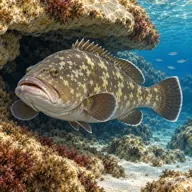
Dusky grouper
Sometimes · Ċerna
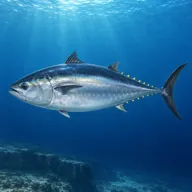
Atlantic bluefin tuna
Lucky day · Tonn · Summer
Getting in and staying safe
Same approach as the wider Ras il-Hobz site: the field lane out of Ghajnsielem, then park on the open rock of the headland. Entry and exit are from flat rock beside the treatment works outfall pipe, with a second option on the other side of the point if the wind favours it. No ladder, no steps, no facilities. Swim out on the surface, take a bearing on the far shore before you descend, and agree a turn point with your buddy because the pinnacle is easy to overshoot in poor visibility.
- The seaward face is effectively bottomless, easy to exceed your plan
- Ten minute swim each way, gas and fatigue management matter
- Narcosis on the deeper channel crossing at 30 to 35 m
- Open water navigation, an SMB is sensible before ascending
- Sharp rock entry and exit, no ladder
- Boat traffic in the Gozo channel
A bit of history
No wreck story here, just geology. The pinnacle is a detached stack of Lower Coralline Limestone, the oldest and hardest rock in the Maltese sequence, left standing when the softer material around it was cut away by the sea. The headland it sits off guards the entrance to Mgarr ix-Xini, the Knights' old galley creek, overlooked since 1661 by the largest of Gozo's coastal watchtowers.
Divers say
Sign in to rate this site and leave a note for the next diver.
- No reviews yet. First one gets bragging rights.
Further reading: Atlantis Gozo Diving site guide · Blue Waters Dive Cove site spotlight · Ritual Dive site description · Divers Guide conditions and logbook data · Calypso Sub Aqua Club site notes