🦞 Crustaceans · Dardanus spp.
Hermit crabs
A borrowed shell that gets up and walks
Meet the Hermit crabs
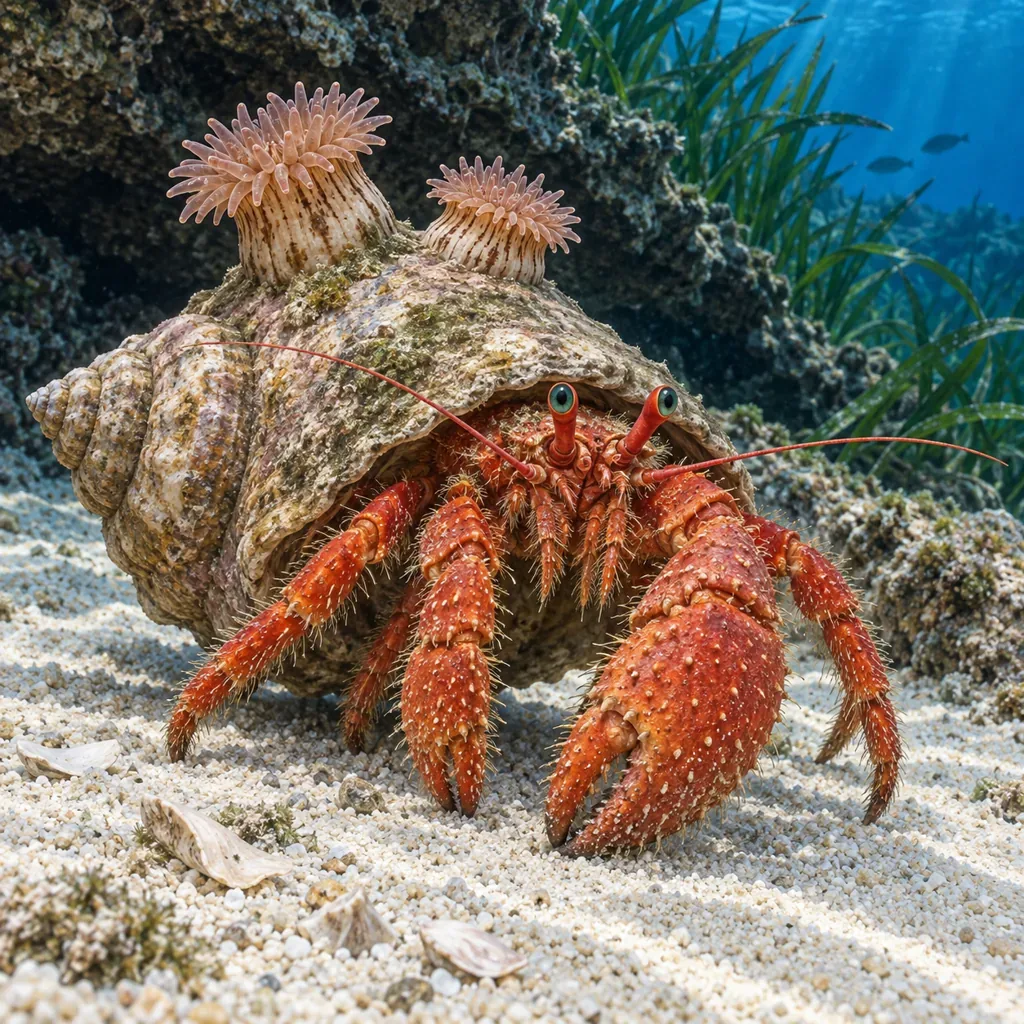
Malta's big hermit crabs are the red hermit crab (Dardanus calidus) and the greater hermit crab (Dardanus arrosor). Both are startlingly colourful once you light them: scarlet to orange-red legs and claws, often furred with fine hair, and stalked eyes with green or blue highlights. The left claw is much the larger and works as a door, plugging the shell mouth when the animal pulls in. Body length reaches about 10 to 12 cm, and they carry correspondingly large gastropod shells, usually old tun or triton shells. Two much smaller species also turn up: the dark, red-legged Clibanarius erythropus in shallow pools and the tiny Calcinus tubularis under stones.
The big ones live on rocky reef, mixed sand and rubble, and the edges of Posidonia meadows, from a couple of metres to 100 m, with most sightings between 5 and 40 m. They are scavengers, working over anything dead or rotting, and they are permanently busy, so a hermit crab is one of the easier animals to watch behaving naturally.
The detail worth knowing is the anemone. Dardanus commonly carries one or more Calliactis parasitica anemones cemented to its shell. The anemone's stinging tentacles deter octopus, and the crab gets the scraps thrown up by the crab's feeding. When it changes shell it carefully prises the anemones off the old one and presses them onto the new.
When to look: All year, day or night; the largest animals are most often out in the open after dark.
Diving with them
- Watch any shell that is moving faster than a snail should; that is almost always a hermit crab.
- Check the shell for Calliactis anemones before you frame the shot, because the pairing is the story.
- Get low and shoot at eye level; from above they read as just a shell, from the front you get the claws and the coloured eyes.
- If you find two crabs facing off over a shell, hold still and film it, as shell swaps and shell fights are quick and worth seeing.
- Never pull a hermit crab out of its shell or offer it an empty one you have picked up; empty shells are a limited resource on the reef.
Can it hurt you?Handle with care
A big Dardanus can give a firm nip with the large left claw if you pick it up, and the Calliactis anemones on its shell carry stinging cells that can leave a mild itch on thin skin.
First aid: Rinse a nip with clean water and disinfect it. For anemone contact, rinse with seawater rather than fresh water, do not rub, and treat any lasting itch with a soothing cream.
Easily confused with
- Live gastropods such as tritons, which move slowly on a fleshy foot rather than on jointed red legs
- Small hermit crabs (Clibanarius erythropus, Calcinus tubularis), which are a few centimetres across and lack the big red claws
- Sponge crab (Dromia personata), which carries a cut piece of sponge over its back instead of a shell
Where to meet them: 7 sites
Slugs Bay
Malta
Tent Peg Wreck
Malta
Further reading: Diveshack Malta: Dardanus calidus · Diveshack Malta: Dardanus arrosor · Wikipedia: Dardanus calidus · Wild Plants of Malta and Gozo: Clibanarius erythropus