Malta
Douglas A-1 Skyraider
An almost intact American attack aircraft sitting upright on sand at 96 metres off Benghisa Point. One of Malta's flagship deep trimix dives, and a permit-only site.
Sea conditions
Good right now
Some chop (0.5 m E)
Forecast for the site, updated 01:46 AM
- Waves
- 0.5 m
- from E
- Wind
- n/a
- Swell
- 0.5 m
- 5 s period
- Sea temp
- 29 °C
Next 7 days
Exposed to wind and swell from: E (90°), SE (135°), S (180°), SW (225°), W (270°). An offshore boat site with no shelter of any kind. The team needs a flat sea and light wind, both to hold the shot and to spend an hour hanging on decompression in open water. Southerly and easterly swell rules it out completely, and most operators want a forecast of a metre or less before they will run it. Best season: May to October, with the settled spells in June and September the most reliable. Summer thermoclines do nothing for the bottom, which stays cold all year..
The dive
The Skyraider is small, tidy and astonishingly complete. Twelve metres of aeroplane with a fifteen metre wingspan, sitting square on clean sand with its undercarriage up, looking more parked than crashed. At 96 metres the light is thin and the colour has gone, so what you get is shape: the big radial cowling, the four blade propeller, the open canopy with its armour plate behind the seat.
Bottom time is measured in minutes and run time in hours. Trimix, full redundancy, a team that has worked together and a plan everybody has rehearsed are the entry requirements, and the wreck sits under Heritage Malta's protection, so the permit and an approved operator come before anything else.
What makes it worth the decompression is the story attached. The aircraft was located in 2009 and opened to divers in 2020, by which point it had spent more than seventy years on the bottom with almost nothing to disturb it. The pilot walked away from the ditching, which puts this in the rare category of wreck you can visit without a memorial attached.
- A nearly intact aircraft standing upright on clean sand
- The four blade propeller and open canopy, both still in place
- A wreck tied to the first recorded helicopter rescue in the Mediterranean
- One of the deepest permitted dives in Maltese waters
- Zero silt, so the visibility on the bottom is usually superb
Typical plan
Reckon on a run time of two to two and a half hours for around 12 to 15 minutes on the aircraft. A typical team dives a hypoxic trimix in the region of 10/70 with travel and decompression gases staged on the line, descends the shot at a controlled rate, makes one circuit of the airframe against a strict turn time, and returns to the line for a long staged ascent finishing on oxygen at 6 metres. Support divers meet the team in the mid water stops with spare gas and drinks. This is a planned project dive with a surface team, not something to bolt onto a week's holiday.
What the bottom looks like
- 1Nose and radial engine cowling96 m deep · 95 m out
- 2Four blade propeller96 m deep · 103 m out
- 3Open cockpit canopy and armour plate96 m deep · 112 m out
- 4Wings and tail section, still attached96 m deep · 128 m out
- 5Flat sand seabed around the airframe97 m deep · 140 m out
Flat, featureless fine sand with no relief at all for hundreds of metres in any direction.
Who you might meet


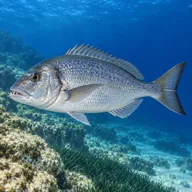
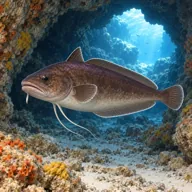
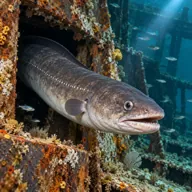




Getting in and staying safe
Boat only, and only through a registered dive centre or club holding the Heritage Malta permit. Charters run out of Birżebbuġa, Marsaxlokk and nearby harbours for the short ride to a point roughly a kilometre off Benghisa Point. Expect a shot line, one or two support divers, decompression gas staged on the line and a surface team watching the clock and the shipping. Nothing about this dive is self organised, and nobody sensible tries.
- 96 metres, with gas density, narcosis and high pressure nervous syndrome all in play
- Long decompression obligation, typically well over an hour of stops
- Current at depth and along the shot line
- Freeport and commercial shipping traffic on the surface, the boat must be well marked
- Permit required, diving it without one is an offence
- Cold and darkness on the bottom, redundant lighting and thermal protection essential
- No bail-out to the surface, every problem has to be solved in the water
A bit of history
Douglas designed the A-1 Skyraider as a late war attack aircraft, although production only got going in 1946. More than three thousand were built and the type soldiered on for decades, the last propeller driven attack aircraft the United States Navy bought. This one, serial 09236, was one of four flying mail between Ħal Far airfield in Malta and the carrier USS Midway. In December 1947, minutes after take off, the engine failed completely. Lt Robert H. L. Reeb ditched flat with gear and flaps up at around 75 to 90 knots. The aircraft floated for roughly ninety seconds, long enough for him to climb out and inflate the emergency dinghy, and a Sikorsky HO3S Dragonfly from the Midway picked him up in what is recorded as the first helicopter rescue in the Mediterranean. The wreck was rediscovered in 2009 and opened to divers on 1 August 2020 under Heritage Malta management.
Divers say
Sign in to rate this site and leave a note for the next diver.
- No reviews yet. First one gets bragging rights.
Further reading: Underwater Malta, Douglas A-1 Skyraider · Heritage Malta, Douglas A-1 Skyraider · Wrecksite, Douglas A-1 Skyraider · Malta Dive Sites, Douglas A-1 Skyraider