🐟 Fish · Phycis phycis
Forkbeard
Lipp tal-qawwiin Maltese, also Lipp il-baħar tal-qawwi, Lipp
Cave loafer with a chin whisker and silky fins
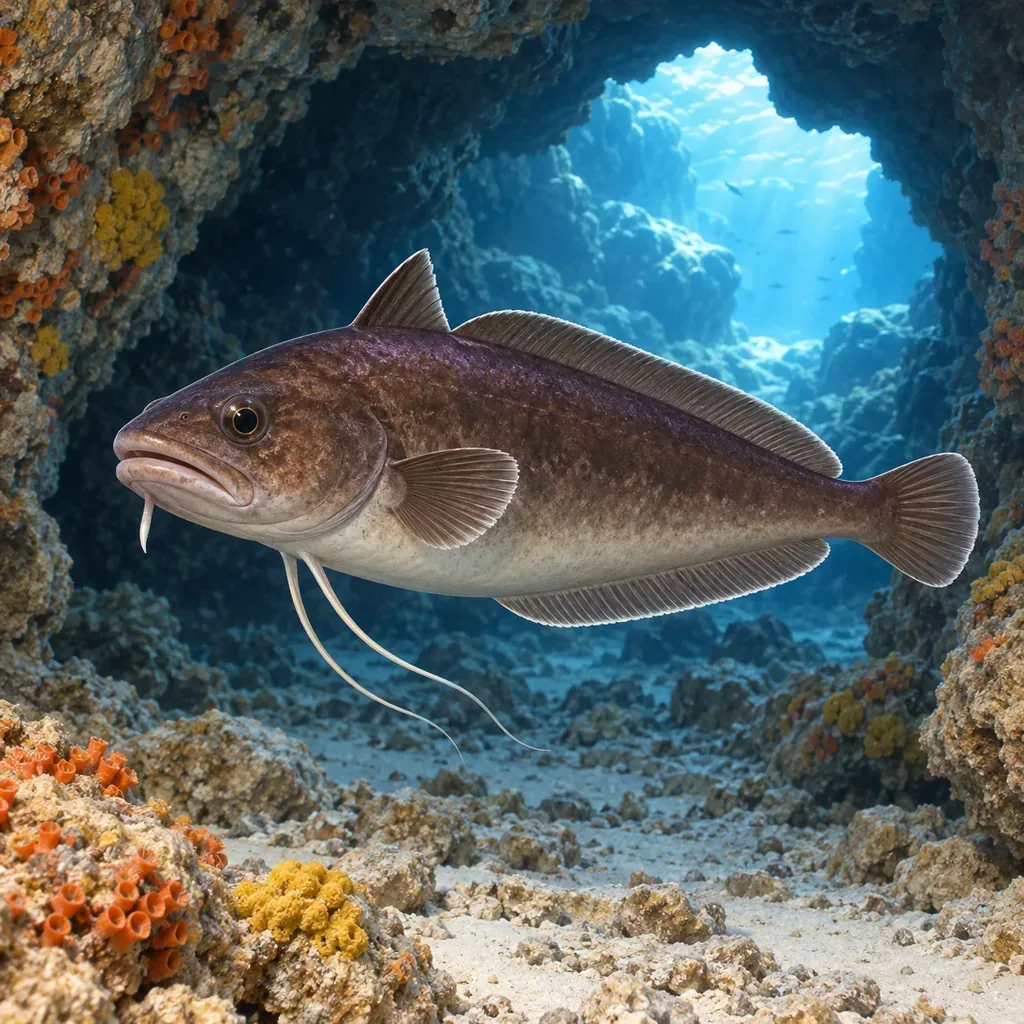
Meet the Forkbeard
A soft-bodied relative of the cod, built like a small, sad-eyed hake. The body is chocolate to grey-brown, sometimes almost purple in torchlight, with a paler belly and thin pale edging on the fins. The head is blunt with a large mouth and a single short barbel under the chin. The second dorsal fin and the anal fin are long and low and run almost to the tail, giving it a rippling, skirted outline, and the pelvic fins are reduced to a pair of long trailing filaments that it holds out in front like feelers.
It is a night fish and a cave fish. By day it lies up under overhangs, in the back of caverns and in rock crevices, usually hanging motionless a few centimetres off the floor. It comes out after dark to hunt small fish, crabs and shrimp over rock and sand. Most are 25 to 35 cm; the maximum is about 65 cm.
Around Malta, Gozo and Comino it is one of the classic finds of a cave dive - Santa Marija Caves, Billinghurst, the Inland Sea tunnel and the overhangs along the Gozo cliffs all hold them - and it also appears deeper on the walls. Divers meet it from about fifteen metres down, and it becomes commoner with depth.
When to look: All year; cave dives at any time of day and open-reef night dives are both good, and it is easiest to find in the dark.
Diving with them
- Sweep the torch along the floor at the back of caverns and under big overhangs - it sits still and is easy to miss
- Keep the beam off its eyes; a soft edge of light rather than a direct hit will let you watch it for far longer
- The two long pelvic filaments held forward are the quickest identification in a torch beam
- It hovers almost motionless, which makes it a rare gift for cave photography if you get your buoyancy sorted first
- Be careful of your fins near it - the silt in the back of a Maltese cavern lifts instantly and ends the encounter
Can it hurt you?Harmless
Harmless. It is a soft-finned fish with no venomous spines, and it will simply back away into the rock if you get close.
Easily confused with
- Greater forkbeard (Phycis blennoides) - paler, slimmer, lives deeper and has an even longer pelvic filament
- Shore rockling (Gaidropsarus mediterraneus) - smaller, with several barbels around the snout rather than one under the chin
- A juvenile conger, which is eel-shaped with no separate tail fin
Where to meet them: 40 sites
HMS ML 130
Malta
Further reading: FishBase - Phycis phycis · Il-Miklem - Lipp il-baħar tal-qawwi / Phycis phycis · Vassallo History - Maltese, English and Latin fish names