Malta
Anadrian
A forty metre working dredger sunk in 1999 and now sitting upright on sand at around 65 metres off the north east coast, squarely in trimix country. Short bottom time, long ceiling, and a boxy industrial hull that photographs beautifully in the blue.
Sea conditions
Excellent right now
Flat, sheltered and calm
Forecast for the site, updated 01:47 AM
- Waves
- 0.4 m
- from ESE
- Wind
- n/a
- Swell
- 0.4 m
- 5 s period
- Sea temp
- 29 °C
Next 7 days
Exposed to wind and swell from: N (0°), NE (45°), E (90°), NW (315°). An offshore site with nothing to hide behind. Anything with north or east in it builds a swell that makes shotting and decompression unpleasant, and skippers will call it off early rather than risk a team hanging in chop. The settled, windless mornings of late spring and summer are what you are waiting for. Best season: June to October, with the calmest water and warmest decompression usually falling in August and September..
The dive
The Anadrian spent her life scooping spoil out of Maltese harbours, which is not glamorous work, and she looks the part: a stubby steel box with a grab derrick, winches and a lot of flat deck. That plainness is exactly what makes her a satisfying tech dive. Nothing is hidden behind fussy superstructure, so a team arriving on the shot can read the whole layout in the first minute and spend the rest of the bottom time actually looking at things.
She sits upright and true on a pale sand plain, and at 65 metres the light is that flat cobalt that makes steel look almost black. The hull is intact enough to swim the full length at deck level, roughly 58 to 62 metres depending where you are, then drop to the sand for a keel level pass on the way back to the line. Machinery spaces are open in places, but this is not a wreck people penetrate for the sake of it, and there is little reward for squeezing into a dredger's innards.
Plan it as a proper decompression dive with a real gas plan. Fifteen to twenty minutes on the bottom is a generous, honest allowance, and it is plenty. Boats run out from the Sliema and St Paul's side, the surface is often glassy in summer, and the ride back gives you the whole north east coastline while you breathe off your oxygen.
- An intact working dredger, unusual among Malta's scuttled fleet
- Upright on clean sand with the full length swimmable at deck level
- Her original steam engine survives ashore in the Maritime Museum
- Quiet site with far fewer teams on it than the headline tech wrecks
Typical plan
Trimix, twinset or rebreather, and two decompression gases. Descend the shot to the after deck at roughly 58 metres, swim forward along the deck line past the winches and derrick to the bow, then drop to the sand at 65 metres for a slower return along the hull side. Fifteen to twenty minutes bottom time gives a full tour without an absurd ceiling. Back to the shot with plenty of gas in reserve and expect somewhere around forty to sixty minutes of decompression depending on your mix and your conservatism.
What the bottom looks like
- 1Shot line onto the after deck58 m deep · 17 m out
- 2Open machinery space, engine long since removed59 m deep · 30 m out
- 3Grab derrick and winch gear60 m deep · 45 m out
- 4Bow and forward hull plating62 m deep · 58 m out
- 5Sand plain running out from the hull65 m deep · 85 m out
Flat, pale sand with almost no relief, which is why the black hull stands out so sharply.
Who you might meet
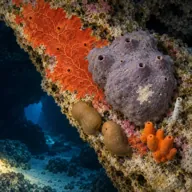
Sponges and encrusting growth
Almost always · Sponża
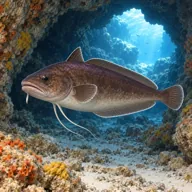
Forkbeard
Often · Lipp

Cardinalfish
Often · Re tat-trilji

Greater amberjack
Sometimes · Aċċola · Summer and autumn
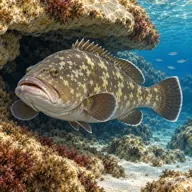
Dusky grouper
Sometimes · Ċerna
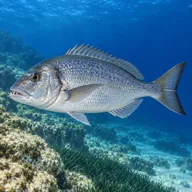
Common dentex
Sometimes · Dentiċi
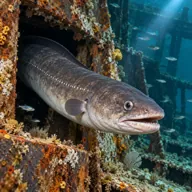
Conger eel
Sometimes · Gringu
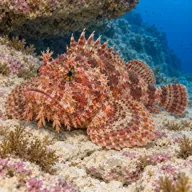
Red scorpionfish
Sometimes · Ċippullazza

Stingray in the surrounding sand
Lucky day · Bumarin
Getting in and staying safe
Boat only, and realistically only with a centre that runs technical charters. There is no shore option and no sensible swim. Expect a shot line onto the wreck, a live boat or a trapeze for decompression, and a crew who will want to see your certification and your gas plan before you kit up. Departure is usually from the harbours on the north east side of the island, with a run of twenty to forty minutes depending where you leave from.
- Depth of 60 to 65 metres, well beyond recreational limits and requiring trimix and staged decompression
- Narcosis and gas density if anyone is tempted to dive it on air
- Open water decompression with any current that runs at the surface
- Snagged fishing line and net on a wreck that sits in worked ground
- Silt inside the machinery spaces if you go in
- Long surface interval offshore, so sun, seasickness and dehydration all bite
A bit of history
Anadrian was built in 1952 as a grab dredger, roughly 40 metres long and 9 metres in the beam, and she worked Maltese waters until she was taken out of service in 1989. She lay idle for about a decade before being deliberately sunk in 1999. Her triple expansion steam engine was a genuinely notable piece of Victorian style marine engineering by the time it came out, and rather than let it corrode away at 65 metres it was removed along with other fittings and put on display at the Malta Maritime Museum in Birgu. The hull itself was left to become a dive site, and it has held up well.
Divers say
Sign in to rate this site and leave a note for the next diver.
- No reviews yet. First one gets bragging rights.
Further reading: Malta Dive Sites: Anadrian · Wrecksite entry for Anadrian · DIVE Magazine, Malta's wreck dives · Divernet on Maltese wreck protection zones