B-24 Liberator Bomber
An American four engine heavy bomber that ditched off southern Malta in May 1943, found again in 2015 and opened to permitted technical divers in 2020. It lies upright on sand at about 55 metres with both wings spread and the engine nacelles unmistakable. It is also a war grave.
 Wreck
 Aircraft
Sea conditions
Stay dry right now
Sea is up (3.2 m W) · Fresh WNW wind (30 km/h) · Gusts to 46 km/h
Done for today. Tomorrow: not looking good. Best it gets is 23 at 17:00: Sea is up (1.3 m W)
Forecast for the site, updated 19:45 · Models disagree
Measured at Delimara (5.3 km away, 19:44): 23 km/h from WNW, gusts 40. The next hours lean on it.
- Waves
- 3.2 m
- from W, biggest 4.7
- Wind
- 30 km/h
- WNW, gusts 46
- Swell
- 0.5 m
- 10 s period
- Sea temp
- 22 °C
- air 19 °C
Hour by hour
Next 7 days
 0 3.3 m
48 W
 0 3.2 m
46 WNW
57 0.8 m12 W
 85 0.4 m
13 ESE
78 0.5 m12 E
 72 0.6 m
17 N
77 0.5 m15 SSE
Sunrise 06:25, sunset 17:05
Waves: Copernicus Med-Waves 4 km + MFWAM 8 km + EWAM 5 km + ECMWF WAM 9 km. Wind: ICON-2I 2 km + ECMWF IFS 9 km + ICON-EU 7 km + UKMO 10 km + ARPEGE 11 km. Read a few km out on the side the site is open to, then blended.
Exposed to wind and swell from: E (90°), SE (135°), S (180°), SW (225°). An offshore site off the south east corner of the island with nothing to hide behind on the seaward sectors. Skippers want a settled forecast, because hanging a team on a trapeze in open water off this coast is no fun in swell. Summer mornings before the sea breeze fills in are the usual window. Best season: June to October, with July to September giving the best run of flat mornings and the warmest decompression..
The dive
You arrive at a rectangle of open water off the south east corner of Malta, drop down a shot into that particular southern blue, and at somewhere around fifty metres a shape resolves that your brain refuses to file as a wreck for a second or two, because wrecks are ships. Then the wings arrive. Thirty three metres of them, laid flat on pale sand, with four engine nacelles along the leading edges and a couple of propellers still in place.
The airframe is battered in exactly the way the story predicts. She hit the water with the undercarriage down, flipped, floated upside down for a few minutes and went down tail first, so the nose is destroyed, the cockpit is torn open and the tail section is broken and folded under the fuselage. What survives is startlingly legible: machine gun positions, oxygen cylinders, the structure of the wing. Corals and sponges have started to take the metal but nowhere near enough to disguise what it is.
Dive it with the right attitude. One of the ten crew was never recovered and the site is treated as a war grave, so nothing gets touched, nothing gets moved, and nothing comes home in a pocket. Heritage Malta manages access and a permit is required, arranged through one of the centres licensed to run it. Bottom time will be short, the ceiling will be long, and it is entirely worth it.
- A 33 metre wingspan laid out flat on clean sand
- Engine nacelles with propellers still attached
- One of Malta's Heritage Malta managed historic wreck sites
- A genuine 1943 ditching with a documented crew and a story that ended in 2023
- Rarely dived, so almost always yours alone
Typical plan
Trimix with two decompression gases, twinset or rebreather, and a permit in hand. Down the shot to the fuselage at around 55 metres, then a deliberate circuit: out along one wing past the nacelles, forward to the ruined nose and open cockpit, back down the fuselage to the folded tail, and out along the second wing. Fifteen to twenty minutes on the bottom covers the whole airframe without rushing. Back to the line, then expect roughly forty five to seventy minutes of decompression. Touch nothing.
What the bottom looks like
- 1Shot line onto the fuselage55 m deep · under the boat
- 2Wing with engine nacelles and surviving propellers56 m deep · 12 m from the boat
- 3Torn cockpit and destroyed nose56 m deep · 26 m from the boat
- 4Broken tail section folded beneath the fuselage56 m deep · 38 m from the boat
- 5Second wing and outboard nacelles56 m deep · 50 m from the boat
- 6Sand plain around the airframe56 m deep · 68 m from the boat

Flat, pale sand, which is why the airframe reads so clearly from the moment it comes into view.
Who you might meet

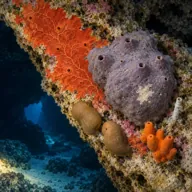
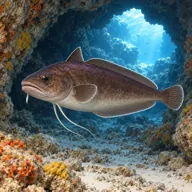


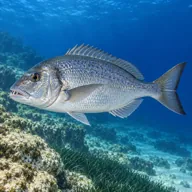

Lucky day
Marked ones can hurt you. What they do and what to do about it is under Getting in and staying safe.
Getting in and staying safe
Boat only, and only through a dive centre authorised to run Heritage Malta permitted historic wreck dives. Boats typically leave from Marsaxlokk or the south east harbours, with a short run out. Expect paperwork, a briefing on the protected status, verification of technical certification and experience, and a shot line laid by the crew. There is no shore option and no unpermitted diving on the site.
Where the boat stops
Permit only. Dived only through a centre registered with Heritage Malta, from a boat with AIS and clearance from Valletta or Marsaxlokk VTS. Nobody else may stop inside the protected area around it.
A war grave. Touch nothing and take nothing.
Positions as charted (WGS84) in Transport Malta Notice to Mariners 02 of 2024, archaeological zones at sea . Check the latest notice before you rely on them.
- Fifty five metres plus, requiring trimix and staged decompression
- Protected war grave status, with legal consequences for interfering with the site
- Sharp torn aluminium and jagged cockpit edges
- Fishing nets and line, which have had to be cleared from the airframe before
- Current at depth and on the decompression stops
- Exposed offshore position with no shelter if the weather turns
Marine life to respect

Common stingray · Boll Can hurt you
Whips a barbed tail if stepped on or cornered. Stay off the sand and give it room.
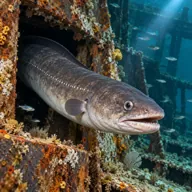
Conger eel · Gringu Can hurt you
Crushing bite if a hand goes into its hole. Look in from a distance and keep fingers out.
A bit of history
The aircraft is a Consolidated B-24 Liberator, an American four engine heavy bomber roughly 20 metres long with a 33 metre wingspan, of which more than 18,000 were built. This one, serial 42-40112, took off from a USAAF field in Libya on 6 May 1943 as part of a raid on Reggio Calabria in southern Italy, where she was hit by anti aircraft fire. With engines failing the crew turned for Malta, which was routinely used as a haven by damaged aircraft coming back from Sicily and Italy. Landing attempts at Luqa failed and she was ditched in the sea off Benghisa Point with the undercarriage still down, flipping onto her back on impact. Nine of the ten men aboard were rescued by the RAF. The tenth, Sergeant Irving R. Newman, was missing for eighty years until his remains were identified in August 2023. The wreck was located by a remote sensing survey in 2015, surveyed in 2016 by the University of Malta with the Armed Forces of Malta, excavated in 2018 and 2019 with support from the US Defense POW/MIA Accounting Agency, and opened to divers on 1 August 2020.
Divers say
Sign in to rate this site and leave a note for the next diver.
- No reviews yet. First one gets bragging rights.
Further reading: Underwater Malta: B-24 Liberator · Heritage Malta: B24 Liberator · Heritage Malta news: nets cleared from the B24 · DIVE Magazine: Malta opens new historic wreck sites · Wrecksite entry for the B-24 Liberator