MV Imperial Eagle
The old Malta to Gozo ferry, sunk deliberately off Qawra Point in 1999 and sitting dead upright on sand at forty two metres. Nearby, an arch, a seventeenth century anchor and a bronze Christ with his arms out.
 Wreck
Sea conditions
Stay dry right now
Sea is up (3.0 m NW) · Long swell (1.3 m every 10 s) · Fresh WNW wind (58 km/h) · Gusts to 91 km/h
Done for today. Tomorrow: not looking good. Best it gets is 25 at 17:00: Sea is up (1.2 m NW)
Forecast for the site, updated 19:45 · Models disagree
Measured at Ċirkewwa (10.9 km away, 20:29): 63 km/h from WNW, gusts 71. The next hours lean on it.
- Waves
- 3.0 m
- from NW, biggest 4.7
- Wind
- 58 km/h
- WNW, gusts 91
- Swell
- 1.3 m
- 10 s period
- Sea temp
- 22 °C
- air 18 °C
Hour by hour
Next 7 days
 0 3.0 m
48 W
 0 2.9 m
47 WNW
55 0.9 m16 WNW
 87 0.4 m
13 ESE
80 0.5 m12 E
 75 0.5 m
18 NNW
82 0.5 m15 SW
Sunrise 06:25, sunset 17:05
Waves: Copernicus Med-Waves 4 km + MFWAM 8 km + EWAM 5 km + ECMWF WAM 9 km. Wind: ICON-2I 2 km + ECMWF IFS 9 km + ICON-EU 7 km + UKMO 10 km + ARPEGE 11 km. Read a few km out on the side the site is open to, then blended.
Exposed to wind and swell from: NW (315°), N (0°), NE (45°), E (90°), SE (135°). Qawra Point sticks out into the open north east, so anything from the north west round to the south east puts swell on the site and stops the boats. Westerly and south westerly winds give flat water and very good visibility. In settled weather it is diveable most of the year. Best season: April to November. Late September and October generally give the clearest water and the most reliable calm days..
The dive
Most scuttled wrecks feel like a stage set. The Imperial Eagle does not, partly because she is small and human sized and partly because so many Maltese people actually travelled on her. Forty five metres of ferry, upright and square on the sand, deck at thirty two metres and keel at forty two. The timber has long since rotted away, so what is left is the steel skeleton: frames, bulkheads, corridors and open holds, with a single ship's wheel remaining where the bridge used to be.
She is open for penetration and the interior is simple, with short corridors and rooms that let light in from several directions. That said, thirty five metres inside a wreck is not the place to be casual, and the usual rules about training, a line and a torch each apply.
The real reason this dive has such a reputation is the neighbourhood. Qawra Reef runs alongside with its top around twenty five metres, pierced by a natural arch you can swim through. Wedged in the rocks just outside the arch is a huge anchor dating back to the sixteen hundreds. And in a dip in the sand ahead of the bow stands Kristu tal-Baħħara, a bronze Christ with outstretched arms, moved down here in 2000 from its original home near St Paul's Island. Chaining reef, arch, anchor, statue and wreck into one dive is the whole point, and it is why nobody comes here just once.
- A Malta to Gozo ferry sitting perfectly upright on sand
- Kristu tal-Baħħara, the bronze Christ statue, a short swim from the bow
- Swim-through arch in Qawra Reef at twenty five metres
- Anchor from the sixteen hundreds wedged in the rocks
- Open corridors and holds for divers trained to penetrate
Typical plan
Pick two of the four attractions rather than chasing all of them. A good route is down the line to the reef top at twenty five metres, through the arch, past the anchor, across to the statue at around thirty eight metres, then onto the wreck deck at thirty two metres for a lap before ascending back up the reef. Nitrox 28 or 32 is close to mandatory if you want more than fifteen useful minutes deep. Budget forty to forty five minutes total with a decompression or extended safety stop on the reef, and plan the wreck interior as a separate dive on another day.
What the bottom looks like
- 1Top of Qawra Reef25 m deep · 97 m from the boat
- 2Natural arch through the reef wall26 m deep · 80 m from the boat
- 3Seventeenth century anchor wedged in the rocks30 m deep · 63 m from the boat
- 4Kristu tal-Baħħara, the Christ statue38 m deep · 20 m from the boat
- 5Bow and foredeck of the Imperial Eagle32 m deep · under the boat
- 6Open holds and corridors amidships36 m deep · 25 m from the boat
- 7Sand at the keel line by the stern42 m deep · 45 m from the boat
- 8Seagrass patches on the way back to the reef30 m deep · 70 m from the boat


Flat sand at forty two metres with seagrass patches, backed by the rocky wall of Qawra Reef.
Who you might meet
Almost always
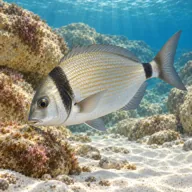
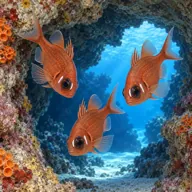
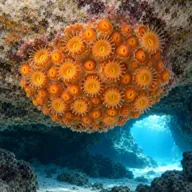
Often
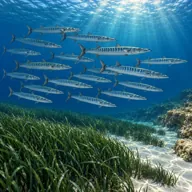
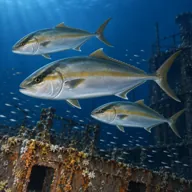
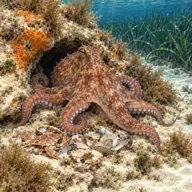
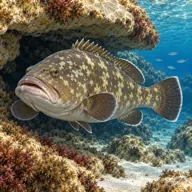
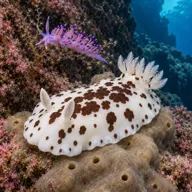
Marked ones can hurt you. What they do and what to do about it is under Getting in and staying safe.
Getting in and staying safe
Boat only, about half a kilometre north east of Qawra Point, which means a very short run from Buġibba, Qawra or Salina and a slightly longer one from Sliema. Operators shot the wreck or run a marked line down to the reef top so you can work the reef, statue and wreck in sequence. Several dive centres sit within walking distance of the Qawra and Buġibba boat jetties, with parking, fills, toilets and a cafe within a minute of where you kit up.
Where the boat stops
Yellow marker buoy laid over the wreck
35° 57.812' N 14° 26.035' E
35.96353, 14.43392 · Open in Google Maps
Laid from May to October (Notice to Mariners 48 of 2017).
Positions as charted (WGS84) in Transport Malta Notice to Mariners 42 of 2017, special mark buoys indicating a wreck . Check the latest notice before you rely on them.
- Depth of forty two metres, decompression obligation is easy to acquire
- Nitrogen narcosis at the statue and inside the wreck
- Penetration into a stripped steel hull with limited exits
- Sharp corroded metal and collapsing frames
- Boat traffic off Qawra Point in summer
- Current between the reef and the wreck on windy days
- Snagged fishing line around the reef and anchor
- Task loading: too many attractions for one bottom time
Marine life to respect
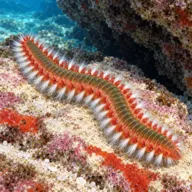
Bearded fireworm · Busuf Can hurt you
Bristles snap off in the skin and burn for hours. Never touch; lift them out with tape, then hot water.
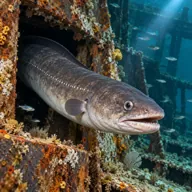
Conger eel · Gringu Can hurt you
Crushing bite if a hand goes into its hole. Look in from a distance and keep fingers out.
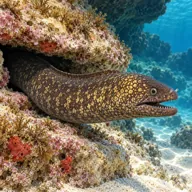
Mediterranean moray · Morina Can hurt you
Bites hard if a hand goes into its hole. Keep hands out of cracks and never feed one.
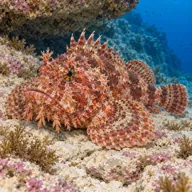
Red scorpionfish · Ċippullazza Can hurt you
Venomous spines, and it sits still on the rock. Look before you kneel or hold on; hot water if stung.
A bit of history
She was launched in 1938 by John Crown and Sons in Sunderland as New Royal Lady, a forty five metre excursion steamer. The Royal Navy requisitioned her in 1940 for transport work, and after the war she returned to civilian service, was renamed Crested Eagle in 1947 and ran trips on the Thames and along the south coast of England. In 1958 she was sold to E. Zammit and Company in Malta, renamed Imperial Eagle and put on the Malta to Gozo run carrying about seventy passengers and ten cars. She changed hands again in 1968 to the Pisani family and finished her working life hauling cargo and livestock from Gozo to Valletta, then lay rotting at Mgarr and eventually half sank at her moorings in Valletta. The local diving community bought her in 1995 with the intention of creating an underwater park, and after four years of paperwork she was finally scuttled on Monday 19 July 1999 off Qawra Point. The Christ statue joined her the following year. She sits in a marine conservation area, one of a long line of Maltese scuttlings that also includes Rozi, Um El Faroud, Karwela, P29 and P31.
Divers say
Sign in to rate this site and leave a note for the next diver.
- No reviews yet. First one gets bragging rights.
Further reading: Malta Diving, Imperial Eagle wreck guide · Atlantis Diving, Imperial Eagle wreck · Wrecksite, MV Imperial Eagle · Simplon Postcards, MV Crested Eagle history · SSI MyDiveGuide, MV Imperial Eagle