Qawra Point · Malta
L-Cave
A tight L-shaped tunnel at 33 metres off Qawra Point, dark for the first ten metres and then opening up towards a lit exit at 36. Beautiful if you are calm and experienced, deeply unpleasant if you are not.
Sea conditions
Good right now
Some chop (0.4 m ESE)
Forecast for the site, updated 01:45 AM
- Waves
- 0.4 m
- from ESE
- Wind
- n/a
- Swell
- 0.4 m
- 5 s period
- Sea temp
- 29 °C
Next 7 days
Exposed to wind and swell from: NW (315°), N (0°), NE (45°), E (90°). Open north-facing water, so it needs a calm day with southerly or southwesterly wind, both for the long swim and for the exit back through the pool. Visibility offshore here is normally excellent, often 25 metres or more, which makes the dark tunnel mouth stand out. Light current can run along the reef top. Best season: May to October, on flat days. Early morning gives the calmest surface for the swim out..
The dive
L-Cave is a proper little test piece. It is a swim-through rather than a cave system, but it earns respect because of where it sits and how it starts. The entrance is at the bottom of the Qawra Reef wall at around thirty-three metres, tucked behind a rock in a small valley, and the first ten metres of tunnel are narrow and genuinely dark. Kick badly there and you will fill the whole passage with sand, which is a miserable experience for whoever is behind you.
Past that pinch the tunnel widens and bends to the left, which is where the name comes from, and the light of the exit appears ahead at about thirty-six metres. From there it is easy going and quietly magnificent, a rock corridor with a sand floor and cardinalfish hanging in the corners.
Getting there from shore is a fifteen to twenty minute swim and a simple navigation problem: hold roughly thirty degrees until the Qawra Reef drop-off appears in front of you, follow the wall east, and a few minutes later you drop into the valley where the entrance hides.
Most centres do it from a boat because it saves the swim and the gas, and because a thirty-three metre entrance at the end of a long approach makes for tight numbers. Either way: torch, gas plan, and a firm rule about who leads.
- A genuine L-shaped tunnel with a dark entrance and a lit exit
- Navigation that actually feels like navigation
- Dropping into a hidden valley at the foot of the Qawra wall
- Cardinalfish and scorpionfish packed into the corners
- Quiet, rarely busy, and not on the standard tourist rotation
Typical plan
From a boat: drop on the reef top, down the wall to the valley at 33 metres, through the tunnel single file with torches on and the best finner leading, out at 36, then straight back up the wall to work shallower for the rest of the dive. From shore, add 15 to 20 minutes each way on a 30 degree bearing and plan your gas accordingly. Nitrox 32 strongly recommended, maximum depth 36 metres, tight no-stop discipline or a small planned deco margin. DSMB before ascent, always.
What the bottom looks like
- 1Qawra Reef top, first landmark on the bearing18 m deep · 400 m out
- 2Reef drop-off falling from 18 to 33 metres26 m deep · 445 m out
- 3Small valley at the foot of the wall33 m deep · 470 m out
- 4L-Cave entrance, partly hidden behind a rock33 m deep · 500 m out
- 5Narrow dark first section then the left hand bend35 m deep · 512 m out
- 6Exit into daylight at 36 metres36 m deep · 528 m out
- 7Wall face worked shallower on the way back30 m deep · 560 m out
Fine sand on the tunnel floor, rough limestone wall and rubble in the valley outside.
Who you might meet
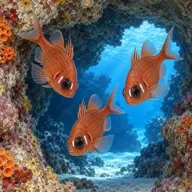
Cardinalfish
Almost always · Re tat-trilji
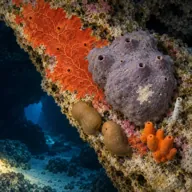
Encrusting sponges
Almost always · Sponża
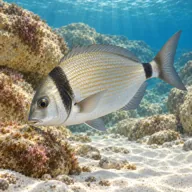
Two-banded bream
Almost always · Sargu
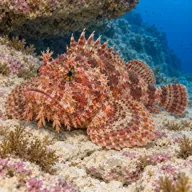
Red scorpionfish
Often · Ċippullazza
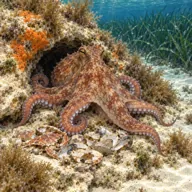
Common octopus
Often · Qarnit
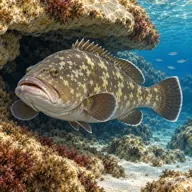
Dusky grouper
Sometimes · Ċerna
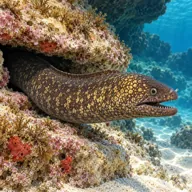
Mediterranean moray
Sometimes · Morina
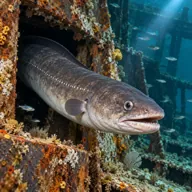
Conger eel
Sometimes · Gringu
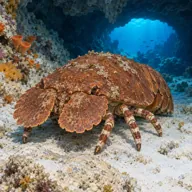
Slipper lobster
Sometimes · Ċikala
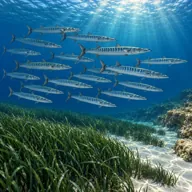
Barracuda
Sometimes · Lizz
Getting in and staying safe
Best as a boat dive, and most centres treat it that way. From shore it is the north side entry at Qawra Point, the rock-cut pool below the tower, parking on the promenade or near the aquarium and a walk of roughly 150 metres. Then a swim of 15 to 20 minutes out on a bearing of about 30 degrees. Carry a DSMB, because you will surface in a boat lane. Cafes, restaurants and toilets are on the promenade. If you are shore diving it, do the sums on gas twice: the swim out and back is not free.
- Overhead environment with a narrow, dark first section
- Silt-out risk, a careless fin stroke ruins visibility for everyone behind
- Entrance at 33 metres and exit at 36, deep for an overhead swim-through
- Long approach swim eating gas and no-stop time before you even arrive
- Boat traffic on the surface, DSMB essential
- Entrance partly hidden behind a rock, easy to miss and waste bottom time hunting
- Narcosis at depth in a confined dark space
A bit of history
No wreck, no story, just water working on limestone over a very long time. The tunnel is a solution and erosion feature cut through the reef mass, and the sand floor inside is what has washed in and settled over the years. The nearby offshore reef is better known for the Imperial Eagle, scuttled in 1999, and the Statue of Christ that was relocated out to the reef in 2000.
Divers say
Sign in to rate this site and leave a note for the next diver.
- No reviews yet. First one gets bragging rights.
Further reading: Malta Dive Sites: L-Cave · Malta Dive Sites: Qawra Point overview · Divers Guide: Qawra Reef · Dive Systems Malta: Qawra Point