Qawra Point · Malta
Qawra Reef
The big one off Qawra: a reef top at 15 to 20 metres, a steep drop-off to 30 or 40, and a row of wide caverns cut back under the rock. Barracuda, amberjack and dentex patrol it and the visibility is usually superb.
Sea conditions
Good right now
Some chop (0.4 m ESE)
Forecast for the site, updated 01:45 AM
- Waves
- 0.4 m
- from ESE
- Wind
- n/a
- Swell
- 0.4 m
- 5 s period
- Sea temp
- 29 °C
Next 7 days
Exposed to wind and swell from: NW (315°), N (0°), NE (45°), E (90°), SE (135°). Fully open to the northern sector, so it needs a settled day with southerly or southwesterly wind. The site is known for excellent visibility, often 25 to 30 metres and sometimes more, which is a large part of why divers make the effort. Current on top of the reef is the thing that catches people out, so check it before committing to the deep leg. Best season: May to October, with September usually giving the best combination of warm water, clear visibility and calm northerly conditions..
The dive
Qawra Reef is the serious dive of the Qawra Point family. It starts just short of L-Cave, runs out roughly 300 metres towards the Imperial Eagle and the Statue of Christ, and keeps going beyond that. The top sits at fifteen to twenty metres, then the edge tips over into a steep drop to thirty or forty, with sand sloping away deeper still.
The wall itself is rough and broken, full of cracks and holes, and cut back in several places into wide-mouthed caverns. They are not deep, which is the beauty of them: you can swim in, look back at a huge blue window, and never lose daylight. The floors are fine sand at twenty-nine to thirty-three metres. Outside the cavern mouths are big boulders, and big boulders in Malta usually mean grouper.
The open water off the edge is where the site earns its reputation. Barracuda, dentex, amberjack and tuna all work this drop-off, and on a good day you spend as much time looking out into the blue as at the rock.
It can be done from shore with a long swim, but the sensible version is a boat that anchors right on the reef edge. Either way it is an experienced diver's site: depth, distance and occasional current on the reef top all conspire to eat your margins.
- A row of wide caverns you can enter without ever losing daylight
- Steep drop-off from 18 metres to 40, with boulders and grouper at the base
- Regular barracuda, dentex and amberjack traffic out in the blue
- Exceptional visibility, often the clearest water on the north coast
- The Imperial Eagle and the Statue of Christ further out along the same reef
Typical plan
Boat drop onto the reef top, over the edge and down the wall to 32 or 33 metres, work along the cavern mouths and the boulder field for twelve to fifteen minutes, then climb the wall and spend the back half of the dive at 15 to 18 metres on the reef top. Around 45 minutes total on nitrox 32, maximum depth 33 metres if you skip the wreck and statue, more if you plan for them properly. Torch for the caverns, DSMB up before you leave the reef top, and a hard turn on gas because the boat is the only easy way home.
What the bottom looks like
- 1Reef top at 15 to 20 metres18 m deep · 420 m out
- 2Steep drop-off into 30 to 40 metres26 m deep · 480 m out
- 3Rough wall of cracks, holes and ledges31 m deep · 510 m out
- 4Wide-mouthed caverns with fine sand floors at 29 to 33 metres32 m deep · 545 m out
- 5Big boulders outside the cavern mouths, grouper territory34 m deep · 590 m out
- 6Statue of Christ, out along the reef38 m deep · 690 m out
- 7Imperial Eagle, scuttled 1999, at the far end42 m deep · 760 m out
Rugged limestone reef and wall with fine sand floors inside the caverns and a sloping sand bottom below the drop-off.
Who you might meet
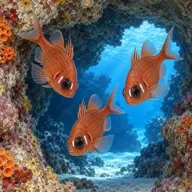
Cardinalfish
Almost always · Re tat-trilji
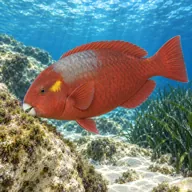
Mediterranean parrotfish
Almost always · Marzpan
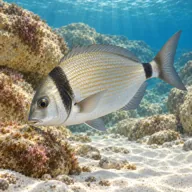
Two-banded bream
Almost always · Sargu
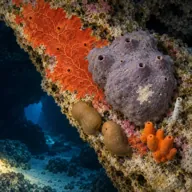
Encrusting sponges
Almost always · Sponża
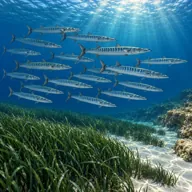
Barracuda
Often · Lizz
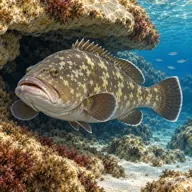
Dusky grouper
Often · Ċerna
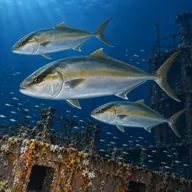
Amberjack
Often · Aċċola · Late summer
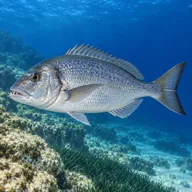
Dentex
Often · Dentiċi
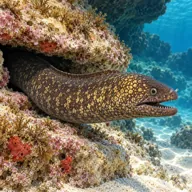
Mediterranean moray
Often · Morina
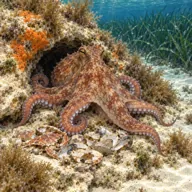
Common octopus
Often · Qarnit
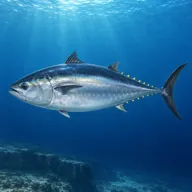
Atlantic bluefin tuna
Sometimes · Tonn · Summer
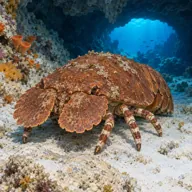
Slipper lobster
Sometimes · Ċikala
Getting in and staying safe
Boat is the right answer. Charters run from Bugibba and the surrounding centres and can anchor very close to the reef edge, which saves you a great deal of gas. The shore option starts at the north side of Qawra Point: park on the promenade or near the aquarium, walk about 150 metres, enter via the rock-cut pool below the tower, then swim roughly 500 metres out. That swim is long, exposed and in a boat lane, so it needs a DSMB, good navigation and an honest look at your fitness. Cafes, restaurants and public toilets are on the promenade at the point.
- Depth, with the wall running from 15 metres to 40 and the sand deeper again
- Occasional strong currents over the reef top
- Heavy boat traffic between Bugibba and the reef, DSMB is mandatory
- Long surface or submerged swim if diving from shore
- Cavern overheads with fine silt floors that cloud easily
- Narcosis and gas management at 33 to 40 metres a long way from the exit
- Fishing line and lost tackle on the reef edge
A bit of history
The reef has no wreck of its own, but two famous neighbours sit out along it. The Imperial Eagle, a small passenger ferry that once ran the Malta to Gozo crossing, was scuttled off Qawra in 1999 to create an artificial reef, and lies at around forty-two metres. Close to her stands the Statue of Christ, a sculpture that was blessed and sunk off Malta in 1990, then relocated out to the Qawra reef area in 2000 where it now sits at roughly thirty-eight metres. Between them they make the outer end of this reef one of the better known stretches of water on the north coast.
Divers say
Sign in to rate this site and leave a note for the next diver.
- No reviews yet. First one gets bragging rights.
Further reading: Malta Dive Sites: Qawra Reef · Divers Guide: Qawra Reef · Dive Systems Malta: Qawra Point dive site · Malta.com: Qawra Reef · Oyster Diving: scuba diving Malta guide