🦞 Crustaceans · Parapenaeus longirostris
Deep-water rose shrimp
Gamblu abjadin Maltese, also Gambli bojod, Gamblu roża
Malta's trawler shrimp, far below diving depth
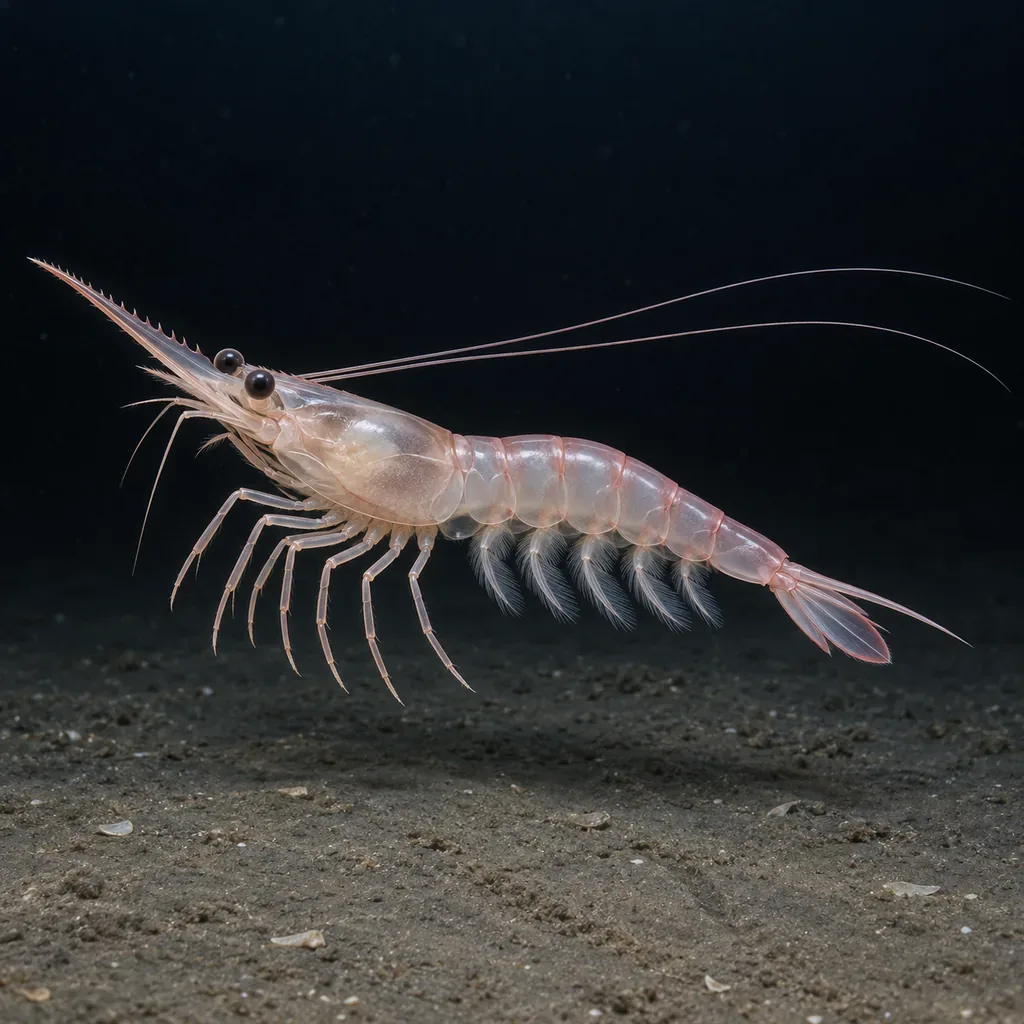
Meet the Deep-water rose shrimp
A smooth, pale pink prawn with a long toothed rostrum spiking forward between the eyes, a slightly translucent body and a faint reddish flush along the tail segments that deepens after death, which is why it is sold as a rose or pink shrimp. Males reach about 16 cm total length and females about 19 cm, so a market specimen is a decent handful.
This is not a reef animal. It lives on mud and muddy sand on the continental shelf edge and upper slope, recorded from around 20 m down to over 800 m but concentrated between 100 and 400 m. Juveniles settle shallower, around 100 m, and the biggest animals stay below 350 m. By day it buries in soft sediment and it moves up into the water at night to feed, which is why trawlers work particular depths at particular hours.
For Malta it matters commercially rather than visually. It is one of the main targets of the bottom trawl fishery in the Strait of Sicily, shared by Maltese, Italian and Tunisian boats, and it turns up on ice at Marsaxlokk and in the fish shops far more often than it turns up on a dive. Recreational divers will not meet it; you may see one on a deep technical dive over soft bottom, and that is about the limit.
When to look: Spawns through the year with peaks between late spring and early autumn; it is effectively out of reach of sport diving at any season.
Diving with them
- Do not plan a dive around this one; its normal depth band starts below 100 m and most of the population is deeper still.
- If you want to see it, the Sunday market at Marsaxlokk is a far better bet than any dive site.
- On deep trimix dives over mud or muddy sand, look for a pale prawn with a long spiked rostrum and eyes that flare in the torch beam.
- It buries by day, so anything you do see on soft bottom is most likely out and feeding at night.
- Know it by sight anyway; it helps to be able to tell a trawled market prawn from the reef shrimps you meet on a dive.
Can it hurt you?Harmless
Harmless. The only sharp thing on it is the toothed rostrum, and that is a handling nuisance in the kitchen rather than a diving risk.
Easily confused with
- Giant red shrimp (Aristaeomorpha foliacea) and blue and red shrimp (Aristeus antennatus), which are deeper, much redder and have a longer, thinner rostrum
- Caramote prawn (Penaeus kerathurus), a shallower banded prawn sold in the same markets
Where to meet them: 5 sites
Further reading: SeaLifeBase: Parapenaeus longirostris · Eurofish species profile · Connectivity of Parapenaeus longirostris in the Mediterranean · EU commercial designations, Maltese entry