🪸 Corals & anemones · Anemonia viridis
Snakelocks anemone
Shaggy green tentacles that never pull in
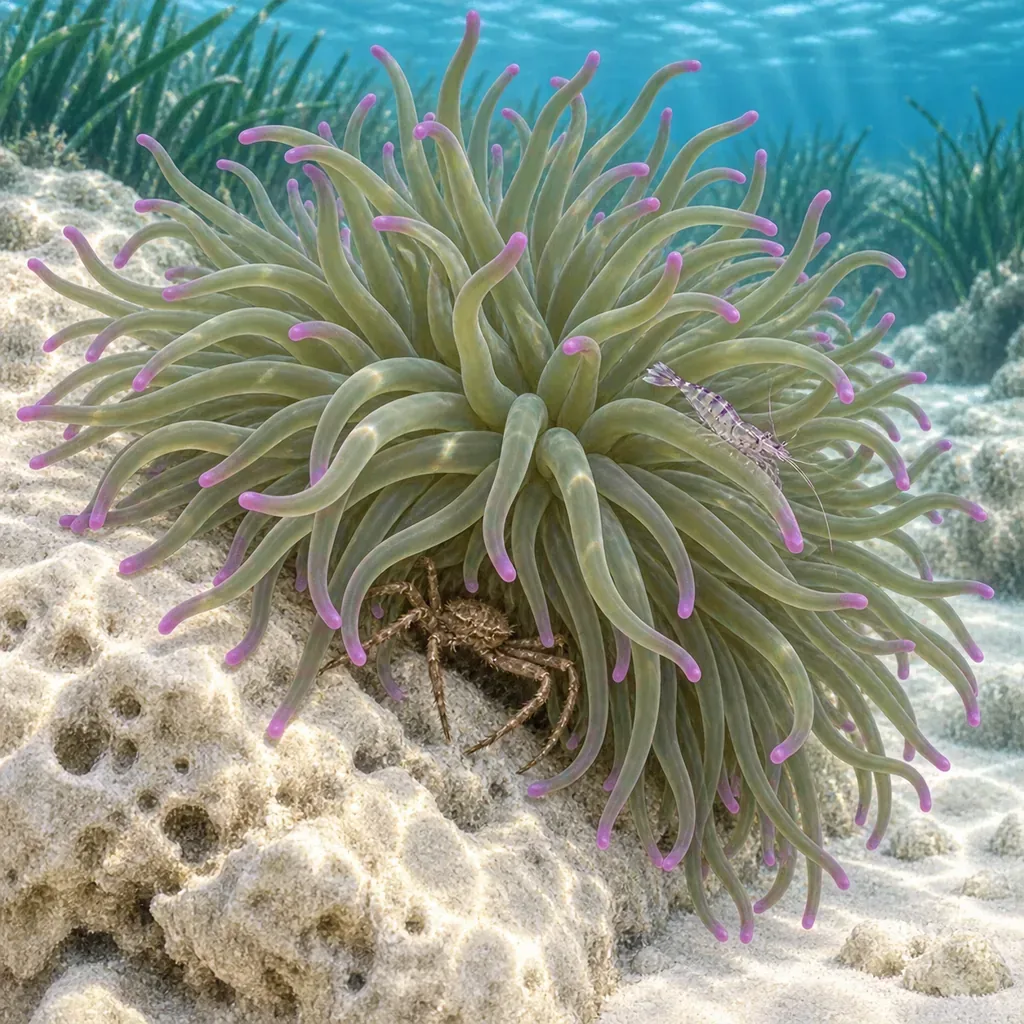
Meet the Snakelocks anemone
The commonest anemone on Malta's shallow rock, and the easiest to recognise because it cannot properly retract. Up to two hundred long, wavy tentacles stream out from a short column that is usually hidden in a crack, giving a shaggy, permanently untidy look. The tentacles are grey-green to olive-brown, very often with lilac, violet or rose tips, and a fully grown animal covers 15 to 20 cm of rock. The green comes from single-celled algae living in the tissue, which is why it sits out in bright sunlight rather than hiding.
You will meet it in the first few metres of almost any rocky Maltese entry - Ġnejna, Qawra Point, the shallows at Ċirkewwa and Xatt l-Aħmar, the boulder slopes of Comino - down to about 15 m and rarely deeper. It favours sunlit rock, boulder tops and the edges of seagrass, and often grows in loose groups of a dozen or more.
It is worth two minutes of close looking, because the tentacles are a home as well as a weapon. The little spider crab Inachus phalangium sits under the tentacle canopy immune to the stings, and the elegant anemone shrimp Periclimenes sagittifer, glassy with violet and white markings, picks its way among them. Both are easy to miss until you stop moving and let your eyes settle.
When to look: All year in the shallows; most obvious on calm sunny days when the tentacles are fully extended.
Diving with them
- Hover still for a minute and scan the base of the tentacles for the spider crab and the anemone shrimp
- Perfect safety-stop and snorkel subject, since it lives in the top few metres
- Do not handle it: the sting is mild but real, and the tentacle tips damage easily
- Backlight the tentacles with the sun behind them to bring out the violet tips
- It cannot close up like other anemones, so a specimen that looks limp and pale is usually stressed or bleached, not just shut
Can it hurt you?Handle with care
It stings. Brushing bare skin, especially the inside of the wrist or the face, gives a nettle-like burn and sometimes a red weal that itches for a day or two. Wetsuits and gloves stop it completely.
First aid: Rinse with seawater, not fresh water, and do not rub. Vinegar helps deactivate any remaining stinging cells. Soaking the area in hot water at about 45 C for 20 minutes eases the burn, and an antihistamine or hydrocortisone cream settles the itch. Seek medical help for stings near the eyes or any spreading reaction.
Easily confused with
- Beadlet anemone (Actinia equina) - smaller, plain red or brown, and pulls into a smooth blob when disturbed
- Golden anemone (Condylactis aurantiaca) - fewer, thicker tentacles with pink or purple tips, column buried in sand rather than wedged in rock
- Trumpet anemone (Aiptasia) - slimmer, brownish and translucent, usually in harbours and shaded crevices
Where to meet them: 5 sites
HMS Urge
Malta
HMT Crownsin
Malta
Junkers Ju 88 (South)
Malta
Mtahleb
Malta
Further reading: Wikipedia - Snakelocks anemone (Anemonia viridis) · MarLIN - Snakelocks shrimp (Periclimenes sagittifer) · Animal Diversity Web - Anemonia viridis · DAN Southern Africa - Jellyfish and hydroid sting first aid