🐟 Fish · Dactylopterus volitans
Flying gurnard
Biesin Maltese, also Bież il-baħar, Garnaw
Armoured bottom-walker that opens peacock wings
Meet the Flying gurnard
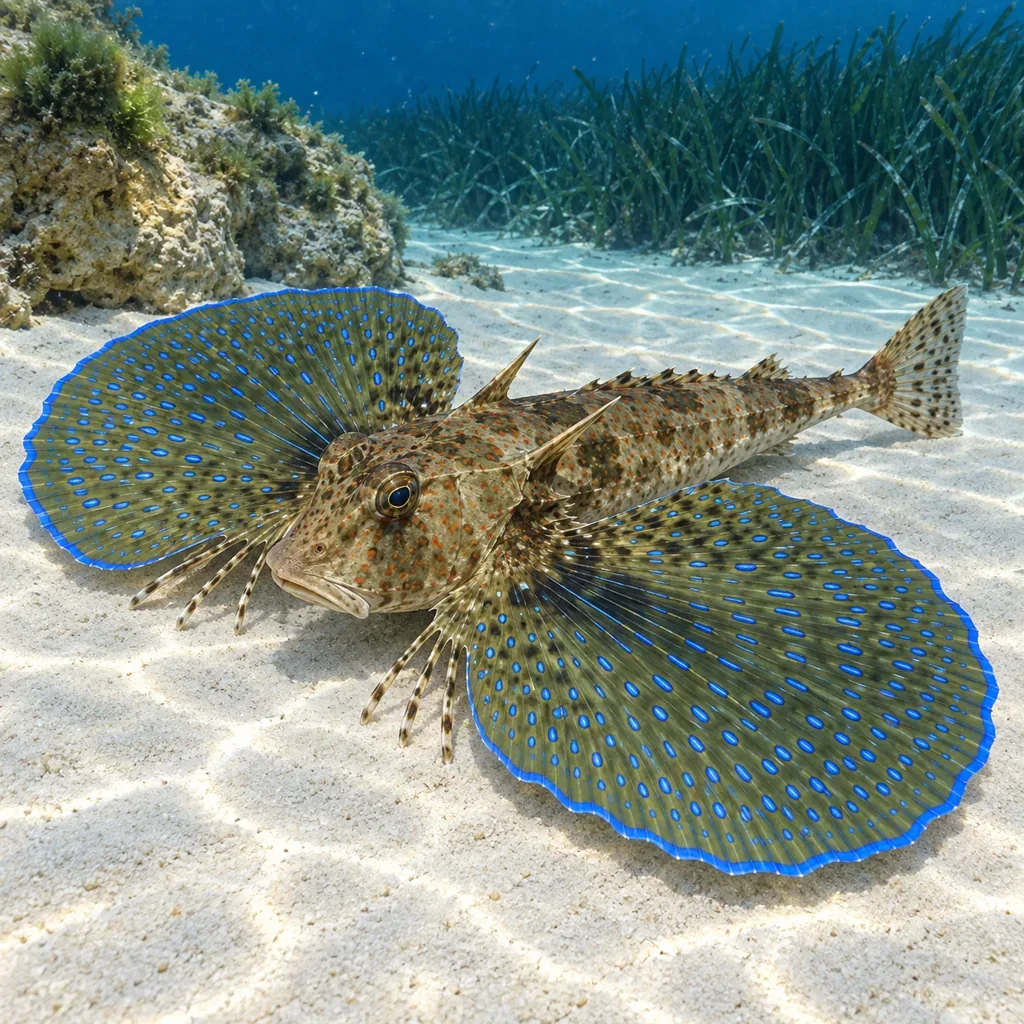
One of the strangest-looking fish in the Mediterranean and a real find on a Maltese dive. The head is blunt, boxy and armoured in bony plates, with a long backward-pointing spine at each corner and eyes set high. The body is brown to olive with darker mottling and reddish speckling, tapering quickly to a small tail. What makes it is the pectoral fins: enormous rounded fans, translucent olive with dense bright blue spots and a vivid electric blue edge, which it keeps folded flat and only spreads when alarmed.
It does not fly and it does not really swim much either. It spends its time on sand and rubble next to rock, walking slowly on the short separate front rays of the pectoral fins and probing for crabs, small bivalves and little fish. Most are 25 to 35 cm; the maximum is around half a metre.
Around Malta, Gozo and Comino it is uncommon rather than rare, and it turns up on open sand near reef edges and in sandy bays, mostly between about five and fifty metres. Sightings cluster in the warmer half of the year. It is a fish you find by looking at empty sand rather than at the reef.
When to look: Mostly late spring through autumn in warm water, over open sand beside reef; sightings are occasional rather than dependable.
Diving with them
- Scan flat sand next to rock - with the fins folded it looks like a mottled lump and divers swim straight past it
- Do not force the display; if you approach very slowly it will keep walking and let you film it moving, which is the better footage
- It walks on the short front rays of its pectoral fins, and close-focus on those is worth the dive
- Keep low and level to avoid kicking up sand; once the site silts, the fish leaves
- If it spreads the fins, back off - it is a startle response, not a pose
Can it hurt you?Harmless
Harmless to divers. Despite the armoured head and bony spines it has no venom, and it would rather walk away than confront anything.
Easily confused with
- Tub gurnard (Chelidonichthys lucerna) - also has blue-edged pectorals but a slimmer pointed head and three free finger-like rays in front of each fin
- Other true gurnards - smaller fins and a long tapering snout, not a boxy armoured head
- At a glance on sand it can be mistaken for a lizardfish or a small scorpionfish until the fins open
Where to meet them: 22 sites
Further reading: FishBase - Dactylopterus volitans · Il-Miklem - Bież il-baħar / Dactylopterus volitans · Vassallo History - Maltese, English and Latin fish names (Bies)