🐟 Fish · Synodus saurus
Atlantic lizardfish
Gremxula tal-baħarin Maltese, also Sawru, Skalm
A sand-coloured ambusher with a lizard grin
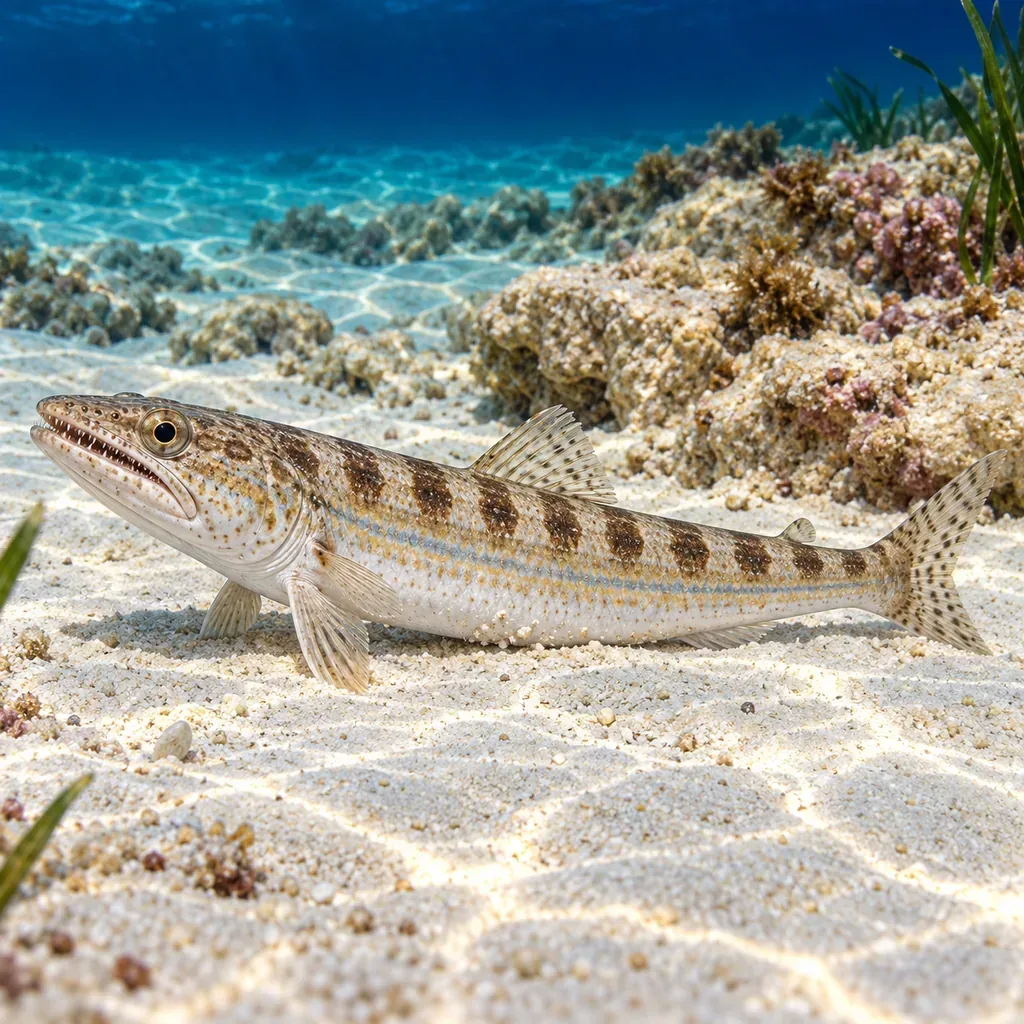
Meet the Atlantic lizardfish
A cylindrical, almost pencil-shaped fish with a flattened, wedge-shaped head, a wide mouth that reaches back past the eye, and rows of fine needle teeth that show even when the mouth is shut. The back is sandy beige to pale brown with a chain of darker saddle blotches and, in good light, faint blue-grey and gold lines along the flanks; the belly is white. There is a small fleshy adipose fin near the tail. Maltese fish are usually 15 to 25 cm, occasionally up to about 40.
It hunts by ambush and it does it from the bottom. A lizardfish props itself on its pelvic fins on clean sand or on the sand-rock border, sometimes half-buried with only the head clear, and stays absolutely still. When a small fish drifts overhead it launches straight up in a blur, takes the prey and drops back into exactly the same spot. Divers usually find them on the sand approaches and mixed sand-and-rubble bottoms at sites like Għar Lapsi, Mġarr ix-Xini, Dwejra, Cirkewwa's sand channel and the shallows off Comino, mostly between 3 and 30 m.
They are astonishingly confident. Where most sand fish flee, a lizardfish will usually let you close to within half a metre before it moves, which makes it one of the friendliest photographic subjects in Maltese waters.
When to look: All year, and most often seen in the warmer months from May to October on shallow sand bottoms in bright light.
Diving with them
- Scan the sand-rock border rather than open sand, they like the line where rubble meets clean bottom
- They hold position when approached, so move in steadily and stop, rather than drifting sideways and spooking them
- Get the lens level with the head to show the flattened skull and the teeth, which is what makes the shot
- If one disappears, look for a slight bump in the sand with two eyes, they bury with only the head showing
- Watch for a minute if you have air to spare, the vertical strike at passing prey is over in a fraction of a second
- Do not touch or handle one, those teeth are genuinely sharp even though the fish will never come at you
Can it hurt you?Harmless
No threat to divers. It has no venom and never approaches people; the only way to get hurt is to pick one up and get cut on its needle teeth.
Easily confused with
- Synodus synodus, the diamond lizardfish, recently confirmed in Maltese coastal waters, which is shorter-headed and more boldly blotched
- Greater weever and other weevers, which bury completely with only the eyes and a venomous black first dorsal fin showing, so check before you kneel
- Red mullet, which also sit on sand but have two chin barbels and a much blunter head
- Small barracuda, which are silvery and hang in midwater rather than resting on the bottom
Where to meet them: 2 sites
Further reading: FishBase: Synodus saurus, Malta country page with Maltese names · Wikipedia: Atlantic lizardfish · Synodus synodus in the coastal waters of Malta, central Mediterranean · EUNIS: Synodus saurus distribution