🐟 Fish · Mullus surmuletus
Striped red mullet
Triljain Maltese, also Trilja tal-qawwi, Trilja tal-faxxi, Trill
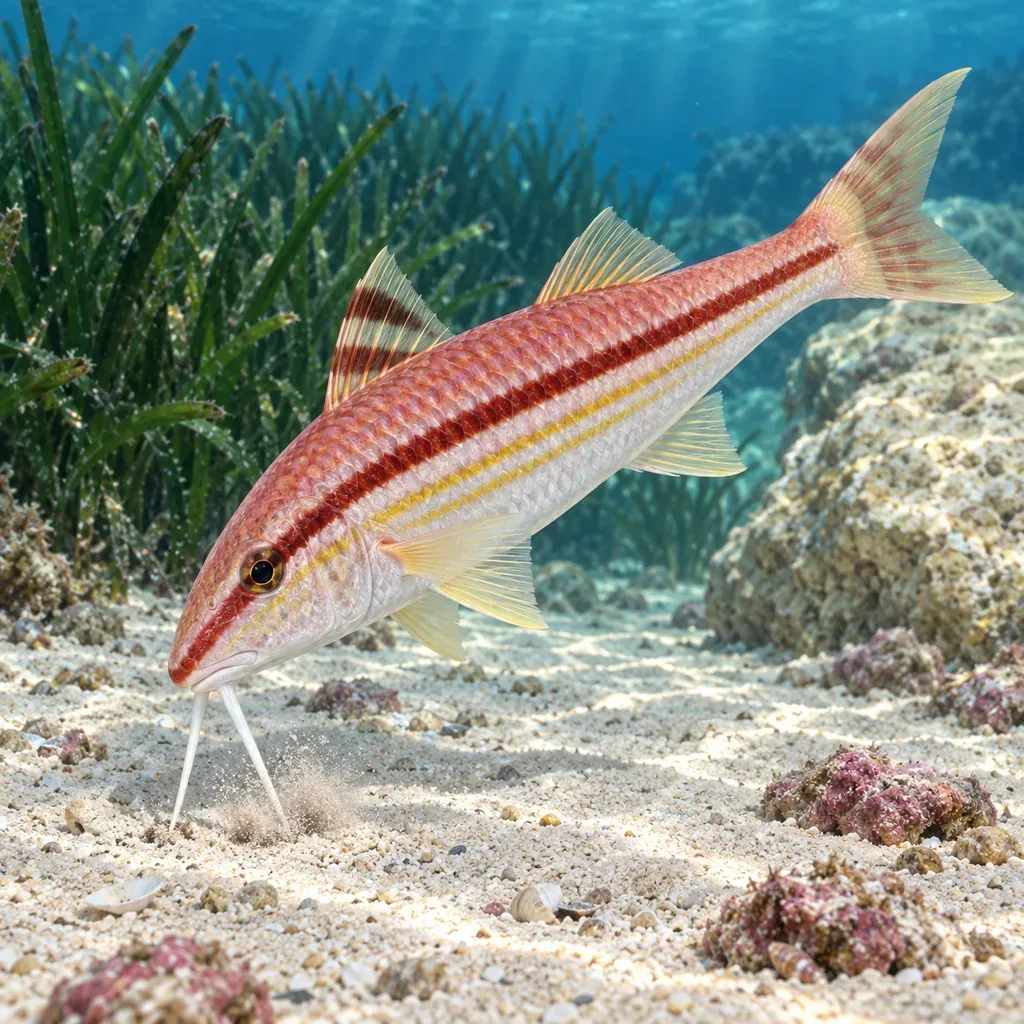
Barbels down, ploughing the sand for supper
Meet the Striped red mullet
The striped red mullet is the pink-and-gold fish you see nose-down on sand with two long whiskers sweeping the sediment. Those barbels are chemical sensors under the chin, and the fish drops them into the seabed to find worms, shrimps and small molluscs. The body is elongated with a steeply sloping but not vertical forehead, the eyes sit high, and the colour is variable: often a reddish or rosy back over a white belly, with a dark red stripe running from the snout through the eye to the tail and two or three golden-yellow lines along the lower flank. The first dorsal fin carries dark red or brown bands, which is a useful identification point. Fish around Malta are typically 15 to 25 cm and can reach 40 cm.
It works sand, shell gravel, mixed rubble and the clean patches between Posidonia clumps, mostly between about 5 and 60 metres, and is one of the commonest bottom fish on Maltese shore dives: the sand at Ċirkewwa, Xatt l-Aħmar, Ġnejna, Armier and the sandy plains around the wrecks all hold them. Feeding fish stir up small clouds of sediment, and other species learn to follow them, so a red mullet grubbing along is often trailed by wrasse and seabream waiting for something to bolt.
Colour changes fast. A resting fish on sand goes pale and washed out with reddish blotches, then flushes deep rosy pink when it moves or is startled, which is why the same species can look like two different fish on one dive. Spawning runs from late spring into midsummer.
When to look: All year, feeding most visibly in daylight over open sand, with more and larger fish inshore from late spring through summer around the May to July spawning season.
Diving with them
- Follow the sediment puffs: a feeding mullet gives its position away before you see the fish.
- Settle on the sand a couple of metres off and stay still, and the fish will usually work its way towards you rather than away.
- Watch the barbels, which are the whole story of this animal and the detail worth photographing.
- Look for the followers, because wrasse, seabream and sometimes a comber will be picking off whatever the mullet flushes out.
- At night they rest quietly on open sand, pale and blotchy, and can be approached very close with a soft light.
Can it hurt you?Harmless
No risk at all. Red mullet have small mouths, no venom and no spines that matter, and they simply move away from an approaching diver.
Easily confused with
- Red mullet (Mullus barbatus), the trilja tar-ramel, which has an almost vertical blunt forehead, no clear dark lateral stripe and an unmarked first dorsal fin
- Juvenile seabream over sand, which lack barbels entirely
- Atlantic lizardfish, which also sits on sand but is slimmer, blotchy brown and props itself up on its pelvic fins
Where to meet them: 13 sites
Tent Peg Wreck
Malta
Further reading: FishBase: Mullus surmuletus (size, depth, diet, spawning) · GBIF vernacular names for Mullus surmuletus, Maltese entries (Trilja, Trilja tal-qawwi)