Malta
Lockheed P2V Neptune
A submarine hunter that never sank in anger. This RAF Neptune was broken on landing, sold to a film company and dumped off Baħar iċ-Ċagħaq as a movie prop, then lost for nearly sixty years until divers found it again in 2015.
Sea conditions
Excellent right now
Flat, sheltered and calm
Forecast for the site, updated 01:47 AM
- Waves
- 0.4 m
- from ESE
- Wind
- n/a
- Swell
- 0.4 m
- 5 s period
- Sea temp
- 29 °C
Next 7 days
Exposed to wind and swell from: NW (315°), N (0°), NE (45°), E (90°). This stretch of coast is open to the north and east, so a gregale kills the site and makes the boat ride miserable. Westerlies and south westerlies flatten it right out. Visibility out on the sand is frequently in the twenty to thirty metre range. Best season: May to October, with the best water clarity in September and October..
The dive
There is not a great deal of aeroplane left, and that is fine, because what there is sits beautifully. A section of fuselage lies on sand at thirty two metres with the wing stubs and engine cowlings still attached, and the outer wing panels rest nearby, half swallowed by the seabed. Everything worth salvaging was stripped before she went in the water, so do not come looking for instruments or an intact cockpit.
What you get instead is scale and setting. The Neptune had a thirty metre wingspan, so even in pieces the footprint is large, and it is scattered across clean sand between meadows of Posidonia. Visibility out here is usually excellent, the aluminium picks up the light, and the contrast between the pale sand, the dark seagrass and the wreckage makes this one of the more photogenic aircraft dives in Malta.
At thirty two metres on sand it is a short dive with a clean profile and no overhead. That makes it a good first aircraft wreck for a recently qualified advanced diver, and a pleasant nitrox pootle for anyone else. Give yourself time to swing out over the seagrass on the way back, because that is where the cuttlefish, gurnards and the occasional ray turn up.
- A rare aircraft wreck within recreational depth limits in Malta
- Wing stubs and engine cowlings still attached to the fuselage
- Wings lying separately in the sand, adding to the footprint
- A wreck that was sunk to be filmed, then lost for nearly sixty years
- Excellent visibility over clean sand and seagrass
Typical plan
Straightforward square profile. Descend the shot to thirty two metres, circle the fuselage and the separated wings for fifteen to eighteen minutes, then ascend to twenty metres and drift over the seagrass edge for the rest of the dive. Nitrox 32 is the obvious gas and roughly doubles your usable bottom time compared with air. Forty to forty five minutes total with a safety stop, deploying a marker before you leave the bottom.
What the bottom looks like
- 1Fuselage section with wing stubs31 m deep · 18 m out
- 2Engine cowlings32 m deep · 30 m out
- 3Outer wing panels half buried in sand32 m deep · 50 m out
- 4Open sand around the debris field32 m deep · 70 m out
- 5Posidonia meadow on the way back up30 m deep · 100 m out
Clean pale sand broken by meadows of Posidonia seagrass, with the wreckage lying on top rather than buried.
Who you might meet
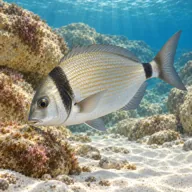
Two-banded sea bream
Almost always · Sargu

Posidonia meadow
Almost always · Alka
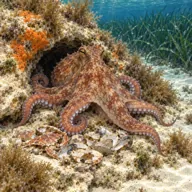
Common octopus
Often · Qarnit
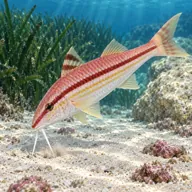
Striped red mullet
Often · Trilja
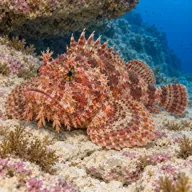
Scorpionfish
Often · Ċippullazza
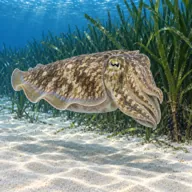
Cuttlefish
Sometimes · Siċċ · spring
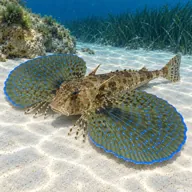
Flying gurnard
Sometimes · Bies

Common stingray
Sometimes · Boll
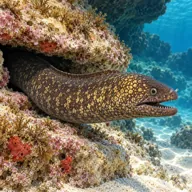
Mediterranean moray
Sometimes · Morina
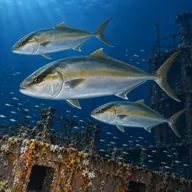
Amberjack
Sometimes · Aċċola · autumn
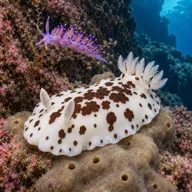
Nudibranchs
Sometimes · spring
Getting in and staying safe
Boat only. She lies roughly five hundred metres offshore from Baħar iċ-Ċagħaq on the north eastern coast, a short run from Sliema, Buġibba or Salina. Most operators put a shot in or run a GPS drop straight onto the fuselage, since the wreckage is low and easy to swim past on sand. Bring a delayed surface marker for the ascent, because there is nothing to hold on to and the boat needs to find you.
- Depth of thirty two metres, so no-decompression time is short on air
- Nothing to shelter behind on open sand if current is running
- Easy to swim past low wreckage and lose the site in poor visibility
- Sharp torn aluminium edges on the fuselage section
- Boat traffic along the north east coast in summer
- Silt stirred off the sand cuts visibility fast for the divers behind you
- Narcosis creeping up on divers new to thirty metres
A bit of history
The Lockheed P2V Neptune was an American maritime patrol and anti-submarine aircraft, and the RAF flew a batch of them as the Neptune MR.1, a British designation for the P2V-5. This one, serial WX547 of 36 Squadron, was written off at RAF Luqa on Friday 13 January 1956 when its undercarriage collapsed during a routine landing. It never flew again. The RAF stripped anything useful and in May 1957 the airframe was sold to a film production company, which scuttled it off Baħar iċ-Ċagħaq to serve as the underwater set for The Silent Enemy, a submarine thriller released in 1958. The wreck then dropped out of sight entirely and was only relocated by local divers in 2015. Malta has a small habit of this: Scotscraig, better known as Popeye's Barge, is another wreck that got its start on a film set.
Divers say
Sign in to rate this site and leave a note for the next diver.
- No reviews yet. First one gets bragging rights.
Further reading: Calypso Sub-Aqua Club, Lockheed P2V Neptune · Divewise Malta, Lockheed P2V Neptune · Scuba Diver Life, new airplane wreck found in Malta · Aviation Safety Network, Neptune MR.1 WX547 · Wrecksite, Lockheed P2V Neptune