Malta
Harq Hamiem Cave
Malta's only known fully submerged terrestrial cavern, reached by a staircase rather than a boat, with two chambers stacked on top of each other and a floor that drops past fifty metres. Freshwater at the top, seawater at the bottom, and a shrimp that lives nowhere else.
Sea conditions
Excellent right now
Flat, sheltered and calm
Forecast for the site, updated 01:47 AM
- Waves
- 0.4 m
- from ESE
- Wind
- n/a
- Swell
- 0.4 m
- 5 s period
- Sea temp
- 29 °C
Next 7 days
Exposed to wind and swell from: not yet mapped. Wind and swell are irrelevant once you are inside, which makes this the one Maltese site that is technically diveable in a gale. Everything else about it is harder than a bad sea day. The water is cool and clear at the top, and the visibility below the halocline depends entirely on how carefully the team in front of you swam. Best season: Any time of year, subject entirely to permission.
The dive
This one breaks every rule of Maltese diving. There is no shore entry over slippery rock, no surface swim, no swell. You walk down a flight of steps inside the headland on the north side of St George's Bay and there is the water, sitting quietly in a chamber the size of a small church, twenty metres from floor to vault.
The interesting part is what the water does. At the top it is close to fresh, rainwater that has soaked through the limestone. Within the first few metres you hit a thermocline, and somewhere around eighteen metres the halocline arrives: a shimmering, oily looking layer where fresh sits on salt and the whole cave briefly goes out of focus. Below that it is proper seawater, which tells you the cave talks to St George's Bay through the rock somewhere out of sight. A narrow corridor leads from the upper chamber down into the fully submerged lower one, and the floor there keeps going past fifty metres.
It is also a fragile, protected and politically contested place. The cave and the valley above it were designated an Area of Ecological Importance and Site of Scientific Importance in 2008, and the land above has been the subject of very large development proposals that campaigners have fought for years. The endemic cave dwelling amphipod, usually described locally as the albino shrimp, lives in almost no other measured volume of water on earth. Go in with overhead training, a guideline, and the lightest fin kick you own.
- The only fully submerged terrestrial cavern known in the Maltese islands
- A textbook halocline you can watch fresh water floating on salt
- An endemic cave shrimp found essentially nowhere else
- A vault comparable in scale to some of Malta's grandest interiors
- Completely immune to the weather, and completely dependent on permission
Typical plan
A trained cave team lays a continuous guideline from the water's edge, works the upper chamber at five to ten metres to settle trim, then descends the corridor and drops through the halocline into the lower chamber. Realistic objectives run from a shallow twenty metre look around on nitrox to a full trimix push towards fifty metres with staged decompression back in the upper chamber. Thirds on gas at minimum, redundant lights, and an absolute ban on touching the floor.
What the bottom looks like
- 1Water's edge at the foot of the stairway0 m deep · 0 m out
- 2Upper chamber, high vault overhead7 m deep · 18 m out
- 3Narrow corridor down to the lower chamber14 m deep · 42 m out
- 4Halocline, fresh over salt20 m deep · 55 m out
- 5Lower chamber, fully submerged40 m deep · 85 m out
- 6Deepest measured floor52 m deep · 112 m out
Fine pale silt and fallen limestone rubble, easily disturbed and very slow to clear.
Who you might meet
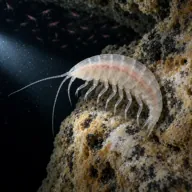
Cave dwelling copepods and micro crustaceans
Almost always
Bacterial films on the rock
Almost always
Endemic cave amphipod, the local albino shrimp
Often
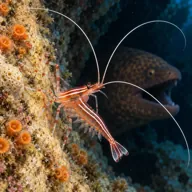
Common shrimp species from the bay
Sometimes · Gamblu

Cardinalfish near the deeper seawater layer
Lucky day · Sultan iċ-ċawl
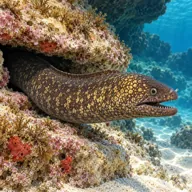
Mediterranean moray
Lucky day · Morina
Getting in and staying safe
Not a public dive site. Entry is through private land on the north side of St George's Bay and a built stairway that drops into the upper chamber, so permission from the landowner and the relevant authorities comes first and there is no way around it. Kit has to be carried down the steps, which is the real work of the day: think two trips, or a helper. Once inside there is no surface support, no boat, and no way to exit except back up the same stairs. St Julian's has every cafe and toilet you could want within a few minutes' walk, which is a strange contrast with what you are about to do.
- Overhead environment with no direct route to the surface from the lower chamber
- Depths past 50 metres inside a cave, so mixed gas and full cave protocols
- Silt floor that clouds instantly and can take hours to settle
- Halocline around 18 metres that ruins visibility and messes with buoyancy
- Narrow connecting corridor between the chambers
- Carrying full kit down and back up a long staircase
- Extremely fragile habitat, easy to damage with fins or bubbles
- Access is restricted, so diving without permission is both illegal and unsupported
A bit of history
The cavern is a karst feature dissolved out of Maltese limestone and drowned as sea level rose after the last glaciation, which is why a cave that formed in air is now full of water. Two chambers sit on different levels and are joined by a narrow submerged corridor. Its water column preserves a layered freshwater to seawater gradient that makes it scientifically valuable well beyond diving, and it supports an endemic cave adapted crustacean. Malta's environment authority gave the cave and Wied Harq Hamiem formal protection in 2008. Since then a succession of very large hotel, residential and retail proposals on the land above have kept the cave in the newspapers, with local campaigners arguing that construction and dewatering would wreck the hydrology that makes it what it is.
Divers say
Sign in to rate this site and leave a note for the next diver.
- No reviews yet. First one gets bragging rights.
Further reading: Wikipedia: Ghar Harq Hamiem · Malta Dive Sites: Harq Hamiem Cave · The Shift News: a unique cave threatened by development · MaltaToday: fate of Harq Hammiem cave still unclear · Lovin Malta: diver explores Harq il-Hammiem