🦞 Crustaceans · Anchialine and marine cave crustaceans
Cave crustaceans
Pale, eyeless life in the dark end of the cave
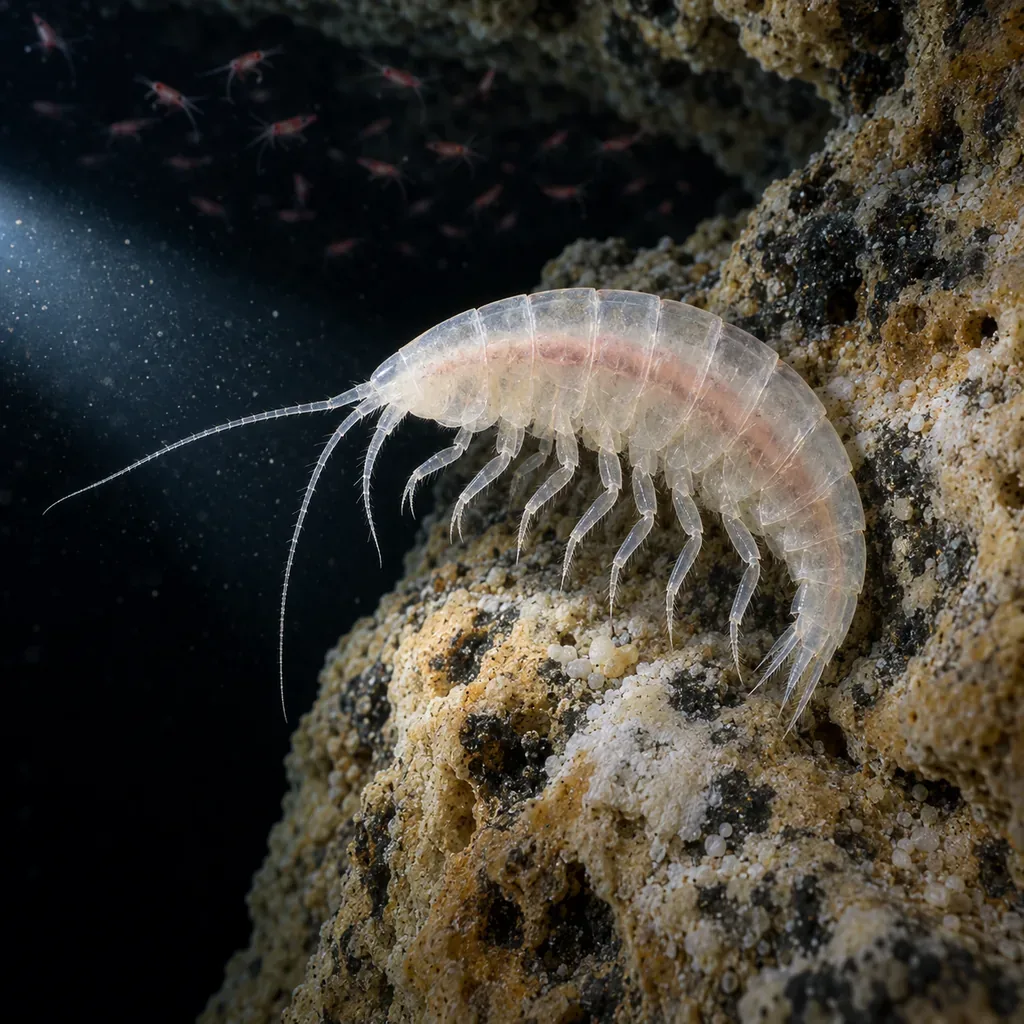
Meet the Cave crustaceans
This is a group entry for the small crustaceans that live where the light stops. Maltese sea caves have a recognisable zonation: a bright entrance with algae and sponges, a dim middle section, and a dark inner zone where the water barely mixes, food is scarce, and the walls carry white or grey bacterial films that look like a thin coating of paint or mucus. It is in that inner zone that the specialists live.
The best-documented Maltese site is Għar Ħarq Ħamiem at St George's Bay in St Julian's, an anchialine cave with fresh water sitting over brackish water over near-seawater, two chambers, a sharp thermocline in the top few metres and a lower chamber running to around 50 m. It is a Site of Scientific Importance and an Area of Ecological Importance, and in 2024 the eyeless amphipod Neogammarus karamani was recorded there for the first time in the Maltese islands. Alongside amphipods, the fauna of such caves is dominated by copepods, ostracods, isopods and small mysid shrimps of the genus Hemimysis, which hang in reddish swarms under dark ceilings.
Be careful with the stories. Divers often talk about a local "albino shrimp", and pale, weakly pigmented shrimps of the ordinary reef genera do turn up in Maltese cave darkness, along with the golden coral shrimp Stenopus spinosus and prawns of the genus Palaemon in the twilight zone. But no blind endemic cave shrimp has been formally described from Malta, and what is confirmed in the literature is the eyeless amphipod, the copepods and the bacterial films, not a white shrimp.
When to look: All year; cave water changes little with the seasons, which is exactly why these animals live there.
Diving with them
- Bring a narrow bright beam and look at the wall and ceiling rather than into the open water; almost everything here is a centimetre or two long.
- Reddish clouds hanging under a dark ceiling that scatter when your light hits them are mysid swarms, not silt.
- The pale grey or white smears on the rock are bacterial films, part of the food chain here rather than pollution, so do not wipe them off.
- Perfect buoyancy is the whole game: one fin stroke in a dark cave ends the dive for everyone behind you and smothers the wall community.
- Għar Ħarq Ħamiem is a protected overhead environment, not a fun dive; treat any Maltese cave beyond the light zone as a cave dive needing proper training, lines and permission.
Can it hurt you?Harmless
None of these animals can hurt you; they are millimetres to a few centimetres long and have no venom. The danger in a Maltese sea cave is the overhead environment, the silt and the exit, not the fauna.
Easily confused with
- Ordinary reef shrimps and prawns washed into the twilight zone, which are larger, pigmented and have normal eyes
- Suspended silt and marine snow, which drifts passively where a mysid swarm reacts to your light
Where to meet them: 1 sites
Further reading: First record of Neogammarus karamani in a Maltese marine cave · Għar Ħarq Ħamiem anchialine cave, Malta · Distribution and ecology of decapod crustaceans in Mediterranean marine caves · Feeding strategies of Mediterranean marine cave mysids