Malta
Dornier Wal XI
The remains of an interwar Italian flying boat lying on open sand in the middle of Ġnejna Bay, shallow enough to snorkel and one of the oldest aircraft you can dive anywhere in Malta.
Sea conditions
Excellent right now
Flat, sheltered and calm
Forecast for the site, updated 01:47 AM
- Waves
- 0.4 m
- from ESE
- Wind
- n/a
- Swell
- 0.4 m
- 5 s period
- Sea temp
- 29 °C
Next 7 days
Exposed to wind and swell from: W (270°), NW (315°), SW (225°). Ġnejna faces the open northwest, so a blow from that quarter fills the bay with surge and turns the sand to soup. In settled weather visibility is excellent, often 25 metres and more, and the bay stays flat with effectively no current. Check the swell forecast rather than just the wind speed. Best season: May to October. Early mornings in summer beat both the beach crowd and the afternoon sea breeze..
The dive
There is not a lot of aeroplane left. What survives is a section of hull with the stubby sponsons still attached, plus a scatter of cockpit hardware including a rudder pedal, all sitting on open sand in the middle of Ġnejna Bay. It is low, flat and very easy to swim straight past if you are not counting kick cycles.
That modesty is the charm. This is a 1930s Dornier Wal, a twin engine flying boat with a 22 metre wingspan, and the pieces in front of you were flying over the Mediterranean before the Second World War had started. Freedivers get as much out of it as scuba divers do, and on a bright day the whole thing is lit like a studio set.
The rest of Ġnejna is a gentle sand and boulder bay with seagrass patches in the gaps, so the wreck slots neatly into a longer wander. Bring a compass and a rough bearing from the beach, because the real skill here is finding a low wreck on featureless sand rather than diving it.
One caution on the numbers: published depths vary. Most current sources put the wreckage at around 5 to 6 metres in the middle of the bay, while some older guides describe aircraft remains further out at about 15 metres. Plan for a search rather than a guaranteed find, and do not be surprised if a local guide takes you somewhere other than where you expected.
- A 1930s flying boat you can reach on a single breath
- Sponsons and cockpit fittings still recognisable after ninety years
- Beautiful shallow light for photography and freediving
- Sand, boulders and seagrass in one easy bay
- A proper navigation exercise wrapped around a historic wreck
Typical plan
Kit up at the car, walk in off the sand and drop to 3 metres as soon as you are clear of the swimmers. Take a compass bearing out into the middle of the bay and swim a slow search between 5 and 7 metres, zigzagging either side of the bearing until the sponsons appear. Forty five minutes to an hour on a single cylinder is plenty and gas is rarely the limiting factor at this depth. Finish along the boulders and seagrass at the southern side of the bay in 4 to 5 metres, which is where most of the life lives anyway, and walk out on the same beach you started from.
What the bottom looks like
- 1Scattered boulders on the sand near the shore4 m deep · 60 m out
- 2Posidonia patches between the rocks5 m deep · 120 m out
- 3Fuselage section with the sponsons attached6 m deep · 260 m out
- 4Cockpit fittings including a rudder pedal6 m deep · 268 m out
- 5Open sand toward the mouth of the bay8 m deep · 400 m out
Clean pale sand across the middle of the bay, broken up near the sides by boulders and patches of seagrass.
Who you might meet
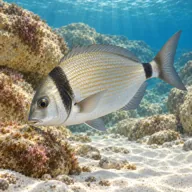
Two-banded bream
Almost always · Sargu

Damselfish
Almost always · Ċawl

Mediterranean parrotfish
Almost always · Marzpan
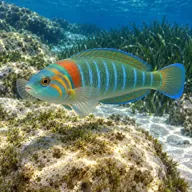
Ornate wrasse
Almost always · Tirda tal-passa
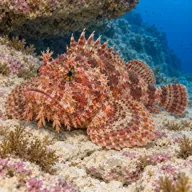
Scorpionfish
Often · Ċippullazza

Octopus
Often · Qarnit

Red mullet
Often · Trilja

Common stingray
Sometimes · Raja
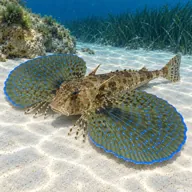
Flying gurnard
Sometimes · Bies · Summer
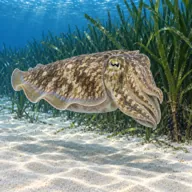
Cuttlefish
Sometimes · Siċċa · Spring

Short-snouted seahorse
Lucky day · Żiemel tal-baħar
Getting in and staying safe
Ġnejna Bay is reached from Mġarr down a narrow road that drops steeply to the shore, so take the descent slowly and think about whether your hire car wants to come back up it fully loaded. There is a free car park right by the beach which fills early at weekends, and the attendant will expect a euro or two. From the car it is a short carry across sand to a walk in entry, which is about as kind as Maltese shore diving gets. A restaurant, toilets and watersports hire operate behind the beach in season, and the boathouses along the sides belong to local fishermen.
- Swimmers, kayaks and small boats all over the bay in summer
- Featureless sand makes navigation the main challenge, carry a compass
- Very little relief on the wreckage, easy to swim straight past it
- Swell rolls into the bay from the west and northwest and stirs the sand
- Shallow depth tempts very long dives, watch time, cold and sun exposure
- Sea urchins on the rocks at either side of the bay
- The wreck is a protected historic site, look but leave everything in place
A bit of history
The aircraft was a Dornier Do J Wal, a German design built under licence in Italy, roughly 17 metres long with a 22 metre wingspan, three crew and room for eight to ten passengers. This one carried the registration I-AZEA and flew for the Italian airline SANA. On 16 February 1932 an engine fire forced it down onto the sea near Malta. Everyone aboard was taken off by HMS Brillant and the flying boat was towed in. For decades the wreckage in Ġnejna was assumed to be a CANT Z.506B floatplane. The Malta Aviation Museum, working with the Dornier Museum in Germany, went back through the evidence and re-identified it as a Wal, with a surviving cleat clinching the case.
Divers say
Sign in to rate this site and leave a note for the next diver.
- No reviews yet. First one gets bragging rights.
Further reading: Malta Dive Sites, Dornier Wal XI wreck · Aviation Safety Network, I-AZEA accident record · Divers Guide, Ġnejna Bay · Visit Malta, Ġnejna Bay