Malta
Ras ir-Raheb
Malta's western elbow, where a cave you can swim into from the surface drops to 25 m and the cliff outside falls away past 70 m into open blue. One of the island's great big-water dives.
Sea conditions
Excellent right now
Some chop (0.4 m ESE)
Forecast for the site, updated 01:47 AM
- Waves
- 0.4 m
- from ESE
- Wind
- n/a
- Swell
- 0.4 m
- 5 s period
- Sea temp
- 29 °C
Next 7 days
Exposed to wind and swell from: W (270°), NW (315°), SW (225°), N (0°). As a west-facing headland it takes anything from the open Mediterranean quarter head-on, and a point always accelerates whatever current is running. Guides consistently flag currents, surge and swell here. Go on a flat easterly day and be prepared for the skipper to call it off. Best season: Late May to October. Visibility is regularly 30 to 40 m and can touch 50 m in autumn.
The dive
Ras ir-Raheb is the blunt headland that separates Fomm ir-Rih from the coast running north towards Gnejna, and it gives you two dives in one. The first is the cave, which opens at the waterline and sinks to about 25 m inside, a proper cathedral of a thing that swallows the daylight in stages as you go down. The second is the wall outside, which starts on a narrow shelf around 20 m and then simply stops being a slope.
Below that shelf the rock goes vertical and keeps going to a sandy floor somewhere past 70 m. There is nothing to hold on to visually, no sand to reassure you, just deep blue in every direction and a face of limestone at your shoulder. Divers who come here for the first time often report a strange wobble of vertigo, and the honest answer is that it is the clarity playing tricks rather than anything going wrong.
The better plan for most people is to use the wall as scenery rather than as a target. Run it east towards Fomm ir-Rih, where the ground rises to a friendlier 20 m, and let the pelagic traffic come to you. This is one of the spots where amberjack and the odd tuna genuinely pass through, and the resident grouper here are a decent size.
- A cave you enter from the surface and follow down to 25 m
- A properly vertical wall into water deeper than 70 m
- Big blue with a real chance of amberjack and passing pelagics
- Resident grouper that are used to being looked at
- Visibility that routinely hits 40 m
Typical plan
Drop onto the shelf beside the rock, do the cave first while you are fresh and your light is strong, working down to around 25 m inside and back out into daylight. Then take the wall east towards Fomm ir-Rih at a planned 30 to 35 m for ten to fifteen minutes, keeping the rock on one shoulder as your only reference. Come up in stages along the shelf and finish shallow. Nitrox 28 pays for itself here, and if you are going past 35 m treat it as a staged decompression dive with a slung deco cylinder. Total run time 40 to 50 minutes.
What the bottom looks like
- 1Cave mouth at the surface4 m deep · 5 m out
- 2Cave floor at about 25 m22 m deep · 16 m out
- 3Narrow shelf at 20 m20 m deep · 34 m out
- 4Lip where the wall goes vertical30 m deep · 42 m out
- 5Sheer face into the blue55 m deep · 55 m out
- 6Sandy floor beyond 70 m72 m deep · 80 m out
Hard limestone shelf and vertical wall above a clean sand floor that sits deeper than 70 m.
Who you might meet
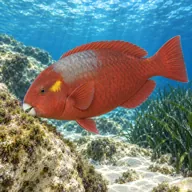
Mediterranean parrotfish
Almost always · Marlozz
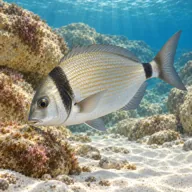
Two-banded bream
Almost always · Sargu
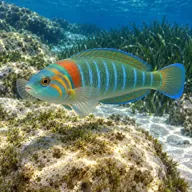
Ornate wrasse
Almost always · Ħaruġ

Cardinalfish
Almost always · Re tat-trilji
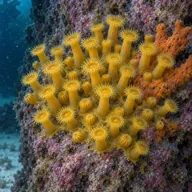
Golden zoanthids
Almost always
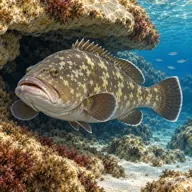
Dusky grouper
Often · Ċerna
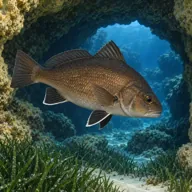
Brown meagre
Often · Gurbell
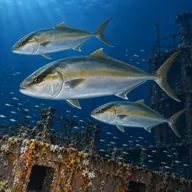
Amberjack
Sometimes · Aċċola · Late summer and autumn
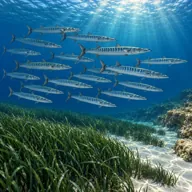
Barracuda
Sometimes · Lizz
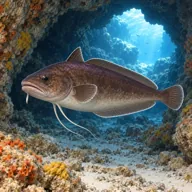
Forkbeard
Sometimes · Lipp
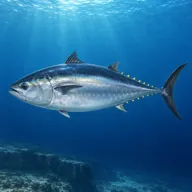
Atlantic bluefin tuna
Lucky day · Tonn · Summer
Getting in and staying safe
Boat only, and it has to be a boat willing to sit close to a cliff in open water. Most operators run up from Cirkewwa or across from Gnejna when the forecast allows. The skipper puts you on the shallow shelf right against the rock so you can pick your depth on the way in rather than free-descending over nothing. There is no shore alternative: the clifftop is reachable on foot from Baħrija but the drop to the sea is not.
- Strong currents that can set hard around the point
- Deep water directly below you with no natural depth stop
- Blue-water disorientation and vertigo on the vertical face
- Cave section needs a light, a line plan and good buoyancy
- Surge inside the cave mouth even on a fairly calm day
- Boat cover is your only exit, so a DSMB is not optional
A bit of history
The headland is named for a Roman-period temple site on the clifftop, sometimes called Ras il-Knejjes, the point of the churches. Excavations there turned up the remains of a small sanctuary and sculptural fragments, and the Maltese name, the monk's head, probably comes from the ruined structure rather than any actual hermit. Geologically the point is Upper Coralline limestone sitting on softer Blue Clay, which is why the whole west coast here is a line of collapsing cliff and boulder scree.
Divers say
Sign in to rate this site and leave a note for the next diver.
- No reviews yet. First one gets bragging rights.
Further reading: Calypso Sub-Aqua Club site notes · Divers Guide: Ras ir-Raheb · Wikipedia: Ras ir-Raħeb · Malta Dive Sites index entry