🦞 Crustaceans · Palinurus elephas
Common spiny lobster
Awwistain Maltese, also Awista, Ġurad il-baħar, Ljunfant il-baħar
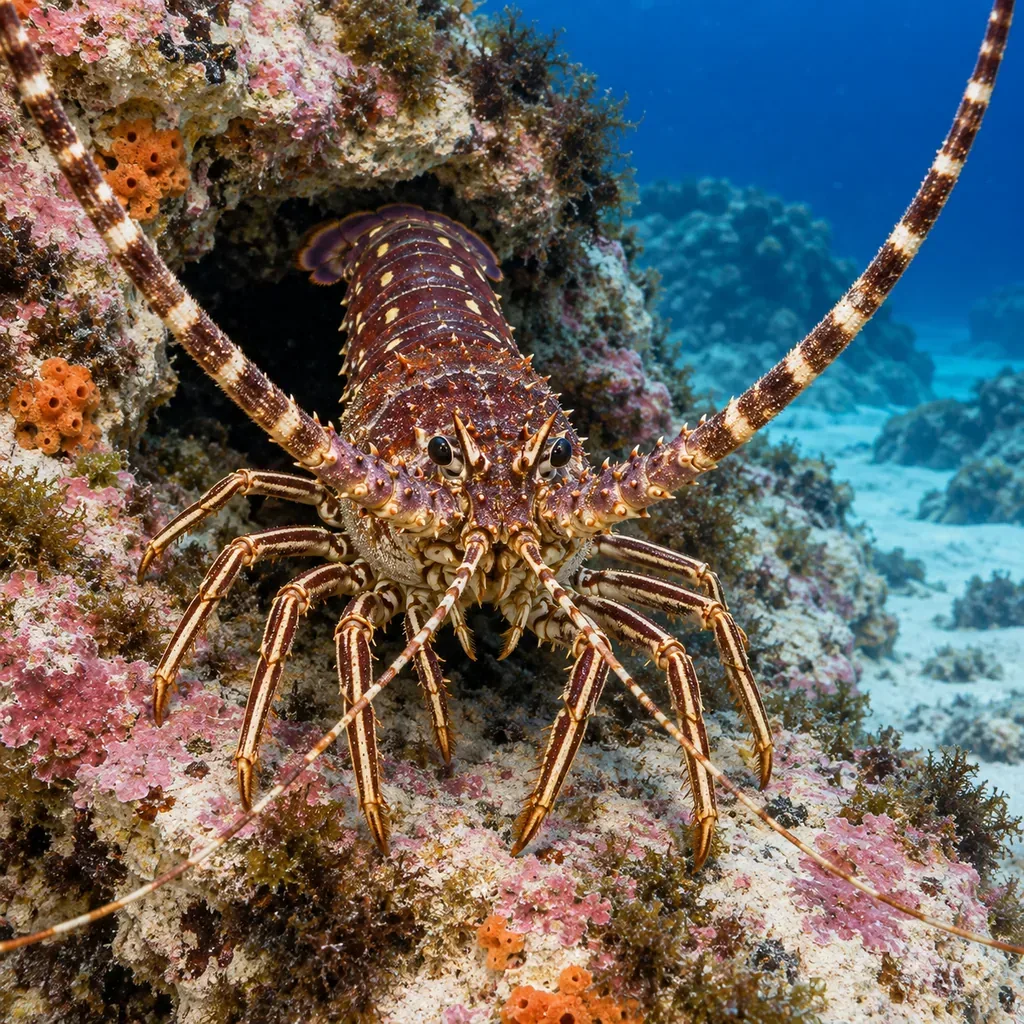
Two long whips waving from a black crevice
Meet the Common spiny lobster
The spiny lobster is the classic clawless lobster of the Mediterranean: a heavy, reddish-brown to purplish-brown animal covered in forward-pointing spines, with pale yellow and cream flecks along the abdomen and two enormously long, thick antennae that can be longer than the body. It has no crushing claws. Divers usually see the antennae first, two dark whips sweeping slowly out of a hole, long before they see the animal.
Around the Maltese islands it lives on rocky reef, boulder slopes and coralligenous walls wherever there are deep, dark holes to back into. It is recorded from about 5 m to 200 m and is commonest between 10 and 70 m, which puts good animals right at the edge of recreational depths on Gozo's north coast and on the deeper reefs off Ċirkewwa and Delimara. Big ones can reach 50 cm and several kilos, though anything over 30 cm is unusual in fished waters.
It is nocturnal, spending the day jammed in a crevice with only antennae and spiny head showing, then walking out over the reef at night to feed on mussels, urchins, worms and carrion. Several animals often share the same shelter, so where you find one antenna, look for a second pair deeper in.
When to look: All year; animals move out onto open reef after dark, and egg-carrying females are most often seen in autumn and late winter.
Diving with them
- Scan crevice mouths for antennae rather than bodies; the whips move even when the animal is completely hidden.
- Approach from the side and low. Come at it head-on and it will flick backwards into the hole with a loud tail slap.
- If it is agitated it rubs the base of its antennae to make a rasping creak you can sometimes hear underwater.
- Night dives on boulder slopes are by far the best chance of seeing a whole animal in the open.
- Look for the orange egg mass under the tail of females; leave those animals well alone and do not crowd them.
Can it hurt you?Handle with care
It has no claws and cannot bite, but the shell and antennae are covered in hard forward-pointing spines that will graze or puncture a bare hand if you grab it or reach blindly into its hole.
First aid: Wash a graze with clean fresh water, disinfect it and keep it dry; marine scratches infect easily, so watch for redness over the following days.
Easily confused with
- Mediterranean slipper lobster, which shares the same caves but is flat, clawless and has shovel-shaped plates instead of whip antennae
- European lobster, which is blue-black and has two large claws
Where to meet them: 19 sites
Further reading: SeaLifeBase: Palinurus elephas · Wikipedia: Palinurus elephas · Diveshack Malta marine life guide · Il-Miklem: Maltese crustacean names