🦞 Crustaceans · Homarus gammarus
European lobster
Ljunfantin Maltese, also Ljunfant il-baħar
The rare blue one with the heavy claws
Meet the European lobster
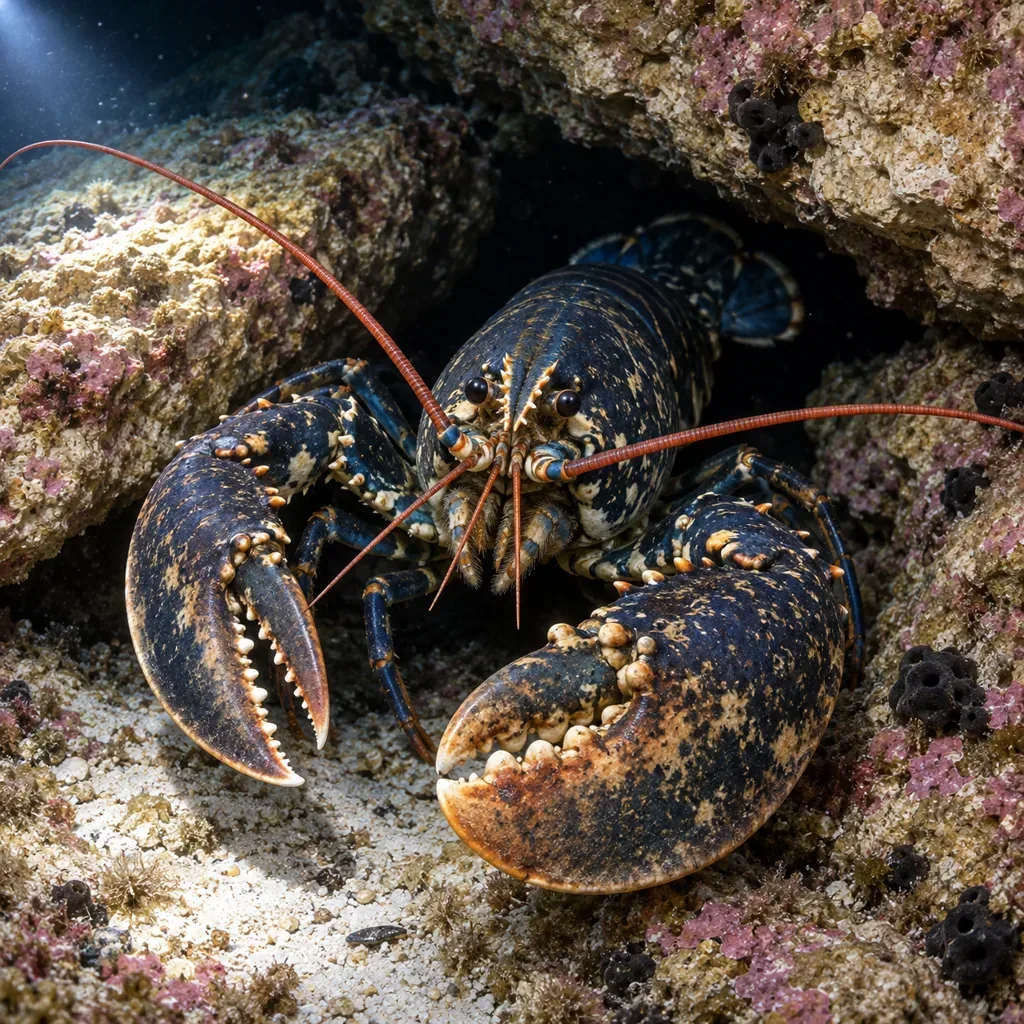
This is the true clawed lobster, and in Maltese waters it is the rarest of the three big ones. The body is a dark navy to blue-black with cream marbling and long red antennae, and the two front claws are unmistakable and unequal: one heavy crusher with blunt knobbed teeth, one slimmer cutter with sharp ones. Animals of 30 to 40 cm are a good Maltese size; the species can reach 60 cm and several kilos elsewhere.
It wants hard bottom with deep shelter, so look on rocky reef, boulder fields and the broken ground around wreck debris, mostly between about 10 and 50 m. It is solitary, territorial and strongly nocturnal, sitting in a burrow or crevice by day with claws held forward across the entrance and coming out at night to hunt crabs, molluscs, urchins and carrion.
Be realistic about your chances. Fishing pressure has thinned it out badly across the central Mediterranean, and most Maltese divers who see one see it on a night dive as a pair of claws and two red antennae in a hole. Ċirkewwa, Delimara and the deeper boulder slopes on Gozo's north coast are the sort of ground where it turns up.
When to look: All year, almost always after dark; it stays deep in shelter through the day.
Diving with them
- Two red antennae plus a pair of pale claws filling a hole is the giveaway; the blue body is usually invisible.
- Light it obliquely rather than head-on, and keep your distance, as it retreats fast when a beam hits it squarely.
- Never put a hand into a crevice you cannot see into; the crusher claw is genuinely strong.
- Check rubble and plating around wreck sites at night, where crabs and shells give it easy feeding.
- Note the two different claw shapes if you get a photo; which side the crusher sits on varies between individuals.
Can it hurt you?Handle with care
It will not come at you, but the crushing claw can bruise or break the skin of a finger if you handle it or reach into its hole.
First aid: Let go and let the animal release rather than pulling; clean and disinfect any broken skin and keep an eye on it for infection.
Easily confused with
- Common spiny lobster, which is reddish brown, spiny and has no claws at all
- Mediterranean slipper lobster, which is flat and clawless with shovel-shaped front plates
Where to meet them: 8 sites
Further reading: Wikipedia: Homarus gammarus · Diveshack Malta marine life guide · EU commercial designations, incl. Maltese name Ljunfant · Barcelona Convention SPA/BD Protocol annexes