Lantern Point · Comino
Inner Lantern Point
The quieter half of Comino's southwest headland: a vertical wall that breaks up into car-sized boulders, with a narrow limestone fissure hiding a small cave. Deep, dark and usually empty of other divers.
Sea conditions
Excellent right now
Flat, sheltered and calm
Forecast for the site, updated 02:29 AM
- Waves
- n/a
- Wind
- 4 km/h
- S, gusts 8
- Swell
- n/a
- Sea temp
- n/a
- air 25 °C
Next 7 days
Sunrise 06:47, sunset 19:05
Exposed to wind and swell from: NW (315°), W (270°), SW (225°). Sheltered from anything with south or east in it, wide open to the westerly quarter. The site needs a genuinely flat day: if the boat crew are squinting at the swell on the way out, it will be worse on the point. Visibility is typically excellent, often 25 m or better, because there is no runoff anywhere near. Best season: May to early November, with the clearest water and warmest thermocline from September to early November..
The dive
Everyone motors round to the famous chimney. This is the bit just inside it, north of the lighthouse, and it rewards anyone who bothers. You drop onto a wall that falls away cleanly, keep the rock on your right shoulder, and let the blue do the work. Below about 30 metres the wall stops being a wall and becomes a jumble of enormous fallen blocks with dark gaps between them, which is exactly the sort of terrain that makes a torch beam worth carrying.
The headline feature is a tall crack in the limestone that opens into a shallow cave. It is small, it is not technical, and it is full of the quiet things: cardinalfish hanging motionless in the gloom, feather-duster worms that vanish the moment your shadow lands on them, burrowing anemones in the sediment. Big fish are not really the point here. Texture is.
Shallower and further in, the boulder field gives way to broad patches of Posidonia, which makes for a pleasant, low-effort last fifteen minutes while you burn off deco obligation. Plan it as a deep first half and a very lazy second half, because this is a boat dive with no shore exit and a headland that can turn on a current without much warning.
- A clean vertical wall that keeps going past sport-diving limits
- Boulder field big enough to feel genuinely cathedral-like
- Small cave in a limestone crack, packed with cardinalfish
- Almost always empty while the boats queue at the chimney
- Visibility that regularly makes 30 m feel like 10 m
Typical plan
Drop in, get down the wall promptly and run the deep leg first: 38 to 42 m along the boulders for eight to ten minutes, keeping the rock on your right. Step up to the 25 m ledge, work back along the wall, then find the fissure and the cave at around 20 m for a look with the torch. Finish over the seagrass at 10 to 12 m and shoot an SMB before you leave the bottom. Air divers should budget 35 to 40 minutes total on a 15 litre cylinder with a generous reserve; 32 percent nitrox is a poor fit for the deep leg, so either run air with a conservative plan or treat this as a light staged deco dive with a 50 percent deco mix.
What the bottom looks like
- 1Top of the vertical wall16 m deep · 22 m out
- 2Start of the collapsed block field33 m deep · 60 m out
- 3Deepest ledge before the sand haze44 m deep · 110 m out
- 4Limestone fissure and shallow cave20 m deep · 170 m out
- 5Posidonia patches on the shallow shelf15 m deep · 210 m out
Fractured Coralline limestone wall breaking down into large fallen boulders, with thin sediment pockets and seagrass patches on the shallower shelf.
Who you might meet

Cardinalfish
Almost always · Re tal-Imnieħru

Damselfish
Almost always · Kaħlija
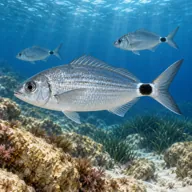
Saddled bream
Almost always · Kaħli
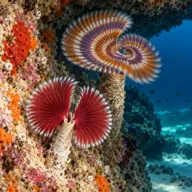
Peacock fan worm
Often
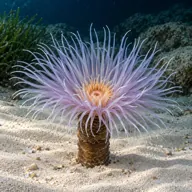
Burrowing anemone
Often
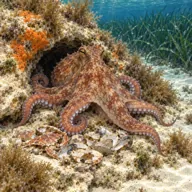
Common octopus
Sometimes · Qarnit
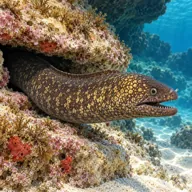
Mediterranean moray
Sometimes · Morina
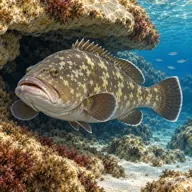
Dusky grouper
Sometimes · Ċerna
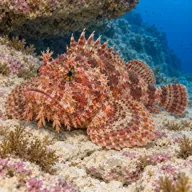
Scorpionfish
Sometimes · Ċippullazza
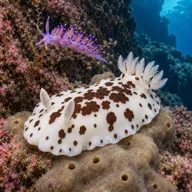
Nudibranchs
Sometimes · Spring

Greater amberjack
Lucky day · Aċċola · Late summer
Getting in and staying safe
Boat only. Most skippers run out from Cirkewwa, Mgarr in Gozo, or Bugibba, with the crossing to the southwest tip of Comino taking roughly twenty to forty minutes depending on where you start. There is no mooring and no shelter, so it is usually a live drop with the boat following your bubbles. Nothing on land: no ladder, no toilets, no cafe, no bail-out point. Whatever you need goes on the boat with you.
- Depths past 40 m on the boulder field, with real narcosis risk
- Current can run hard around the headland and switch with the tide
- Surge pushing you into the fissure and cave entrance
- Overhead environment in the cave: torch and a buddy line of sight
- Heavy tourist boat and ferry traffic on the surface, so deploy an SMB
- No shore exit at all, and no shelter if the wind gets up mid-dive
- Loose blocks and silty pockets between boulders
A bit of history
The whole headland is Ras l-Irqieqa, capped by the Comino lighthouse, and the rock is Upper Coralline limestone: hard, fractured, and prone to shedding house-sized blocks into deep water. That collapse debris is what you are swimming over. The "inner" in the name simply distinguishes it from the chimney site around the corner on the point proper.
Divers say
Sign in to rate this site and leave a note for the next diver.
- No reviews yet. First one gets bragging rights.
Further reading: Calypso Sub-Aqua Club: Inner Lantern Point · MaltaDives: Lantern Point (Ras l-Irqieqa) · Divers Guide: Lantern Point · Calypso Sub-Aqua Club: Lighthouse Reef