🪸 Corals & anemones · Cerianthus membranaceus
Fireworks anemone
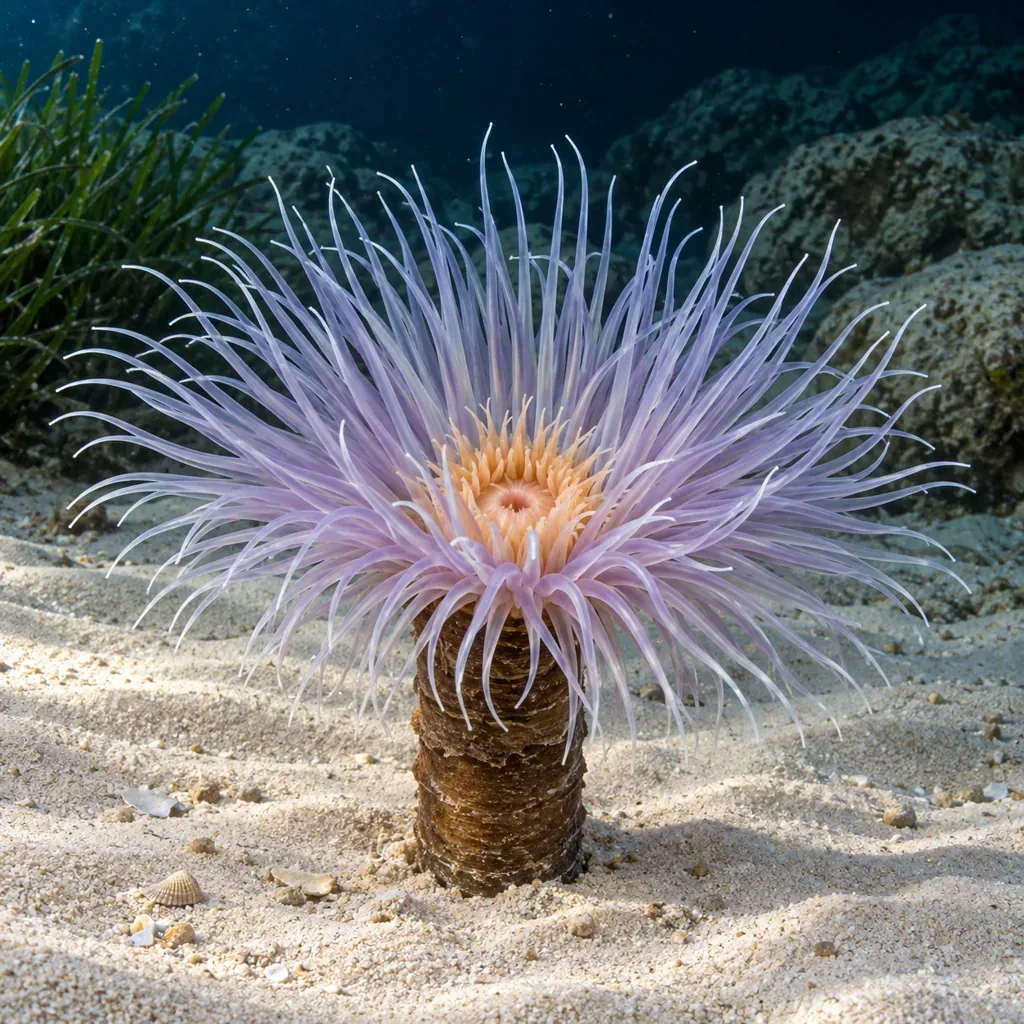
A firework frozen mid-burst on the sand
Meet the Fireworks anemone
A tube anemone rather than a true anemone, and unmistakable once seen. Two sets of tentacles rise from a soft felty tube buried in the sediment: a long outer ring, often 20 to 30 cm across and sometimes more, that fans out in a wide starburst, and a shorter, paler inner tuft around the mouth. Colours run from white and cream through pink, apricot and lilac to deep violet and chocolate brown, and the two whorls are often different shades, which is what makes it look like a firework caught at full bloom.
Unlike rock anemones it never attaches to hard ground. It spins a tough, parchment-like tube of mucus and sediment that can run a metre down into sand or silt, and it withdraws into it in a blink. Around the Maltese islands look for it on the sandy and silty patches between rock and seagrass: the sand bowl at the Blue Hole and Coral Cave in Dwejra, the sandy gullies at Xatt l-Aħmar and Ċirkewwa, and the soft bottoms of the harbours, from about 5 m down past 40 m.
It is a slow, quiet animal that feeds on drifting plankton and tends to be more fully expanded at night or on dim days. Approach it like a nervous fish and it will stay open; barge in and you get a small hole in the sand.
When to look: All year; fullest and most confident at night or in low light.
Diving with them
- Get neutral and stop a body length away, then drift in; a bow wave or a fin wash makes it vanish into the tube
- Scan the flat sand beside reef edges and seagrass margins, not the reef itself
- Night dives at Dwejra and Xatt l-Aħmar are the best chance of seeing one fully open
- Shoot low and level with the sand so the tentacle crown reads as a full circle, and keep your strobes wide to avoid backscatter over silt
- Watch your trim near it: a single careless fin stroke buries the crown and clouds the whole sandy patch
Can it hurt you?Handle with care
Mildly stinging. Deliberately grabbing the tentacles can leave a nettle-like tingle or a light rash on bare skin, but there is no risk through a wetsuit or gloves and it never approaches you.
First aid: Rinse with seawater, do not rub, and dab with vinegar if there is any burning. A cold pack or an antihistamine cream is usually all that is needed.
Easily confused with
- Other tube anemones such as Arachnanthus oligopodus - fewer, banded tentacles, strictly nocturnal, and a much smaller crown
- Golden anemone (Condylactis aurantiaca) - a single whorl of thick tentacles with swollen coloured tips, and no parchment tube
- Feather duster and fan worms - a stiff two-lobed feeding fan on a rigid tube, spiralled rather than a loose starburst
Where to meet them: 5 sites
Further reading: Atlantis Gozo - Tube anemone at Gozo dive sites · Wikipedia - Cerianthus membranaceus · iNaturalist - Cerianthus membranaceus · WoRMS - Cerianthus membranaceus