🐙 Cephalopods · Loligo vulgaris
European squid
Klamarin Maltese, also Klamari
A torpedo of glass and sparks in the dark
Meet the European squid
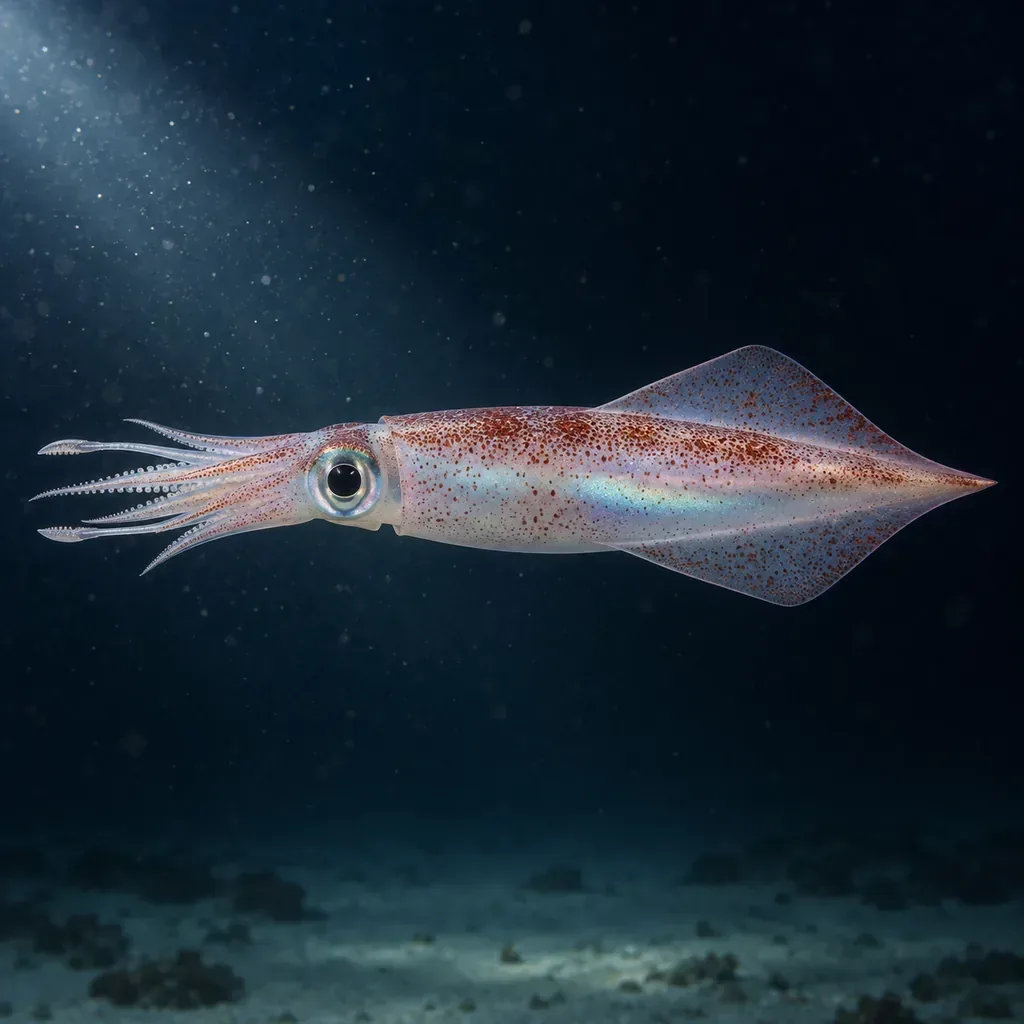
A slim, torpedo-shaped cephalopod, translucent pinkish-white in a torch beam and stippled all over with tiny red-brown chromatophores that flicker on and off like static. Two long triangular fins occupy roughly the rear two thirds of the mantle and meet in a point at the tail, giving the classic dart outline. There are eight arms and two much longer feeding tentacles that stay retracted until the strike. The eyes are large and dark with a round pupil. Mantle length is usually 15 to 30 cm here; large males reach about 40 to 45 cm.
Unlike octopus and cuttlefish this is an open-water animal. It travels in loose schools, hangs in mid-water with the fins undulating, and can jet backwards faster than you can follow it. Divers meet it mostly at night, when squid come up and gather around boat lights and torch beams to pick off the small fish and shrimps the light attracts, and occasionally by day as a school passing over a deep reef.
Around Malta it spawns mainly from late autumn through spring, laying finger-like gelatinous egg strands in big communal bundles on sand and rubble between roughly 20 and 40 m. Divers who find one of these white egg mops should recognise it for what it is and keep clear. Klamar is a standard item on Maltese menus and a favourite target of night fishers using lit jigs off the breakwaters.
When to look: Mainly on night dives and around lit boats; most numerous inshore from late autumn to spring, which is also the spawning season.
Diving with them
- Night dives and safety stops under a lit boat are where you will actually see them, hanging just at the edge of the light
- Keep your torch beam steady and slightly off to the side; sweeping the light chases them away
- Do not try to close the distance - hold still and they will drift in to inspect you
- Watch for the chromatophore flicker rushing across the body, the fastest colour change you will see underwater
- In winter and spring, look on sand and rubble at 20 to 40 m for communal bundles of white finger-shaped egg strands, and stay off them
- For photographs use a low flash power and shoot slightly downward; the translucent body blows out easily
Can it hurt you?Harmless
Harmless to divers. It has a beak like any cephalopod but it flees rather than confronts, and you are extremely unlikely to get close enough to be bitten.
Easily confused with
- Common cuttlefish, which is broader and flatter with a fin skirt running the full length of both sides and a W-shaped pupil
- Midsize squid such as Alloteuthis media, much smaller with a long drawn-out tail tip, often mixed into the same night-time gatherings
- Flying squid, which have shorter, more arrow-like fins confined to the rear and are usually seen far offshore
Where to meet them: 2 sites
Further reading: SeaLifeBase: Loligo vulgaris · European squid overview · English-Maltese terminology for squid · Maltese seafood names in everyday and market use