Malta
Italian E-boat
A broken up fast attack craft from the siege years lying at 45 metres north of Zonqor Point, mixed in with a Corsair wing, a barge and assorted war debris. More of a treasure hunt than a wreck dive.
Sea conditions
Good right now
Some chop (0.5 m E)
Forecast for the site, updated 01:45 AM
- Waves
- 0.5 m
- from E
- Wind
- n/a
- Swell
- 0.5 m
- 5 s period
- Sea temp
- 28 °C
Next 7 days
Exposed to wind and swell from: N (0°), NE (45°), E (90°), SE (135°). Open to the eastern half of the compass with only the island itself to break a westerly. Northeasterly and easterly winds build a short chop quickly here and make the surface work unpleasant, so trips need a settled forecast. Visibility at depth is usually good, often twenty metres or more. Best season: May to October.
The dive
Call it a wreck and you will be disappointed. Call it an underwater junkyard from the most violent years of Malta's history and you will have a great time. At forty five metres, north of Zonqor Point, there is a field of scattered metal among big boulders: torpedo tubes, engine components, structural sections, and enough other pieces that identifying what you are looking at becomes the point of the dive.
The craft itself was one of the fast attack boats that both sides threw at the Malta convoys, and the most commonly repeated explanation locally is that it ran onto one of its own mines while laying a field across the Grand Harbour approaches. Nobody has published a watertight identification, and the popular name has drifted between an Italian MAS type boat and a German Schnellboot over the years, so take any confident claim with salt.
What makes the site worth the gas is the company it keeps. A Corsair wing sits nearby, along with a barge and other bits of the war, so a single dive can take in several completely unrelated pieces of 1940s wreckage. It is boat only, it is technical, and the reward is curiosity rather than a photogenic hull.
- Torpedo tubes still recognisable on the seabed
- A Corsair wing and a barge thrown into the same dive
- One of the few sites where identification is the actual challenge
- Short boat ride for a proper technical objective
Typical plan
Forty five metres for around twenty minutes of bottom time on trimix or a conservative nitrox and deep air plan, with twenty to thirty minutes of decompression. Run a reel from the shot, sweep outwards in a widening search of the debris, and leave yourself gas to get back to the line rather than freelancing an ascent. A good torch turns a grey rubble field into a story.
What the bottom looks like
- 1Main concentration of E-boat structure45 m deep · 18 m out
- 2Torpedo tubes45 m deep · 35 m out
- 3Engine components45 m deep · 55 m out
- 4Corsair wing section46 m deep · 80 m out
- 5Barge remains46 m deep · 105 m out
- 6Boulder field with scattered debris46 m deep · 120 m out
Sand and rubble between large boulders, with metal fragments spread across it.
Who you might meet

Cardinalfish
Almost always · Sultan iċ-ċawl
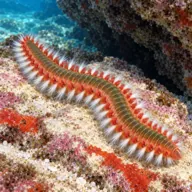
Fireworms
Almost always · Busuf
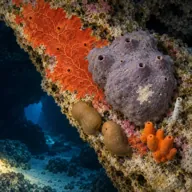
Encrusting sponges
Almost always · Sponża
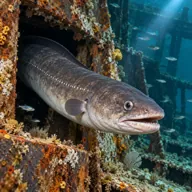
Conger eel
Often · Gringu
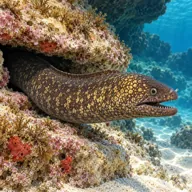
Mediterranean moray
Often · Morina
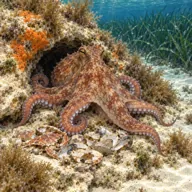
Common octopus
Often · Qarnita
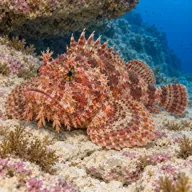
Scorpionfish
Often · Skorfna

Dusky grouper
Sometimes · Cerna

Greater amberjack
Sometimes · Accola · Summer

Common stingray on the sand
Sometimes · Rajja
Getting in and staying safe
Boat only, easily reached from Marsaskala or the southeast harbours since it is only around 1.5 km off Zonqor Point. A shot is dropped on the main debris concentration. Dive centres generally require extended range or equivalent technical certification before they will run it.
- 45 metres, so mandatory decompression and gas planning
- Sharp torn metal scattered among boulders
- Easy to lose the shot line in a low relief debris field
- Fishing line and net snagged on the wreckage
- Possible unexploded ordnance, do not move or lift anything
- Boat traffic out of Marsaskala
- Narcosis at working depth while trying to identify confusing shapes
A bit of history
Fast attack craft of this type, Italian MAS boats and German S boats alike, operated against Malta's supply convoys during the siege, and one of the best known actions was the Decima MAS raid on the Grand Harbour in July 1941. The prevailing local account of this wreck is that the boat detonated a mine from its own load while mining the harbour approaches, which would explain how completely it is broken up. The identification has never been published with certainty, and the surrounding material, including an aircraft wing from a Corsair and the remains of a barge, suggests the area served as a general dumping and casualty ground during and after the war.
Divers say
Sign in to rate this site and leave a note for the next diver.
- No reviews yet. First one gets bragging rights.
Further reading: Malta Dive Sites: Italian E-boat · Divers Guide: Italian E-boat · Wikipedia: Raid on Grand Harbour, July 1941