Gozo
Ħalq Ħamiem
A huge dry cave bitten out of the north coast cliff, with a shaft in its roof that runs all the way up to daylight. The dive starts in six metres of green light under that hole and works out over a boulder field to twenty.
Sea conditions
Excellent right now
Flat, sheltered and calm
Forecast for the site, updated 01:47 AM
- Waves
- 0.4 m
- from ESE
- Wind
- n/a
- Swell
- 0.3 m
- 5 s period
- Sea temp
- 28 °C
Next 7 days
Exposed to wind and swell from: N (0°), NW (315°), W (270°). A fair weather site. Northerly and northwesterly wind shuts the whole coast down, and the cave turns the smallest swell into a surge you can feel at six metres. Southerlies flatten it beautifully. Best season: June to October. Late summer gives the warmest water and the steadiest north coast weather..
The dive
You arrive at a sharp indent in the cliff, and the first thing that registers is not underwater at all: an enormous cavern above the waterline with a chimney bored through its ceiling, open to the sky at the top of the cliff. The boat noses in, you drop into about six metres of water, and the light coming down that shaft turns the whole cave a soft green. It is a strange, cathedral-ish start to a dive that is otherwise very straightforward.
Swim out of the cave and head north and the ground drifts away from you gently at first, then steps over a rocky ledge and settles at around twenty metres on a seabed completely paved with boulders. This is the good bit. The gaps between the rocks are full of small life, and because almost nobody dives here, the resident fish have not learned to be shy. Double-banded bream in numbers, octopus in most of the likely holes, and a genuinely decent chance of finding a seahorse if you slow right down and look at the rubble rather than past it.
As Gozo dives go this is an easy one: shallow, no overhead worth worrying about, no current to speak of most days, and visibility that regularly sits around twenty-five metres. Its difficulty is entirely logistical. It is boat-only, the north coast is fussy about weather, and it is far enough from anywhere that few centres bother. Ask for it on a flat day and you will have the place to yourself.
- A cathedral of a cave with a shaft of daylight dropping through its roof
- Shallow, easy profile that suits photographers and newer divers
- Boulder field at 20 metres that hardly anyone has searched
- Realistic chance of a seahorse if you slow down
- North coast visibility, often 25 metres or better
Typical plan
Drop inside the cave in six metres, spend the first few minutes under the roof shaft with the light, then head north over the ledge to the boulder field at 20 metres. Twenty-five minutes hunting the gaps between rocks is about right, then work back up the slope and finish shallow in the cave where you started. Fifty to sixty minutes on a single twelve with air is comfortable here; nitrox adds nothing you need at this depth but does no harm.
What the bottom looks like
- 1Floor of the main cavern, about 6 m6 m deep · 45 m out
- 2Roof shaft running up to the clifftop0 m deep · 48 m out
- 3Rocky ledge stepping down to 20 m15 m deep · 165 m out
- 4Boulder-paved seabed21 m deep · 215 m out
- 5Sand pockets between the boulders22 m deep · 240 m out
- 6Shallow rock on the return9 m deep · 340 m out
Massive boulders over bare limestone, with coarse sand and shell gravel collecting in the hollows between them.
Who you might meet
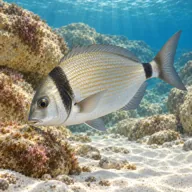
Double-banded bream
Almost always · Sargu
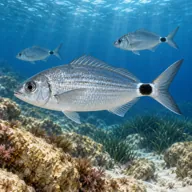
Saddled bream
Almost always · Kaħlija
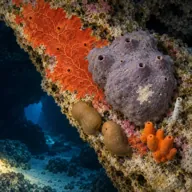
Encrusting sponges
Almost always · Sponża
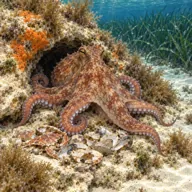
Common octopus
Often · Qarnit

Cardinalfish
Often · Re di trilji · In the cave
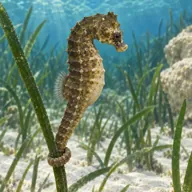
Short-snouted seahorse
Sometimes · Żiemel tal-baħar
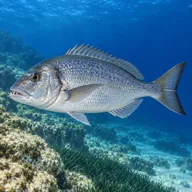
Dentex
Sometimes · Dentiċi
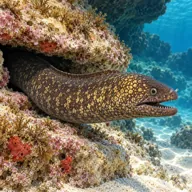
Mediterranean moray
Sometimes · Morina
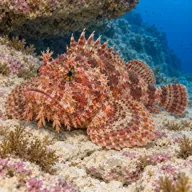
Scorpionfish
Sometimes · Ċippullazza
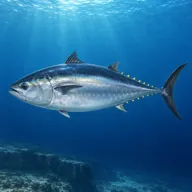
Atlantic bluefin tuna
Lucky day · Tonn · Summer
Getting in and staying safe
Boat only, out of Marsalforn most often, since that is the shortest run along the north coast. There is no shore and no exit from the cliff, so it is an anchored or live-boat drop with a pick-up at the end. No facilities of any kind at the site. The cave mouth is large enough for a small boat to nose into on a calm day, which makes for a memorable entry, but the skipper will not go in if there is any sea running.
- Boat-only with an unbroken cliff and no shore bail-out
- Surge inside the big cave whenever there is north in the sea
- Occasional variable current out over the boulder field
- Falling debris and bird mess under the roof shaft
- Boat traffic in and around the cave mouth
- Weather on this coast changes fast and can end the dive early
A bit of history
The name is Maltese and unglamorous in the best way: ħalq for a mouth or throat and ħamiem for pigeons, so roughly the pigeons' gullet, which is exactly what the roof shaft looks like from inside and exactly who lives in it. The cliffs here are Lower Coralline limestone and the cave is a sea-cut hollow that has eaten upward along a joint until it broke through to the surface, the same process that produced Gozo's windows and collapsed domes. There is a separate and unrelated Ħarq Ħamiem cave on Malta near St Thomas Bay, which causes regular confusion in dive listings.
Divers say
Sign in to rate this site and leave a note for the next diver.
- No reviews yet. First one gets bragging rights.
Further reading: Atlantis Gozo: Ħalq Ħamiem · Divers Guide: Halq Hamiem · Visit Gozo: Ħalq Ħamiem · Malta Dives: Halq Hamiem