Gozo
Tac-Cawla Caves
Four caves cut into a sheer north coast cliff, two of them running well over a hundred metres into the rock to air pockets sealed in by stone. Superb scenery, almost no fish, and a silt floor that punishes sloppy finning.
Sea conditions
Excellent right now
Flat, sheltered and calm
Forecast for the site, updated 01:47 AM
- Waves
- 0.4 m
- from ESE
- Wind
- n/a
- Swell
- 0.3 m
- 5 s period
- Sea temp
- 28 °C
Next 7 days
Exposed to wind and swell from: W (270°), NW (315°), N (0°), NE (45°). The wall faces the open north, so northerly wind closes it completely and a residual swell puts surge right into the cave mouths. Sensitive even to a modest blow the day before. When it is on, visibility outside the caves is usually twenty five to forty metres, and the contrast of the deep blue when you swim back out of a cave is the picture everybody wants. Best season: June to early October, when settled southerlies and flat northern seas are most likely. Not a winter site in any practical sense..
The dive
This is one of the more serious cave sites on Gozo's north coast and it does not get the traffic it deserves, partly because it is boat only and partly because the weather window is narrow. The cliff wall drops straight into the water and keeps dropping to about thirty five metres, where the bottom is a chaos of enormous boulders.
Four caves open in that wall. Two of them you can see from the surface, big obvious mouths in the rock. The other two are entirely underwater, starting around twenty metres and running narrow and straight for roughly forty and fifty metres respectively. The two wide ones are the headline: they go back into the cliff for something like a hundred and twenty and a hundred and thirty metres, far enough that you can surface in a pocket of air completely walled in by rock, with one of them needing a good ten minute swim to reach it.
The best known of the group is Gudja Cave, whose mouth stands a few metres above the waterline and whose entrance shallows sit at about eight metres. A short way in, the floor simply vanishes and falls to around thirty metres, and a huge arch runs down from twenty metres to the seabed at thirty four, making one of the more theatrical exits in Maltese diving.
The warning that comes with every description of this place is the same one: the cave floors are extremely silty. Line, lights, trim, and a genuine willingness to turn the dive.
- Two caves running well over a hundred metres into the cliff
- Surfacing in an air chamber completely enclosed by rock
- Gudja Cave's arch dropping from twenty metres to the seabed at thirty four
- The blast of blue when you swim back out of a long cave
- Massive boulder field at thirty five metres under a sheer wall
Typical plan
Cave-capable kit and a conservative gas rule. A typical dive starts at Gudja Cave: in over the eight metre shelf, along until the floor drops away, down to around thirty metres and out under the arch at thirty four, then back along the wall to look into one of the narrow caves with a reel. Average depth around twenty five metres, max thirty five, forty to forty five minutes on nitrox 30 in twins or a sidemount pair. Two lights each minimum, a reel per team, thirds on gas, and no penetration at all if the swell is putting surge on the entrances.
What the bottom looks like
- 1Gudja Cave mouth, standing above the waterline6 m deep · 8 m out
- 2Shallow entrance shelf inside Gudja Cave8 m deep · 20 m out
- 3Floor of Gudja Cave falling away to 30 m30 m deep · 30 m out
- 4Great arch running from 20 m down to 34 m27 m deep · 40 m out
- 5Narrow submerged cave, about 40 m long22 m deep · 60 m out
- 6Second narrow cave, about 50 m long24 m deep · 80 m out
- 7Wide cave running 120 m in to an air pocket20 m deep · 100 m out
- 8Massive boulders on the seabed at the cliff base35 m deep · 115 m out
Sheer Coralline limestone wall dropping to a floor of massive fallen boulders at thirty five metres, with deep fine silt collected on the cave floors.
Who you might meet

Mediterranean cardinalfish
Almost always · Re tat-trilji
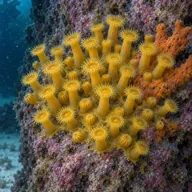
Yellow cluster anemone
Almost always

Mediterranean damselfish
Almost always · Kahlija
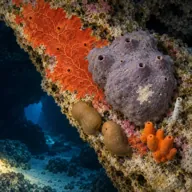
Encrusting sponges
Almost always · Sponża
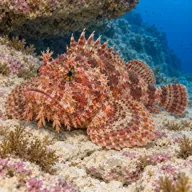
Scorpionfish
Often · Skorfna
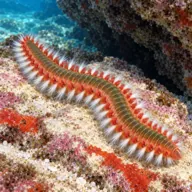
Bearded fireworm
Often · Busuf · Summer

Starfish
Often · Stilla tal-baħar
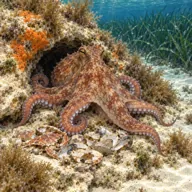
Common octopus
Sometimes · Qarnit
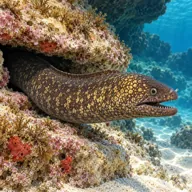
Moray eel
Sometimes · Morina
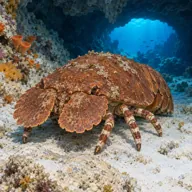
Slipper lobster
Sometimes · Cikala
Getting in and staying safe
Boat only, with a run along the exposed northern coast from Mgarr or Marsalforn depending on who is taking you. Skippers hold off the cliff rather than anchoring on the reef. There is no shore access, no beach, no landing point and nothing to stand on for the entire stretch of coast. Gear up on board, dive, get back on board, and note that a long surface swim to a boat in any chop is unpleasant with cave kit.
- Very silty cave floors that can go to zero visibility in seconds
- Penetrations of over a hundred metres into rock, well beyond daylight
- Air pockets that may contain stale or contaminated air, never breathe from them
- Loss of the exit line means a real emergency, so run a reel and mark jumps
- Depth of thirty five metres at the boulder base compounding a gas plan already stretched by penetration
- Surge at the cave mouths in any northerly swell
- Remote boat-only site with a long ride to assistance
A bit of history
No wreck and no war story, just several million years of limestone doing what limestone does. The caves are dissolution and wave-cut features in Gozo's Coralline Limestone, enlarged along joints and bedding planes, and the deep inner sections were likely dry passages when sea level was much lower during the last ice age. The trapped air chambers at the back are simply high points in the roof that the water never quite filled.
Divers say
Sign in to rate this site and leave a note for the next diver.
- No reviews yet. First one gets bragging rights.
Further reading: Visit Gozo, Tac-Cawla Caves · Visit Gozo, Gudja Cave · Divers Guide, Tac Cawla and Gudja Cave · Malta Dives, Tac-Cawla Caves