Malta
St Paul's Channel
The shallow gap between Malta and St Paul's Islands, a pale rocky trench a few metres deep that slides away towards 25 m where it opens to the sea. Easy, scruffy and almost never on a dive centre schedule.
Sea conditions
Excellent right now
Flat, sheltered and calm
Forecast for the site, updated 01:47 AM
- Waves
- 0.3 m
- from SE
- Wind
- n/a
- Swell
- 0.3 m
- 5 s period
- Sea temp
- 29 °C
Next 7 days
Exposed to wind and swell from: N (0°), NW (315°), NE (45°). Diveable when the wind has a southerly or easterly component and the sea state is low. Anything from north or north west turns the channel into a chute and kills the visibility. Best in the flat, glassy mornings of late spring and autumn. Best season: May to October, with the calmest water usually in June and September.
The dive
Selmunett, the little pair of islands that everyone calls St Paul's, is separated from the mainland by a strip of water you could almost throw a stone across. The channel floor is bright limestone shelving, sand pockets and short stands of Posidonia, sitting in three to six metres for most of its length. On a bright morning the whole thing glows, and you spend the dive with your shadow on the bottom.
Head north west and the character changes. The channel mouth widens, the walls step down in low terraces, and the sand runs out to somewhere around twenty five metres. That is the interesting half of the dive: a small drop, some boulder clutter and fish that behave like they have not been counted before.
Be honest about what this site is. It gets almost no traffic, so published detail is thin and you will be reading the seabed yourself rather than following anyone's route. Treat it as an exploratory potter with a compass rather than a headline dive, and go on a day with no north in the forecast.
- Bright, shallow limestone scenery you can dive on a half-full cylinder
- A quiet corner of the north coast that almost nobody visits
- The step down to 25 m at the seaward mouth for a bit of contrast
- Selmunett overhead, a nature reserve with its own St Paul legend
Typical plan
Drop in on the mainland side, set a compass heading along the channel and swim north west in three to six metres while the bottom stays in easy view. Once the walls open out, follow the sand down to fifteen or twenty metres, turn on thirds or at half a tank, and come back along the opposite side of the gap to vary the scenery. Sixty to seventy minutes on a single 12 litre is realistic, air or a light nitrox mix, with your safety stop happening naturally in the shallows.
What the bottom looks like
- 1Fallen blocks along the mainland edge3 m deep · 20 m out
- 2Posidonia patches on the channel floor6 m deep · 100 m out
- 3Open sand strip through the middle of the gap9 m deep · 170 m out
- 4Terraced step down at the seaward mouth16 m deep · 250 m out
- 5Broken rock and sand at the outer limit25 m deep · 320 m out
Pale limestone shelving broken by sand runs and scattered Posidonia, turning to rubble and sand towards the open end.
Who you might meet
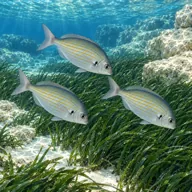
Salema
Almost always · Xilep
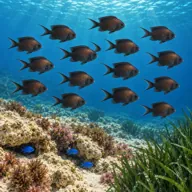
Damselfish
Almost always · Kaħlija
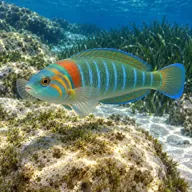
Ornate wrasse
Almost always · Tirda tal-passa
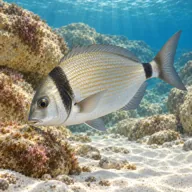
Two-banded seabream
Often · Sargu
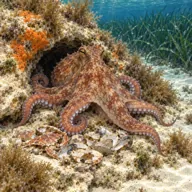
Octopus
Often · Qarnit
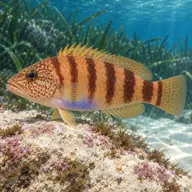
Painted comber
Often · Serran
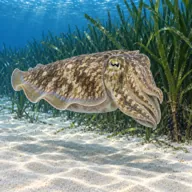
Cuttlefish
Sometimes · Siċċ · Spring
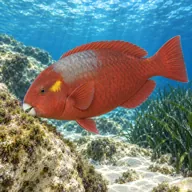
Mediterranean parrotfish
Sometimes · Marżpan
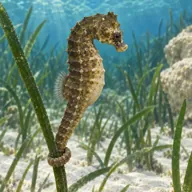
Short-snouted seahorse
Lucky day · Żiemel tal-baħar
Getting in and staying safe
There is no dive centre infrastructure. Reach the mainland shore from the tracks running off the Mellieha to Xemxija road above Mistra, park well clear of field gates, and expect a walk over rough ground in kit followed by a scramble over low rock. The rocks are slick with algae at the waterline, so plan your exit before you get in. Nothing else is provided: no ladder, no toilets, no shade. Most people who dive the channel do it from a small boat instead, which removes the whole problem.
- Current funnels through the narrow section, strongest when wind and swell push water through the gap
- Small boat and jet ski traffic cutting the channel in summer, so fly a DSMB or a buoy
- Surge and washing machine water at the north west mouth in any northerly
- Slippery algae covered rock at entry and exit
- Long carry over uneven ground with kit
- Sea urchins in the shallows
- Jellyfish drifting through in late summer
- Very little published information, so no fixed route to fall back on
A bit of history
Selmunett is bound up with the tradition that the Apostle Paul was wrecked on Malta in AD 60, which is where the islands take their English name. A statue of St Paul has stood on the larger islet since the 1840s. The islands are a nature reserve and a bird breeding site, and the Statue of Christ now off Qawra spent its first decade on the seabed just off here before being lifted in 2000.
Divers say
Sign in to rate this site and leave a note for the next diver.
- No reviews yet. First one gets bragging rights.
Further reading: Malta Dive Sites: St Paul's Channel · Malta Dive Sites: St Paul's Reef (neighbouring site) · Calypso SAC dive site notes for the St Paul's Island area