🪸 Corals & anemones · Eudendrium and Aglaophenia spp.
Hydroids
Feathery sea firs with a sting in them
Meet the Hydroids
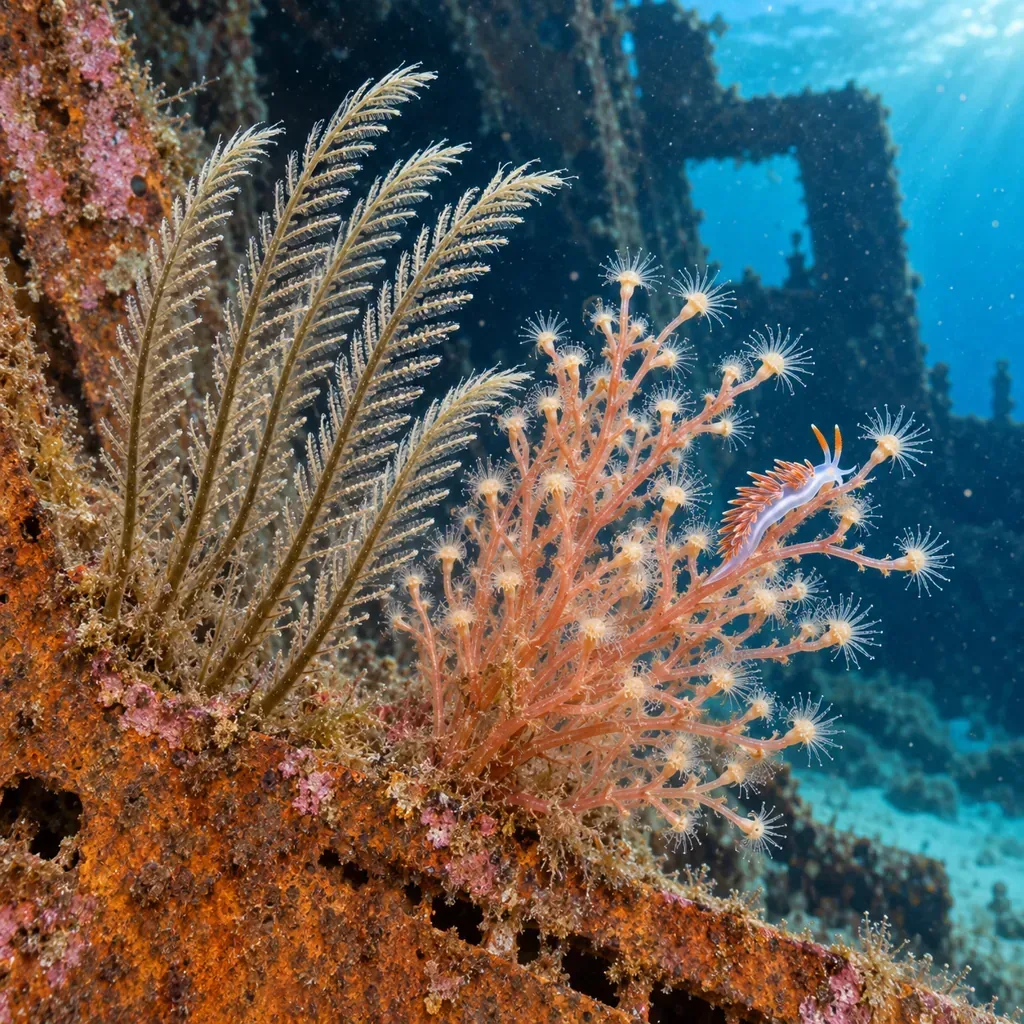
Hydroids look like small ferns or feathers growing out of the rock, and almost every diver assumes they are seaweed. They are animals: colonies of tiny polyps sharing a branching stem, each polyp catching plankton with a ring of stinging tentacles. Three kinds turn up constantly around Malta. Aglaophenia species, the classic sea firs, are stiff feather plumes 5 to 20 cm tall in grey, khaki or dull brown, growing in tufts on rock, on wreck plating and on the stems of larger algae. Eudendrium species, especially Eudendrium racemosum, make looser, bushier colonies of pinkish-orange stems with pale polyp heads at the tips. Pennaria disticha adds fine whitish plumes on harbour structures and lines.
They settle wherever water moves: the current-swept corners of Ċirkewwa and Comino, the railings, masts and ropes of the scuttled wrecks, mooring chains, and the shaded lips of reef ledges from the surface down past 50 m. Colonies come and go with the seasons and can appear on a new surface within months.
Stop at one and there is usually a second story running. Aeolid nudibranchs graze them hard - Cratena peregrina, blue-bodied with orange head tentacles, is the common Maltese one on Eudendrium - and sea spiders, skeleton shrimps and tiny brittle stars use the branches as cover.
When to look: Spring to autumn is peak growth, with the biggest Eudendrium bushes and most nudibranchs on them in the warm months.
Diving with them
- Treat every fern-like tuft on a wreck or a current-swept ledge as a possible stinger and keep bare skin off it
- Slow down and search the branches for aeolid nudibranchs; Cratena peregrina on Eudendrium is a reliable Maltese find
- Wrecks and mooring lines are where you get stung, because that is where you are holding on
- Wear a full suit and decent gloves on wreck penetration and line work, since thin summer gloves are not enough
- Great macro subject in backlight, which shows the branching structure that separates hydroids from algae
Can it hurt you?Handle with care
A mild sting that people usually notice as a delayed prickly, itchy rash minutes to hours after brushing a colony with bare skin, or through thin gloves and worn suit seams. Wrists, neck and the gap between glove and sleeve are the usual spots.
First aid: Rinse with seawater rather than fresh water and do not rub the area. Vinegar deactivates undischarged stinging cells. Immerse in hot water at about 45 C for 20 minutes or apply a cold pack, then use an antihistamine or hydrocortisone cream; the itch can last several days. Seek medical advice for a spreading rash, blistering or any sign of infection.
Easily confused with
- Bryozoans such as Reteporella - hard, brittle, lacy orange or cream sheets rather than soft branching plumes
- Fine red and brown seaweeds - limp and flexible, with no repeating polyp structure along the branches and no sting
- Feather stars (crinoids) - free-moving animals with arms that curl and reposition, unlike a fixed hydroid plume
Where to meet them: 4 sites
Rozi
Cirkewwa, Malta
Small World
Malta
Spitfire Mk Vc
Gozo
Further reading: MarLIN - A sea fir (Aglaophenia kirchenpaueri) · Wikipedia - Eudendrium ramosum · Biology Letters - Kleptopredation in Cratena peregrina · DAN Southern Africa - Jellyfish and hydroid stings