One of the very few diveable Spitfires anywhere, sitting upright on sand at around seventy metres off Qala. A ten minute look at a piece of 1943 that took seventy eight years to be found.
 Wreck
 Aircraft
Divers rarely, if ever, come here.
We found no record of anyone diving this site. It is charted so the picture of what lies under the water is complete, not because it is a place to go: there is no set route, no local briefing to lean on, and nothing on this page has been proven in the water.
Sea conditions
Stay dry right now
Sea is up (3.4 m NW) · Fresh WNW wind (40 km/h) · Gusts to 62 km/h
Done for today. Tomorrow: not looking good. Best it gets is 20 at 17:00: Sea is up (1.3 m NW)
Forecast for the site, updated 19:45 · Models disagree
Measured at Mġarr, Gozo (5.5 km away, 20:29): 36 km/h from WNW, gusts 41. The next hours lean on it.
- Waves
- 3.4 m
- from NW, biggest 4.8
- Wind
- 40 km/h
- WNW, gusts 62
- Swell
- 0.5 m
- 11 s period
- Sea temp
- 22 °C
- air 18 °C
Hour by hour
Next 7 days
 0 3.4 m
50 W
0 3.3 m48 WNW
 51 0.9 m
17 W
 87 0.4 m
15 ESE
73 0.5 m15 E
 71 0.5 m
22 NE
75 0.5 m21 SE
Sunrise 06:25, sunset 17:05
Waves: Copernicus Med-Waves 4 km + MFWAM 8 km + EWAM 5 km + ECMWF WAM 9 km. Wind: ICON-2I 2 km + ECMWF IFS 9 km + ICON-EU 7 km + UKMO 10 km + ARPEGE 11 km. Read a few km out on the side the site is open to, then blended.
Exposed to wind and swell from: N (0°), NE (45°), E (90°), SE (135°), S (180°). Offshore in the channel east of Gozo, so it is open to most of the compass from north round to south and only a settled, low-wind day makes it viable. Skippers want flat water for an hour of hanging on the line, not just for the ride. Visibility at depth is frequently thirty metres or better and the light at seventy metres is a deep, even blue. Best season: June to October, when the odds of a genuinely calm day and a warm surface for long decompression are highest. Operators tend not to run it outside the settled season at all..
The dive
This is a short dive with a long shadow. The aircraft lies upright on a flat sand plain at roughly seventy to seventy two metres, and the first thing you notice on the descent is how small a single seat fighter actually is once the sea has had it. The wings are laid out clean, the cockpit area is recognisable, and the rear fuselage has folded forward from the force of the ditching, leaving the tail sitting upside down just behind the trailing edge of the port wing. The wooden propeller blades did not survive the impact.
Seventy metres in Maltese water is usually spectacularly clear, and on a good day you will see the whole airframe from the shotline before you reach it. There is not much marine life to speak of: a forkbeard or a conger under a wing, a scattering of small sponges and hydroids starting the slow business of colonising aluminium, and the occasional dentex passing through. Everything worth looking at is the machine itself.
Because it is a protected site, you do not just turn up. Heritage Malta manages it and dives are arranged through registered centres and clubs, which in practice means a licensed skipper, a shot, a trimix plan and a team who have done it before. Nothing is to be touched, moved or taken.
Treat it as the memorial it is. The pilot was never found.
- A genuine Second World War Spitfire, upright and intact enough to read at a glance
- One of a handful of diveable Spitfires in the world
- Seventy metre visibility-rich blue with the whole airframe visible from the shot
- A war grave in all but name, with the pilot still missing
- Found only in 2021 and documented by Heritage Malta and Underwater Malta
Typical plan
Hypoxic trimix, shot line descent, and a plan you rehearse on the quay. A realistic profile is twelve to fifteen minutes at seventy to seventy two metres, one slow circuit of the airframe with the camera, then back to the line for around seventy to ninety minutes of staged decompression on travel mix, 50 percent and oxygen. Twin sets plus two or three stages, closed circuit if you have it, redundant lights and computers, oxygen and a hot drink waiting on the boat. Total run time in the region of two hours.
What the bottom looks like
- 1Shot line landing on flat sand71 m deep · under the boat
- 2Nose and engine bay, propeller hub without blades71 m deep · 15 m from the boat
- 3Cockpit area and centre section71 m deep · 28 m from the boat
- 4Port wing, still laid out flat71 m deep · 38 m from the boat
- 5Rear fuselage folded forward, tail inverted behind the wing72 m deep · 46 m from the boat
- 6Open sand plain around the airframe72 m deep · 70 m from the boat

Flat, fine sand with almost no relief, which is exactly why the aircraft has stayed recognisable and why silt lifts easily if you fin carelessly.
Who you might meet
Almost always
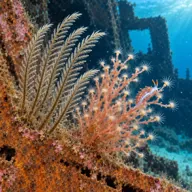
Often

Sometimes

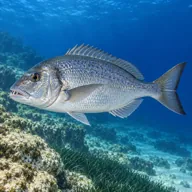


Lucky day
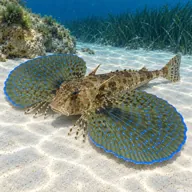
Marked ones can hurt you. What they do and what to do about it is under Getting in and staying safe.
Getting in and staying safe
Only for serious professionals who know exactly what they are doing. With no record of anyone diving here there is no one to ask and no set route, so treat every line below as the start of your own planning, not a briefing. Plan it as an expedition, not a dive.
Boat only, out of Mgarr on Gozo or one of the Malta harbours, and only through a dive centre or club registered with Heritage Malta for the site. Expect a shot line rather than a free descent, a skipper who stays on station, and oxygen and stage bottles rigged before you leave the quay. This is not a site you can shore dive, drop in on, or find yourself. Nothing on the aircraft may be touched or removed, and most operators will brief a strict no-contact, no-penetration policy.
Where the boat stops
Permit only. Dived only through a centre registered with Heritage Malta, from a boat with AIS and clearance from Valletta or Marsaxlokk VTS. Nobody else may stop inside the protected area around it.
Positions as charted (WGS84) in Transport Malta Notice to Mariners 02 of 2024, archaeological zones at sea . Check the latest notice before you rely on them.
- Seventy metres plus, so hypoxic trimix, staged decompression and full redundancy are the entry ticket
- Very short usable bottom time, roughly ten to fifteen minutes for an hour or more of ceiling
- Open water descent and ascent in the channel, with current at depth and on the shot
- Fragile seventy year old aluminium that will collapse if you hold onto it
- Cold at depth even in August, so proper thermal protection and heated undersuits are common
- Exposed offshore position with no shelter if the weather turns during your deco
- Legally protected site, so unauthorised diving carries real consequences
Marine life to respect
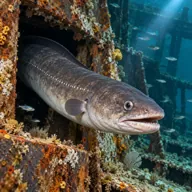
Conger eel · Gringu Can hurt you
Crushing bite if a hand goes into its hole. Look in from a distance and keep fingers out.
A bit of history
On 30 June 1943, in the run up to Operation Husky, the Allied invasion of Sicily, American Spitfires were flying into the newly built strip at Xewkija on Gozo to cover the invasion fleet. A Spitfire Mk Vc of the 308th Fighter Squadron, 31st Fighter Group, Twelfth Air Force, had left Korba in Tunisia routing via Pantelleria for Gozo. It made an approach at Xewkija, missed it, and radio contact was lost. Malta Air Sea Rescue searched and found nothing. The missing aircraft report recorded it as lost into the sea. Records point to the airframe being ES182, flown by 2nd Lieutenant John B Steven Jr of the USAAF, whose body was never recovered. The wreck was found in April 2021 during a side scan sonar survey of Maltese waters, and Heritage Malta and the Underwater Malta virtual museum have since documented it with high resolution imaging.
Divers say
Sign in to rate this site and leave a note for the next diver.
- No reviews yet. First one gets bragging rights.
Further reading: Underwater Malta, Supermarine Spitfire · Heritage Malta, Spitfire · Key.Aero, Spitfire wreck located on Maltese seabed · Dive Shack Malta, Spitfire Mk Vc