🧽 Sponges & bryozoans · Myriapora truncata
False coral
Coral-red twigs that are not coral at all
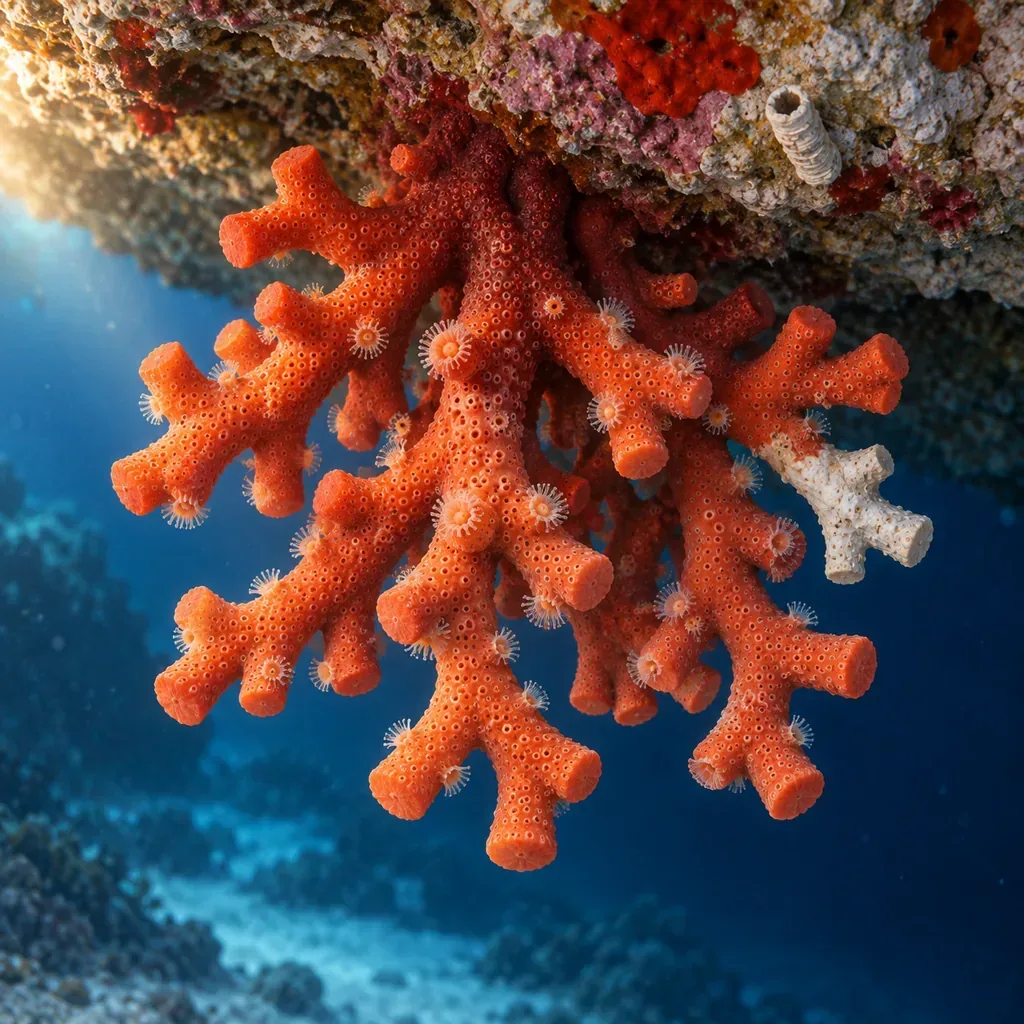
Meet the False coral
False coral is the small orange-red shrub you keep finding on the shaded roof of an overhang and keep assuming is coral. It is a bryozoan: a rigid colony of thousands of microscopic box-shaped animals, each in its own chalky compartment, that between them build a branching skeleton. The branches are stubby and cylindrical, three to six millimetres thick, forking repeatedly, and the giveaway is the tips: they are flat and blunt, as if the whole colony had been trimmed with secateurs, which is where truncata comes from. Colour runs from orange through coral-red to a dull brick, fading to chalky white when the colony dies. A typical Maltese colony is a tuft five to ten centimetres across; a big old one reaches fifteen.
It wants shade and hard rock, so look on the ceilings of overhangs, in the twilight zone just inside cave mouths, on shaded vertical faces and on old wreck plating. It grows from a couple of metres down to over a hundred, but in Malta and Gozo you will see it best between about five and forty metres, at sites like the Blue Hole, Billinghurst, the Inland Sea tunnel and the underside of the Ċirkewwa arch, usually mixed in with scarlet sponge crusts and small gorgonians.
Up close, and only with a torch, the surface is finely pitted: each pit is the doorway of one animal, which pushes out a tiny ring of tentacles to filter the water. Because its branch thickness responds to how much abuse and sediment it endures, researchers have used it as a measuring stick for how heavily a coralligenous reef is being dived.
When to look: All year; it looks the same in every season, and needs a torch at any depth for the colour to show.
Diving with them
- Search ceilings and shaded faces, not the sunlit reef top; it avoids bright light.
- Shine a torch on it and take a proper close look at the surface, where the pits and the extended tentacle rings become visible.
- It is brittle. A fin tip, a dangling gauge or a hand placed for balance will snap branches that took many years to grow.
- Because it snaps so easily, the branch thickness of local colonies is used by scientists as an indicator of diving pressure; a site full of broken stubs is telling you something.
- For macro, back-light it slightly so the branching structure separates from the dark rock behind.
- Never collect it, even a dead white piece; the skeleton is habitat for other small animals.
Can it hurt you?Harmless
Harmless. It cannot sting, bite or irritate; it is a rigid colony of filter feeders and the only thing at risk in an encounter is the colony itself.
Easily confused with
- Red coral (Corallium rubrum) — deeper and mostly in caves, with a much denser blood-red skeleton, pointed rather than truncated branch tips, and white feathery polyps; it is protected and must never be touched.
- Rose lace coral (Pentapora fascialis) — another bryozoan, but built into much larger orange-pink folded plates and lobes rather than fine twigs.
- Orange cup coral (Astroides calycularis) — a true coral forming tight clusters of short orange tubes with obvious polyps inside, not a branching twig.
- Dead white colonies of false coral, often mistaken for broken coral or shell fragments.
Where to meet them: 11 sites
Dawra tas-Sanap
Gozo
Elephant Rock
Comino
HMY Aegusa
Malta
Further reading: Wikipedia: Myriapora truncata · Atlantis Gozo Diving: false coral around Gozo · Ecological Indicators: Myriapora truncata as an indicator of recreational diving impact on coralligenous reefs · Subdiversion species factsheet: Myriapora truncata