Malta
HMY Aegusa
A Victorian steam yacht of real pedigree, once owned by the tea magnate Thomas Lipton, sunk by a mine off Malta in April 1916 and now lying at about 76 metres. Technical, boat only, and rarely visited.
Sea conditions
Good right now
Some chop (0.5 m E)
Forecast for the site, updated 01:47 AM
- Waves
- 0.5 m
- from E
- Wind
- n/a
- Swell
- 0.5 m
- 5 s period
- Sea temp
- 28 °C
Next 7 days
Exposed to wind and swell from: N (0°), NE (45°), E (90°), SE (135°), S (180°). Fully offshore and open to everything except the westerly quarter, where Malta itself gives a little cover. Boats only run it on settled days. Deep visibility is generally excellent and the ambient light is dim enough that torches matter from about forty metres down. Best season: Late May to early October.
The dive
Some wrecks are workhorses. This one was a thoroughbred. Built in 1896 as a screw schooner yacht for a wealthy Sicilian family and later bought by Sir Thomas Lipton, who renamed her Erin and used her as the glamorous support vessel for his America's Cup campaigns, she was all polished brass and deck awnings until the war turned her into an armed patrol yacht.
She went down on the worst night the Malta approaches had in 1916. A German submarine had seeded twenty two mines outside the Grand Harbour, the battleship Russell hit two of them before dawn, and by late evening both the sloop Nasturtium and Aegusa had found mines of their own in the same water. Aegusa is roughly seventy eight metres long and she now sits on the sand with her elegant lines still readable.
At 76 metres she is firmly a trimix dive with a long hang afterwards, and she gets a fraction of the traffic that the shallower Maltese wrecks see. That is part of the appeal: schooner hull, yacht fittings, and the odd sensation of swimming over something built for champagne and race weeks that ended up as a casualty of a minefield.
- A luxury yacht turned warship, sunk on the same night as Russell and Nasturtium
- Nearly eighty metres of schooner hull still holding its shape
- Very low traffic compared with Malta's headline wrecks
- Pairs naturally with Nasturtium on a two dive technical trip
Typical plan
Trimix dive to around 76 metres, twenty to twenty five minutes on the wreck, roughly an hour to ninety minutes of decompression on nitrox and oxygen. Drop the shot amidships, work forward to the bow, back along the opposite rail to the stern, then return to the line for a controlled ascent. Carry a reel and a cutting tool for the netting.
What the bottom looks like
- 1Superstructure remains amidships70 m deep · 20 m out
- 2Schooner bow with anchor gear74 m deep · 45 m out
- 3Stern and propeller76 m deep · 70 m out
- 4Debris field off the hull77 m deep · 95 m out
- 5Open sand beyond the wreck78 m deep · 110 m out
Flat sand and silt with a scatter of broken fittings around the hull.
Who you might meet

Cardinalfish
Almost always · Sultan iċ-ċawl
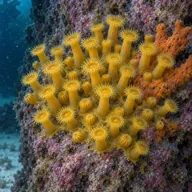
Yellow cluster anemone
Almost always
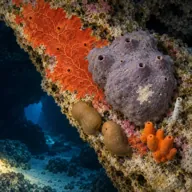
Sponges and bryozoans on the plating
Almost always · Sponża
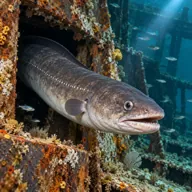
Conger eel
Often · Gringu
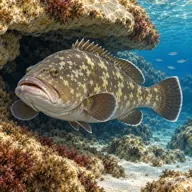
Dusky grouper
Sometimes · Cerna
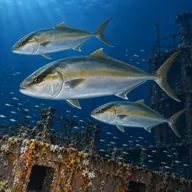
Greater amberjack
Sometimes · Accola · Summer
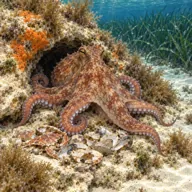
Common octopus
Sometimes · Qarnita
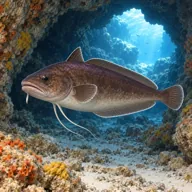
Forkbeard
Sometimes · Lipp tal-qawwi
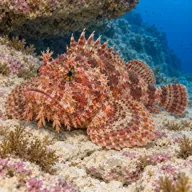
Scorpionfish
Sometimes · Skorfna
Getting in and staying safe
Boat only, out of the Grand Harbour or the eastern marinas. A shot is dropped on the day and the dive is run as a standard deep decompression trip with hung gas, live boat cover and a drift deco plan if the wind has any say in it.
- 76 metres, mixed gas and long decompression
- Snagged fishing net and monofilament on an old iron hull
- Collapsed decks and rotten plating, penetration is a bad idea
- Offshore boat traffic on the Valletta approaches
- Exposed surface with no shelter if a breeze gets up
- Unexploded ordnance is possible on a minefield casualty
A bit of history
Built in 1896 and originally named Aegusa after the old name for Favignana, she was later purchased by Sir Thomas Lipton and renamed Erin, serving as tender to his racing yachts. Loaned to the Red Cross early in the First World War to carry medical staff, she was commissioned into the Royal Navy on 3 July 1915 and reverted to the name Aegusa. On 27 April 1916 the submarine U 73 laid a minefield off Valletta. HMS Russell struck two mines in the early morning, HMS Nasturtium was mined in the evening roughly ten kilometres off the coast, and at about 21:50 Aegusa hit a mine in the same field and sank. Russell now lies at around 115 metres, Nasturtium at about 70, making the three of them a grim little cluster of technical objectives.
Divers say
Sign in to rate this site and leave a note for the next diver.
- No reviews yet. First one gets bragging rights.
Further reading: Malta Dive Sites: HMY Aegusa · Wikipedia: HMS Nasturtium, U 73 minefield of 27 April 1916 · DIVE Magazine: Malta's deep wrecks · Wrecksite: HMY Aegusa · DiveBoat Malta: HMY Aegusa